


A cross-border payment aggregator lets businesses accept global payments without needing separate merchant accounts. In contrast, a payment gateway securely transfers payment data between buyers and banks but requires a direct merchant setup. This article explains the core differences between these two systems, including setup, compliance, payout control, and use cases. It helps you choose the right option based on business size, technical needs, and global reach. Whether you’re launching a global store or scaling an online platform, understanding how these models work is key to faster growth and secure transactions. Global cross-border e-commerce is projected to surpass $7.9 trillion by 2030 (Statista), highlighting the importance of choosing the right payment setup early. You can also explore Order Express, a trusted global payments provider.
Note: Cross-border payment providers must comply with U.S. regulations such as the Bank Secrecy Act (BSA), including registration with FinCEN, adherence to Know Your Customer (KYC) rules, and filing of Suspicious Activity Reports (SARs) when applicable
Understanding Payment Gateways and Aggregators
To make informed payment strategy decisions, you need to know how payment gateways and aggregators work. Both systems help process online payments, but they differ in setup, control, and scalability. This section breaks down what each model does and how they function.
What is a Payment Gateway?
A payment gateway is a digital tool. It sends payment information from the customer to the bank. Also it secures the data using encryption. It checks if the payment can be completed. It then notifies the buyer and seller about the result. Gateways are used in many online shops and mobile apps. Businesses rely on gateways to ensure smooth and secure digital transactions. Without a gateway, digital commerce would be much riskier and less efficient.
Gateways also serve as the front line of fraud prevention. They provide several tools to screen transactions for unusual behavior. Some allow customizable fraud rules and integration with third-party risk engines. For many businesses, gateways are not only transaction processors. They are risk and trust managers as well.
How Payment Gateways Work
Gateways use encryption to protect data during online transfers. They send a request to the bank for payment approval. If approved, the funds are processed. If not, the transaction fails. This process takes seconds and is usually invisible to the buyer. Gateways also manage retries if a transaction fails. They may offer fraud screening tools to detect suspicious behavior. Payment gateways are integrated into checkout pages through plugins or custom APIs. This makes the process seamless for developers and customers.
In many cases, payment gateways are connected to multiple acquiring banks. This helps route transactions based on approval rates or cost. Some gateways also support tokenization. This means sensitive card data is replaced with a secure token. Tokenization lowers PCI scope and enhances customer security.
What is a Payment Aggregator?
A payment aggregator lets businesses accept many types of payments through one platform. They do not need to create a separate merchant account. Aggregators process the payments and send the money to the business. This helps small and medium businesses start accepting payments fast. Aggregators serve as an entry point for new online merchants. They reduce the need for deep banking relationships or technical setup.
Aggregators streamline back-office operations by consolidating settlement, reporting, and compliance into a single dashboard. This unified approach simplifies day-to-day management, especially for businesses with limited operational capacity. In addition, most aggregators offer complementary services for merchants, such as invoicing, loyalty systems, or social commerce tools. These value-added features are typically bundled into an integrated platform designed to support growth and operational efficiency.
How Payment Aggregators Work
Aggregators group many merchants under one account. They handle credit cards, wallets, and other payment types. This makes payments easier for both the seller and buyer. Onboarding is fast. No need for long bank approval processes. Security standards like PCI DSS are followed. This keeps the transactions safe. Aggregators also monitor for fraud, manage compliance checks, and may offer dispute resolution tools. Many also allow recurring billing, which supports subscription models.
Because aggregators assume some financial risk, they often review each merchant’s activity. Sudden changes or large transactions may trigger holds. This allows them to investigate and avoid issues before they escalate. Some aggregators also offer optional compliance add-ons. These include ID verification tools, tax reporting, and payout scheduling.
Cross-Border Aggregators
Some aggregators handle cross-border payments. These are called PA-CBs. They support payments between countries. They also handle currency exchange and anti-money laundering checks. Order Express’s money transfer service functions as a cross-border payment aggregator. It follows all the legal and security rules. Order Express is a registered Money Services Business (MSB) with the Financial Crimes Enforcement Network (FinCEN) and complies with applicable AML regulations, including CTR and SAR reporting, ID verification, and MSB record retention.
It follows all the legal and security rules. This makes it a safe and easy option for businesses that sell globally. PA-CBs also help with VAT reconciliation and FX conversions. They often work with local banks and regulators to ensure compliance in multiple jurisdictions.
Cross-border aggregators must handle multiple compliance regimes. In the U.S., they register with FinCEN as money service businesses. In other regions, they may work under local electronic money or remittance licenses. This makes them suitable for businesses that plan to expand into international markets. PA-CBs also provide tools to comply with sanctions screening and KYC. According to McKinsey’s Global Payments Report, cross-border payment revenues are expected to grow by 6 to 8 percent annually through 2027, further driving demand for efficient aggregator models.
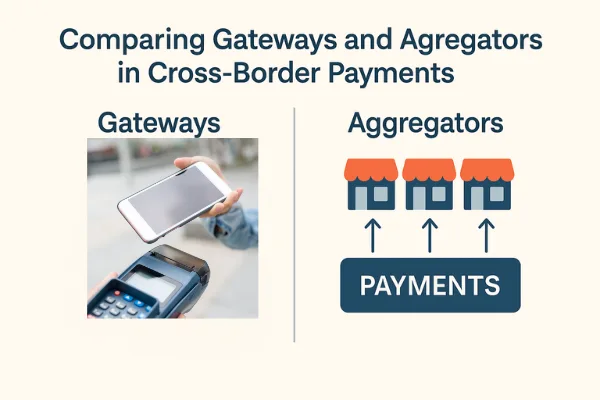
Comparing International Payment Gateway vs Aggregator
This section highlights the practical differences between payment gateways and aggregators. It compares roles, setup, customization, and business fit to help you choose the right solution.
Key Differences
Both gateways and aggregators help businesses receive online payments. But they work in different ways. Here is a simple comparison. Gateways act as a bridge between the customer and the acquiring bank. Aggregators act as the middle layer between the merchant and the payment networks.
The aggregator model is easier to start. The gateway model offers more flexibility. Aggregators focus on simplicity. Gateways offer a broader toolbox. Both have important roles, and the best choice depends on business goals.
Main Role
Gateways send payment details from the buyer to the bank. Aggregators collect and process payments for many merchants. Aggregators often offer dashboards and analytics tools to manage transactions. Gateways focus mainly on the technical path of the payment.
Gateways are like secure messengers. Aggregators are like financial managers who handle processing, settlement, and reporting. This distinction helps businesses decide which model suits their capacity and strategy.
Merchant Accounts
Gateways need each business to have its own merchant account. Aggregators let many businesses use one shared account. This difference impacts onboarding time and compliance needs. Gateways offer more control, but aggregators offer speed and ease.
In regulated industries, having your own merchant account may be required. But for general retail, an aggregator may meet all business needs. Many digital platforms choose aggregators to keep things simple.
Setup Process
Gateways often take longer to set up. Aggregators are faster and easier to start using. Gateways may require bank approvals and documentation. Aggregators typically require only basic business verification.
Time to go live is critical for many companies. Aggregators can onboard in a day. Gateways might take one to four weeks. For time-sensitive launches, aggregators are often the better choice.
Payment Methods
Both support many types of payments. Aggregators often offer more local payment options. Gateways may rely on bank support for certain methods. Aggregators often partner with wallet providers and regional payment networks.
If your audience uses wallets like Pix, Yape, or GCash, an aggregator with local integrations is valuable. Gateways often require you to build those connections manually.
Security
Both follow strong security rules. Aggregators also check for fraud and follow anti-money laundering rules. Gateways may offer tokenization and 3D Secure tools. Aggregators include risk monitoring as part of their core service. Aggregators operating in the United States must implement anti-money laundering (AML) procedures such as ID verification, monitoring for structuring, and reporting suspicious activity through FinCEN’s BSA E-Filing system.
Compliance is shared in the aggregator model. In the gateway model, you must manage your own compliance program. Aggregators supporting Bitcoin ATM kiosks often embed compliance monitoring features, enabling smaller providers to stay aligned with evolving regulations.
Getting Paid
Aggregators may delay payments if something looks suspicious. Gateways send funds based on bank rules. Aggregators usually follow a fixed payout schedule. Gateways give you more control over fund timing, but often require more management.
With a gateway, you deal directly with the acquiring bank. With an aggregator, you receive payouts from their master account. Understanding the timing and rules for both is important to manage cash flow.
Customization
Gateways allow more changes to fit special business needs. Aggregators are more standard but easy to use. Gateways support advanced routing and failover options. Aggregators provide simple tools with limited custom paths.
Custom-built eCommerce platforms often benefit from gateway flexibility. Platforms looking for an out-of-the-box solution will prefer the simplicity of an aggregator.
Best Use Cases
Aggregators are good for small businesses and startups. Gateways work well for larger firms with special needs. Businesses focused on fast go-to-market choose aggregators. Enterprises needing full control choose gateways.
Mixed models are also common. Some firms use aggregators to start and switch to gateways as they scale. Others use both, depending on the country or business unit.
Benefits of Each System
Each payment model offers unique advantages. This section compares the benefits of gateways and aggregators, helping you match features to your business goals.
Benefits of a Payment Gateway
Gateways provide advanced security tools, flexible integrations, and access to multiple acquirers. These advantages are valuable for high-volume businesses and custom platforms.
Improved Control Businesses using gateways have direct control over bank relationships, fund flows, and payment configurations. This is ideal for firms with unique billing or routing needs.
Stronger Brand Presence Gateways let businesses create white-labeled experiences. They can offer custom checkout pages that reflect their brand’s voice and visual style.
Better Analytics and Optimization Gateways often provide real-time transaction data and reporting tools. These insights help improve payment success rates and detect friction points.
Support for New Markets Businesses entering new markets can use multi-currency processing and local acquirers through gateway tools. This speeds up international growth.
Benefits of a Payment Aggregator
Aggregators focus on ease of use, fast setup, and integrated compliance features such as KYC and AML monitoring. These benefits are valuable for startups and growing businesses but must still meet all federal MSB requirements.
One Contract, Many Services With one agreement, merchants gain access to various tools like fraud detection, analytics, and compliance systems. This reduces vendor management.
Faster Market Entry Aggregators like Order Express’s DMV-related services allow businesses to go live in days. This is critical when launching time-sensitive campaigns or seasonal services.
Built-In Support Customer support, refund tools, and chargeback assistance are usually included in aggregator packages. This reduces the need for internal resources.
Less Technical Maintenance Aggregators handle updates, compliance changes, and gateway integrations. This helps merchants focus on core business operations. Features like express shipping options or plane ticket bookings can also be added for customer convenience.

Choosing the Right Cross-Border Payment Solution
Choosing between a payment gateway and a payment aggregator depends on several factors. This section helps you evaluate which model fits your business best, based on size, tech needs, and risk.
Company Size and Transaction Volume
Aggregators fit new businesses with low-to-mid volume. Gateways better serve high-volume companies or those with complex workflows.
A startup may only need basic credit card processing. A marketplace, however, might need sub-merchant onboarding and advanced payout routing.
Integration Needs
Some platforms require plug-and-play tools with minimal developer input. Others need deep, flexible APIs. Choose based on your current and future tech resources.
Risk Profile
Highly regulated industries benefit from gateways that allow control over fraud tools and risk rules. For standard eCommerce, an aggregator offers enough coverage.
Cost Structure
Aggregators often charge flat fees per transaction. Gateways might offer lower processing fees, but add costs for setup, monthly usage, and risk tools.
Evaluate pricing against your average transaction value and projected volume. Small businesses may save with an aggregator. Large ones may benefit from gateway-negotiated rates.
Geographic Reach
Aggregators often support local wallets and currencies in emerging markets. Gateways may require separate bank integrations in each region.
Example: Order Express, a registered cross-border financial services provider, offers global sellers integrated tools for payments, compliance, and operational efficiency. The company complies with FinCEN registration, suspicious activity monitoring, KYC enforcement, and multi-jurisdictional licensing.
This platform is especially well-suited for businesses expanding into Latin America and other underserved markets. With FinCEN registration and multi-jurisdiction compliance, Order Express meets strict financial regulations.
Conclusion
Choosing between a payment gateway and a cross-border payment aggregator depends on your business goals and technical needs. Gateways offer control and flexibility, ideal for high-volume operations or regulated industries. Aggregators focus on simplicity, speed, and built-in compliance, perfect for startups and growing global businesses. For companies expanding across borders, cross-border aggregators provide added tools for FX, KYC, and regional compliance. These platforms make international commerce more accessible, faster, and secure. Businesses that act now can improve payment success rates, build customer trust, and scale faster. Evaluate your transaction volume, compliance needs, and market reach to choose wisely. The right payment solution is not just a backend tool—it’s a strategic partner for global success.
Frequently Asked Questions
Is a payment aggregator the same as a payment gateway?
No. Aggregators manage payments for many merchants under one shared account. Gateways transmit payment data securely from buyer to bank. Aggregators simplify onboarding and compliance. Gateways offer more flexibility and control for established businesses.
Do cross-border aggregators have compliance obligations?
Yes. Cross-border payment aggregators are considered Money Services Businesses (MSBs) and must register with FinCEN, perform customer due diligence, monitor for suspicious transactions, and file CTRs and SARs when required by federal law.
Is a payment processor the same as a gateway?
No. A processor moves money between the buyer’s and seller’s bank accounts. A gateway securely transmits and validates transaction data. Processors handle the financial leg, while gateways focus on communication and encryption.
Are aggregators safe to use?
Yes. Trusted aggregators follow PCI DSS security standards and offer built-in fraud tools and encryption technology. They also monitor suspicious activity and support regulatory compliance such as KYC and AML.
When should I switch from an aggregator to a gateway?
Switch when you need more control, better rates, or custom payment flows. Gateways work well for scaling businesses with complex needs. Aggregators are best for launching quickly, but gateways offer deeper flexibility.
Disclaimer: This article is for general informational purposes only and does not constitute legal, financial, or professional advice.

John is a Content & SEO Specialist who enjoys breaking down complex financial topics, like cross-border payments and money transfers, into content that’s easy to understand. He focuses on creating practical, search-driven content that helps people find answers and make informed decisions.


