


There are four types of payment gateways used in cross-border payments: hosted, self-hosted, API-hosted, and local bank integrations. Each type enables international transactions by securely transmitting data between senders, receivers, and financial institutions. Choosing the right gateway affects transaction speed, data security, user experience, and regulatory compliance. Order Express can help businesses evaluate and implement gateway options in accordance with applicable licensing and regulatory requirements.
This article explains what a cross-border payment gateway is, how each type works, and when to use them. It also covers compliance needs for money transmitters, remittance providers, and global businesses. Use this guide to understand the key differences and select the best-fit gateway for your cross-border payment operations.
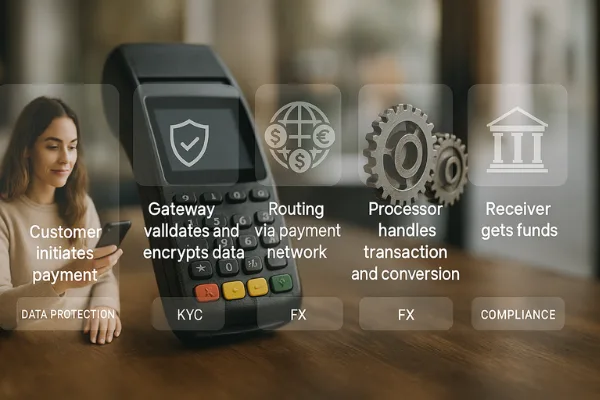
What Are Payment Gateways for Cross-Border Payments?
Payment gateways are systems that securely transmit transaction data between a sender, a receiver, and financial institutions. For cross-border payments, these systems must support multiple currencies, handle compliance checks, and ensure data protection.
Gateways authenticate payment details, encrypt data, and route transactions through appropriate networks. In international payments, this includes coordinating between different banks, currencies, and jurisdictions. Using the right type of gateway is essential for smooth, secure, and fast global money transfers.
Cross-border payment gateways also allow businesses to expand into international markets. They bridge the gap between localized customer preferences and global financial networks. Without them, businesses would struggle to process payments from international clients. Order Express offers licensed money transfer services that meet applicable security and regulatory standards.
The 4 Types of Payment Gateways Used in Cross-Border Payments
Not all payment gateways are built the same. Each type offers different benefits and limitations, especially in cross-border scenarios. Let’s break down the four main types.
1. Hosted Payment Gateways for Cross-Border Transactions
A hosted payment gateway redirects users to a third-party provider’s secure platform to complete their transactions. While the provider handles most technical PCI-DSS card-data safeguards, the money services business (for example, Order Express) still retains full responsibility for all BSA/AML duties, OFAC screening, and other regulatory obligations.
How it Works: When a user makes a payment, they are sent to the gateway’s page. There, they enter their information securely. Once complete, they return to the original platform.
Example Use Case: This model works well for small businesses offering international services with limited technical resources. Firms like PayPal and Skrill offer convenient ways to send money internationally.
Benefits:
- PCI compliance is handled by the gateway provider.
- Quick setup for cross-border transactions.
- Minimal development effort required.
- Useful for freelancers and digital service exporters.
Limitations:
- Customers leave your platform during checkout.
- Limited control over branding and customer experience.
- Transaction fees may be higher.
- Can impact conversion rates due to redirection.
In cross-border payments, hosted gateways can help small or mid-sized firms enter global markets quickly. However, they offer less flexibility and control. For those just starting with international services, hosted platforms can simplify entry alongside tools like check cashing services.
2. Self-Hosted Payment Gateways for International Transfers
A self-hosted gateway allows the business to collect payment information on their own site before transmitting it to the payment processor.
How it Works: Customers enter their payment details on your site. The data is then encrypted and sent to a payment processor.
Example Use Case: A regional cross-border remittance platform that wants control over checkout and data tracking might choose this model.
Benefits:
- Full control over user experience and form design.
- Payment process remains within your platform.
- Better access to customer data for insights.
- Enhances brand consistency in checkout.
Limitations:
- Businesses must ensure PCI compliance.
- Higher technical responsibility for integration and security.
- Not ideal for startups without IT resources.
- Requires investment in secure infrastructure.
For cross-border payments, this model provides better tracking and analytics. However, it requires strict data security protocols and consideration of PCI DSS compliance standards.
3. API-Hosted Gateways in Global Money Transfers
An API-hosted gateway uses an application programming interface (API) to fully integrate payment processing into your site or app.
How it Works: Customers complete payments entirely on your site. The API handles communication with the payment processor behind the scenes.
Example Use Case: A digital remittance app that processes high-volume cross-border payments would benefit from an API-hosted solution.
Benefits:
- Seamless and fully branded payment experience.
- Supports multi-currency and localized payment options.
- Scales well for growing cross-border businesses.
- Allows integration with third-party services like fraud detection tools.
Limitations:
- Requires developer support for implementation and updates.
- Businesses must manage PCI DSS compliance directly.
- More expensive than hosted options.
- Demands constant monitoring and testing.
API-hosted gateways are ideal for modern cross-border payment platforms looking to build a custom, seamless experience. These systems often work well with integrations like vehicle services payments for recurring needs.
4. Local Bank Integration Gateways for Regional Cross-Border Payments
A local bank integration gateway connects directly with a bank in the customer’s country. Customers are redirected to the bank’s site to authorize payment.
How it Works: When paying, users are sent to their local bank’s interface. After confirming the transaction, they return to the merchant’s site.
Example Use Case: An eCommerce site operating in multiple countries uses local bank gateways to boost trust and adoption.
Benefits:
- Familiar interface increases trust in local markets.
- Lower transaction fees compared to some global gateways.
- Simplifies entry into specific countries.
- Can increase transaction success in underbanked regions.
Limitations:
- Limited scalability for broad international use.
- Minimal customization options.
- Slower user experience due to redirection.
- Dependence on individual bank APIs.
In cross-border payments, local bank integrations are valuable in markets with low card penetration but trusted domestic banking networks. They also support services for underserved communities.
Which Payment Gateway Type is Best for Cross-Border Payments?
The ideal gateway depends on business goals, compliance needs, and tech capabilities.
Hosted gateways are best for fast launches into international markets. Self-hosted and API-hosted gateways offer better control and scale. Local bank integrations work well in specific regions but lack global flexibility.
For MSBs or companies like Order Express, a hybrid model combining API integrations with licensed payout partners (e.g., MoneyGram, Spectrum) is ideal. This supports consumer protections and remittance regulations.
Businesses must assess transaction volume, customer preferences, technical ability, and geographic target markets. The wrong gateway could create customer friction or lead to compliance failures under OFAC.

Payment Gateways vs. Remittance Infrastructure in Cross-Border Payments
Traditional payment gateways are built for retail merchants. Remittance providers like Order Express need more robust tools. These tools include compliance checks, KYC/AML controls, and data reporting.
Key Differences:
- Gateways prioritize checkout and card processing.
- Remittance rails support regulated money transfers with identity verification.
- Remittance platforms comply with FATF, BSA, and FinCEN rules such as CTR and SAR filing.
- Gateways focus on shopping cart integration, not on remittance compliance.
Cross-border remittance platforms require deeper transaction monitoring, audit trails, and reporting capabilities. Providers offering courier services with payments must integrate systems that support such visibility.
Compliance Considerations in Cross-Border Payment Gateways
Cross-border transactions must comply with global and local regulations. Any gateway used should support the following:
- FATF Travel Rule compliance
- Customer identification procedures (KYC)
- AML transaction monitoring
- GLBA-aligned data privacy safeguards and any applicable regional privacy requirements
- Transaction reporting to regulators
Consumer Disclosure Note: Licensed money transmitters must provide customers with required pre-payment disclosures, receipts, and error-resolution information in accordance with the Remittance Transfer Rule (12 CFR §1005). Ensure any gateway workflow includes these customer notices or links to them.
Non-compliance risks include fines, license revocation, and reputational harm. Licensed money transmitters like Order Express must integrate gateways that support these functions natively or through partnerships. Consider the impact of identity verification protocols during onboarding and transaction review.
Choosing the Right Payment Gateway for Your Cross-Border Business
Consider these factors:
- Integration Capability: The gateway must support your backend systems and partner APIs.
- Multi-Currency Support: Cross-border payment gateways must handle FX conversions or currency-specific routing.
- Compliance Readiness: Does the provider meet AML, KYC, and data privacy standards?
- Scalability: Can the gateway grow with your transaction volume and geographical reach?
- Uptime and Security: Ensure 99.9% uptime and adherence to security standards like PCI DSS and ISO 27001.
- Localized Experience: Support for local languages, methods, and banks is crucial for recipient engagement.
- Cost and Fee Structure: Understand how fees scale and whether international charges apply.
- Customer Support: Timely support helps resolve gateway errors that can interrupt cross-border payments.
To explore how these elements fit into tailored gateway strategies, businesses should consult with experienced cross-border payment solution providers.
Future of Cross-Border Payments and Gateway Technology
Cross-border payments are becoming more digitized. APIs, blockchain, and AI are reshaping global remittance services.
Future-ready gateways must:
- Integrate with multiple payout partners
- Support real-time transaction monitoring
- Provide dynamic FX rate transparency
- Offer programmable compliance logic
- Support potential future payout methods such as blockchain rails, subject to regulatory approval and licensing
These advancements help financial institutions scale efficiently while staying compliant. Business profiles should reflect how innovation aligns with evolving regulations..
Conclusion
Choosing the right payment gateway for cross-border payments is a strategic decision that impacts cost, speed, and compliance. Each gateway type, like the hosted, self-hosted, API-hosted, and local bank integration, serves different business models and market goals. For growing global companies and licensed MSBs like Order Express, combining API technology with trusted payout partners ensures scalability and regulatory alignment. As cross-border commerce becomes more competitive, businesses must prioritize secure infrastructure, compliance readiness, and localized payment support. A well-selected gateway can improve operational efficiency and customer reach. Evaluate your needs, integrate smartly, and turn your payment system into a long-term global advantage. The right gateway not only moves money, it moves your business forward.
© 2025 Order Express Inc. Publication subject to final Compliance and Marketing approval.
Frequently Asked Questions
What is a payment gateway in cross-border payments?
A payment gateway securely processes transactions between senders and receivers. In cross-border payments, it supports currency conversion. It also ensures data encryption and fraud prevention. Gateways connect with banks across countries. This enables safe and smooth international transactions.
How do hosted gateways work in cross-border scenarios?
Hosted gateways redirect users to a third-party payment page. The provider handles security and PCI compliance. Once payment is complete, users return to your site. These are ideal for small firms needing quick setup. However, branding and control are limited.
What makes API-hosted gateways good for global transfers?
API-hosted gateways allow full payment integration into your website. They support real-time multi-currency processing and branding. These systems offer seamless checkout and compliance options. Developers can add fraud detection and analytics tools. They’re best for high-volume global platforms.
When should businesses use local bank integration gateways?
Use local bank integrations in markets with low card usage. They connect directly with a customer’s bank interface. This boosts trust and payment success. They’re ideal for regional cross-border strategies. However, they’re less scalable for global growth.
How should companies choose the right payment gateway?
Start with your business size, tech capacity, and target regions. Assess currency support and compliance needs. Look for PCI DSS and KYC features. Consider developer resources and API flexibility. Cost, speed, and customer support also matter greatly.

John is a Content & SEO Specialist who enjoys breaking down complex financial topics, like cross-border payments and money transfers, into content that’s easy to understand. He focuses on creating practical, search-driven content that helps people find answers and make informed decisions.


