


A money transfer API is a digital interface that connects financial systems to send, receive, and track payments securely. It enables businesses, banks, and money service providers to integrate payment functions into websites, apps, or platforms without rebuilding their systems. By using APIs, companies can process many domestic and international transfers in near real time, subject to receiving-network hours, compliance reviews, corridor and funding method. They can also automate compliance checks like KYC, AML, and OFAC screening, and improve overall transaction speed. For financial institutions and money services businesses, APIs provide flexibility, faster settlements, and the ability to meet strict regulatory standards while offering convenient services to customers.
The following sections provide a detailed look into what a money transfer API is, how it works, its benefits for businesses, the challenges of integrating it, and why it matters for organizations like Order Express.
Disclaimer: The information provided here is intended for general educational purposes and should not be considered legal advice. Businesses must consult compliance experts or regulators for specific obligations.

What is an API Money Transfer?
A money transfer API is essentially a secure digital interface that connects one application to another for the purpose of processing financial transactions. It provides the framework that allows systems to speak to each other in a way that is consistent, traceable, and reliable.
Think of a fast-food restaurant with an ordering kiosk. The customer interacts with the kiosk screen, but the order is processed through the restaurant’s internal system. Similarly, a money transfer API provides the link between the user-facing application and the financial back-end systems, such as banks, payment processors, and money service businesses.
Money transfer APIs reduce complexity by hiding the details of financial protocols and regulatory requirements, while still ensuring that the transfer is completed securely and in compliance with applicable laws. This makes it possible for businesses to integrate money transfer capabilities into websites, mobile apps, and internal platforms without needing to rebuild their systems from scratch.
When properly implemented, APIs can enable near real-time payments, international money transfers, multi-currency management, and compliance monitoring, with timing dependent on network availability, compliance reviews, corridor and funding method. They allow financial service providers to deliver seamless transactions while still meeting regulatory expectations like the Bank Secrecy Act (BSA), Anti-Money Laundering (AML) obligations, Know Your Customer (KYC) requirements, and the Office of Foreign Assets Control (OFAC) screening. For Order Express, KYC thresholds require customer identification at specific transaction levels such as $3,000 nationwide, $900 in Arizona, and $1,000 in Oklahoma, as well as for check cashing, money orders, and bill payments at similar thresholds.
How Money Transfer APIs Work
The process of a money transfer API can be broken down into several key steps, each of which ensures both the functionality of the transaction and compliance with regulatory obligations:
- Authenticate the request – confirms the request is valid, usually through API keys, tokens, or encrypted credentials.
- Create a quote – generates transfer details including amount, fees, and exchange rates for transparency.
- Fund the transfer – reserves or debits the sender’s funds via bank account, card, or digital wallet.
- Execute the transfer – routes the funds through networks like SWIFT, SEPA, or local clearing systems.
- Track transfer status – provides real-time updates such as pending, completed, or failed, supporting both customer visibility and compliance monitoring.
This workflow illustrates the efficiency of APIs while showing how compliance and transparency are embedded into the process. APIs used by Order Express must also support filing Currency Transaction Reports (CTR) for transactions exceeding $10,000 in cash and Suspicious Activity Reports (SAR) for transactions of $2,000 or more, depending on the type of instrument.
Key Benefits for Businesses
Money transfer APIs bring multiple benefits that help companies improve their financial services and streamline operations:
- Speed – many transactions complete in minutes, depending on network hours, compliance reviews, corridor and funding method. This improves customer service and cash flow.
- Automation – eliminates manual spreadsheets and bank visits with programmable, recurring workflows.
- Global reach – enables international transfers with multi-currency support and real-time conversion rates.
- Security and compliance – built-in encryption, authentication, KYC, and AML monitoring features protect against fraud and regulatory breaches.
- Scalability – supports thousands of simultaneous transactions with role-based access and permissions.
Together, these benefits allow financial service providers like Order Express to remain competitive while maintaining compliance with strict regulations. Businesses also benefit from consumer protection rules under the Remittance Transfer Rule, which enhance transparency and safeguard customers. Under the Remittance Transfer Rule, senders generally have 30 minutes to cancel and 180 days to report errors. Providers must investigate reported errors and provide appropriate refunds or redelivery when required.

Use Cases of API Money Transfer
Money transfer APIs are versatile tools that can be applied to many business scenarios. By supporting automation, scalability, and compliance, they provide solutions that are practical in both domestic and international contexts.
Payouts to Vendors, Employees, and Contractors
Businesses often need to make recurring payments to a wide range of recipients, including employees, freelancers, suppliers, and contractors. APIs enable organizations to automate these payments, ensuring they are delivered accurately and on schedule.
For example, payroll systems can integrate with APIs to issue salaries directly to employees’ accounts, regardless of whether they are domestic or international workers. Vendors and contractors can also receive milestone-based payments automatically, which reduces the administrative burden on finance teams.
This automation eliminates delays and errors that often come with manual processes. Employees and suppliers receive funds promptly, while businesses benefit from improved efficiency and reliability. Digital payout options can also reduce operational friction for businesses that currently rely on manual disbursements.
Note: Order Express does not offer check cashing through its agent network. Any agent offering check cashing does so independently and must meet its own compliance obligations.
Cashback, Refunds, and Claims
Refunds and claims are frequent in retail, e-commerce, and insurance industries. APIs make it easy to automate these processes. Instead of waiting days for manual approvals, customers receive funds directly into their accounts within hours.
Cashback programs and loyalty rewards also benefit from API integration. Instead of mailing checks or issuing credits manually, businesses can automatically deposit rewards into customer wallets or accounts.
By speeding up refunds and claims, businesses build stronger customer trust and encourage repeat business. Automated handling of these financial processes also reduces the chance of human error and ensures compliance with consumer finance protections.
Aggregator Platforms and Multi-Currency Wallets
Platforms that manage payments for multiple users or businesses, such as marketplaces or aggregators, require advanced systems to handle transactions. APIs are essential in these cases because they enable platforms to manage balances, perform currency conversions, and settle payments in real time.
Multi-currency wallets also rely on APIs to track funds across different currencies. Customers can hold balances in multiple currencies, convert them at fair rates, and spend them globally. APIs ensure the conversions are accurate, transparent, and compliant with regulatory requirements.
This functionality is especially useful for businesses operating across borders, where multiple financial systems must be integrated seamlessly. Many platforms also use blockchain learning resources to strengthen their cross-currency strategies.
How Do APIs Improve International Money Transfer Speed?
International money transfers have historically been slow and dependent on multiple intermediaries. Traditional transfers often take several days, particularly when funds move across borders and currencies. Application programming interfaces (APIs) are changing this process by enabling faster, automated, and more transparent international payments.
APIs improve speed in several important ways:
- Direct system connections. APIs create a secure bridge between money service businesses, banks, and payment networks. This reduces reliance on manual processes and legacy systems that cause delays.
- Real-time authorization. With APIs, transaction requests are authenticated instantly using secure keys and tokens, ensuring faster approval and routing.
- Automated routing. APIs identify the most efficient transfer pathway, whether through SWIFT, SEPA, or local networks. This minimizes unnecessary steps and accelerates settlement.
- Faster currency conversion. Many APIs integrate real-time foreign exchange services, which immediately apply conversion rates. Customers know exact costs before sending, reducing back-and-forth delays.
- Continuous monitoring. APIs provide real-time updates on transfer status. Both customers and compliance teams can track payments at every stage without waiting for manual confirmations.
For organizations like Order Express, these improvements translate into better service for customers. Depending on the corridor, network availability, compliance reviews and funding method, transfers that once took days can be completed within hours or sometimes minutes. This approach enhances customer satisfaction, improves business efficiency, and supports compliance with regulatory requirements such as AML reporting obligations and OFAC rules.
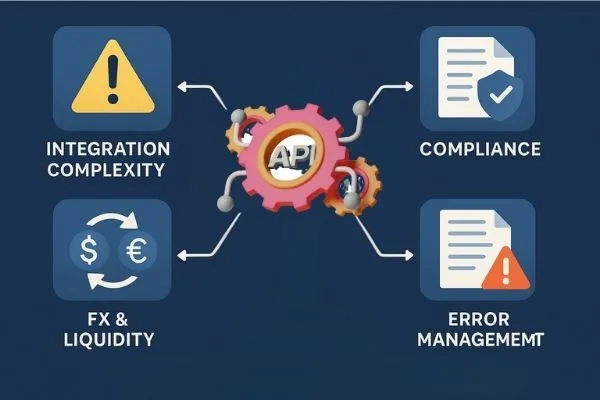
Challenges and Integration Considerations
While APIs offer many advantages, integrating them into financial services comes with technical and regulatory challenges.
Integration Complexity
Setting up an API requires careful planning. Developers must ensure that webhooks are properly configured to provide real-time updates. If a transfer fails, retry logic must be implemented to prevent system downtime.
Security practices are also critical. API keys must be protected, and IP whitelisting should be implemented to restrict access. Failure to apply these security measures can expose businesses to fraud or unauthorized transfers. Companies seeking additional guidance can learn from fintech case studies that showcase best practices.
Compliance and International Regulations
One of the most important considerations for money transfer APIs is regulatory compliance. Financial transactions are heavily regulated, and businesses must comply with rules on customer identification, anti-money laundering, and economic sanctions.
APIs must integrate with systems that perform customer due diligence and monitor suspicious activity. They must also comply with international regulations when handling cross-border payments. This includes the Bank Secrecy Act (BSA), Office of Foreign Assets Control (OFAC) sanctions, and foreign data protection laws like the GDPR.
Using APIs does not remove the responsibility of businesses to comply with these laws. Providers and partners must meet applicable MSB registration and compliance obligations. Agents of a registered MSB may not need separate registration unless they conduct MSB activity independently. For customer identification, follow Order Express KYC requirements that specify acceptable government-issued photo identification. APIs must also detect and prevent structuring, which is the act of breaking up transactions into smaller amounts to evade reporting or recordkeeping thresholds, a practice that is prohibited under the BSA.
FX and Liquidity Management
APIs that support multiple currencies need to handle exchange rates with accuracy. Businesses must ensure that fees, spreads, and conversions are transparent to customers.
Liquidity management is another challenge. Without sufficient balances in each currency, transfers may fail or be delayed. Businesses must monitor currency reserves and plan liquidity to avoid operational issues. For insights into digital assets and exchange-rate impact, some organizations also consult IRS guidance on virtual currencies.
Error Management Best Practices
Errors in financial systems must be handled with care. APIs should log every request and response for auditing purposes. When a transfer fails, the system should notify both the business and the customer, with options for retrying or escalation.
Monitoring dashboards and alert systems are crucial, Maintain required records, including request and response logs, for at least five years. They allow compliance and operations teams to detect patterns of failed transactions or unusual activity quickly. Operations teams at Order Express can apply similar tracking principles to ensure reliability.
Why Choose API-Based Transfers
Money transfer APIs provide businesses with unmatched speed, scalability, and compliance capabilities. They simplify the complexities of international transfers, support automation for recurring payments, and ensure transparency for customers.
For compliance-driven organizations like Order Express, APIs support the integration of AML monitoring, sanctions screening, and record retention into every transaction. This ensures that the company remains aligned with its regulatory responsibilities while offering modern, customer-friendly services.
By choosing APIs, businesses gain greater control over their financial operations while meeting both operational and compliance goals. Those exploring their rights and responsibilities can also review money transfer regulations to better understand protections.
Use of APIs or third-party providers does not transfer Order Express compliance obligations. Order Express remains responsible for required controls and record retention.
How to Access API Money Transfer Services
To access money transfer APIs, businesses must complete an onboarding process that includes:
- Submitting required business documents and licenses.
- Confirming ownership structures and responsible parties.
- Passing identity verification checks and due diligence reviews.
Once approved, businesses receive access credentials and technical documentation. Developers then embed the API into company systems, enabling payments directly from their platforms. Compliance teams oversee the integration to ensure AML, BSA, and OFAC obligations are met at every stage. Use of APIs or third-party providers does not transfer Order Express compliance obligations. Order Express remains responsible for required controls and record retention. Companies looking for tailored support can contact Order Express for more guidance.
Conclusion
Money transfer APIs are reshaping financial services with speed, automation, and security. They simplify international payments, enhance customer trust, and ensure compliance with strict regulations. By integrating APIs, businesses can scale operations, reduce costs, and provide real-time transparency for every transaction.
These tools empower organizations like Order Express to meet customer demands while maintaining compliance with BSA, AML, KYC, and OFAC requirements. Companies that adopt API-driven solutions position themselves for growth, efficiency, and long-term competitiveness in the digital financial landscape. With APIs, the future of money transfers is faster, safer, and more accessible for both businesses and customers.
Ready to simplify your money transfers with API-powered speed and compliance? Contact Order Express today to learn how our solutions can support your business.
Frequently Asked Questions
1. What is a money transfer API?
A money transfer API is a secure digital bridge between financial systems. It enables businesses to send, track, and manage payments. APIs simplify complex protocols and ensure transfers meet regulatory standards. They allow fast and reliable payments across domestic and international networks.
2. How do APIs improve international transfer speed?
APIs connect directly to payment networks, reducing intermediaries that can slow transfers. They use real-time authorization to confirm transactions quickly. APIs also automate routing and currency conversion, which can reduce settlement times. Actual timing depends on corridor, network hours, compliance reviews and funding method. Customers and compliance teams receive immediate updates on transfer progress.
3. Are money transfer APIs secure?
Yes, APIs use encrypted keys, tokens, and multi-level authentication. They include KYC and AML monitoring to detect suspicious activity. APIs also integrate sanctions screening for OFAC and global compliance. These features help protect against fraud, and providers remain responsible for operating required compliance controls.
4. What challenges exist in implementing money transfer APIs?
Integration requires secure webhook management and retry systems for failures. Businesses must protect API keys and restrict access carefully. They must also meet KYC, AML, and data protection obligations. Liquidity planning and error monitoring are critical for reliability.
5. Why should businesses consider using money transfer APIs?
APIs offer faster transactions, automation, and scalability for financial operations. They improve cash flow and customer satisfaction significantly. APIs also ensure businesses remain compliant with BSA, AML, and OFAC rules. Adopting APIs prepares companies for growth in global markets.

John is a Content & SEO Specialist who enjoys breaking down complex financial topics, like cross-border payments and money transfers, into content that’s easy to understand. He focuses on creating practical, search-driven content that helps people find answers and make informed decisions.


