You lock in a currency exchange rate at the right time by combining market timing with the right financial tool when working with a trusted Money Services provider for everyday international transactions. The decision depends on when you transact and which rate-lock mechanism you use.
If you are preparing for an international payment, tuition transfer or property deposit, timing and execution matter equally. Understanding the mechanics behind rate movements and rate-lock tools helps you act confidently during everyday transactions.

How To Time A Currency Exchange Conversion Using Market Signals
Exchange rate timing depends on tracking specific market indicators that directly influence short-term pricing. Instead of guessing direction, you monitor economic releases and liquidity windows before committing funds.
1. Monitor Economic Events That Directly Shift Currency Demand
Major economic releases often trigger rapid currency fluctuations within minutes of publication. Central bank announcements, inflation reports and employment data frequently move exchange rates, as shown in Federal Reserve foreign exchange rate data releases.
When planning to convert funds, follow a structured review process:
- Identify scheduled central bank decisions affecting your currency pair.
- Review recent inflation or employment data trends.
- Confirm whether markets expect rate hikes, cuts or steady policy.
Currencies often strengthen when interest rates rise and may weaken when rates fall, although market outcomes vary depending on broader economic conditions and investor sentiment.
If a rate decision favors your base currency, you may convert before volatility fades. If uncertainty increases, you may wait for stabilization before locking a rate.
2. Track Short-Term Volatility Windows Before Executing
Short-term volatility often increases during overlapping trading sessions between major financial centers. Liquidity tends to improve when London and New York markets operate simultaneously.
Higher liquidity can narrow spreads and improve execution pricing during active hours. Converting during thin trading periods can produce wider spreads and less favorable rates, especially when foreign currency value shifts rapidly in global markets.
To assess timing:
- Compare rate movement during the previous three trading sessions.
- Watch for sudden spikes following economic announcements.
- Confirm current spread levels before initiating the transaction.
Narrow spreads and stable movement generally indicate more efficient execution conditions.
3. Set A Target Rate Before Emotions Influence Your Decision
Setting a target exchange rate reduces emotional decision-making during volatile periods. You define the acceptable rate based on your transaction budget and your broader financial planning goals.
Before transferring funds through a structured money transfer service, determine:
- The maximum rate you are willing to accept.
- The minimum rate that protects your budget.
- The deadline for completing your transaction.
This structured approach prevents hesitation when rates briefly move in your favor. When the target rate appears, you execute immediately rather than speculate further.
For a broader overview of how exchange rates work in practical settings, review our guide to currency exchange fundamentals for everyday transactions.
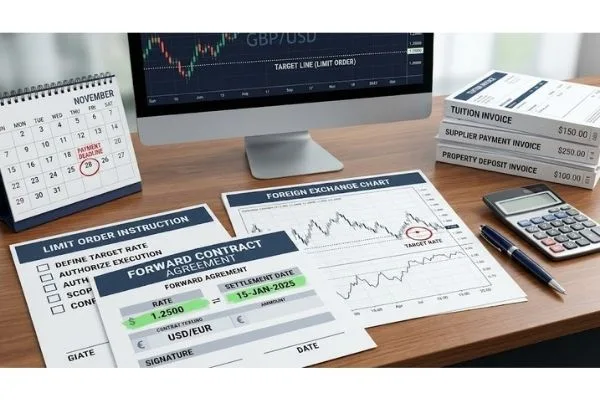
Use Financial Tools That Lock The Rate Once Conditions Are Favorable
Timing alone does not guarantee protection unless you secure the rate contractually. Specific exchange products allow you to fix a rate before settlement.
Choosing the correct mechanism depends on how soon you need to complete the payment and your overall transaction structure.
1. Secure A Forward Contract For Future Payments
A forward contract allows you to lock today’s exchange rate for settlement on a future date. This tool protects you from adverse rate movements before payment.
Forward contracts work effectively when you know:
- The exact foreign currency amount required.
- The settlement date of your payment.
- Your acceptable exchange rate level.
Once booked, the rate remains fixed regardless of market fluctuations. This eliminates uncertainty for tuition, supplier payments or property purchases scheduled weeks ahead.
A forward contract removes timing risk but commits you to the agreed rate. Consumer education resources such as the FDIC Money Smart program emphasize the importance of understanding financial commitments before proceeding.
Forward contracts may involve contractual obligations and may not be available for all customers or jurisdictions. Terms, eligibility criteria and settlement requirements vary by provider.
2. Place A Rate Alert Or Limit Order For Automatic Execution
A limit order instructs the provider to execute your exchange automatically when a target rate becomes available. This tool helps you capture favorable movements even outside business hours.
The process typically follows three steps:
- Define your desired exchange rate.
- Authorize automatic execution when reached.
- Receive confirmation once the order triggers.
This mechanism works well when markets approach a resistance or support level. It prevents missed opportunities caused by constant manual monitoring.
When coordinating payments alongside related services such as check cashing options, aligning liquidity timing can further support structured cash flow management.
A limit order locks the rate only if the market reaches your predefined level.
3. Lock The Rate Immediately When Budget Certainty Matters Most
Sometimes the right time means immediate execution rather than waiting for marginal improvement. If your payment deadline is near, delaying can increase risk.
In some cases, customers choose to lock the rate immediately when:
- The transaction date is within a few business days.
- The current rate aligns with their predefined budget threshold.
- Market volatility shows heightened or unpredictable swings.
In these scenarios, protecting your budget outweighs waiting for small gains. Locking promptly prevents exposure to sudden negative moves.
Consumers sending funds abroad can review general transparency principles outlined in Consumer Financial Protection Bureau guidance on international money transfers, which explain disclosure standards and timing considerations.
Remittance providers must disclose exchange rates, fees and delivery estimates before completing a transaction, as required under U.S. remittance transfer rules.
If you need clarification about timing or documentation before booking a rate, you can also reach out through the Order Express contact page for transaction-specific assistance.
Immediate locking prioritizes certainty over speculative timing.
Key Takeaways
- Locking a currency exchange rate requires both strategic timing and the correct rate-fixing mechanism.
- Monitoring economic events and liquidity windows helps identify favorable execution periods.
- Setting a predefined target rate prevents emotional decisions during short-term volatility.
- Forward contracts and limit orders allow you to secure rates once your conditions are met.
- Immediate locking becomes essential when payment deadlines reduce flexibility.
Frequently Asked Questions
Q: When Is The Best Day To Lock An Exchange Rate?
A: There is no universal best day. Monitor economic releases, liquidity hours and your target rate, then execute when conditions align with your predefined budget.
Q: Can I Lock A Rate Before I Send Money?
A: Yes. You can use a forward contract or limit order to secure a rate before your actual transfer date.
Q: What Happens If The Market Improves After I Lock A Rate?
A: If you use a forward contract, you remain committed to the agreed rate even if markets later move favorably.
Q: How Long Can I Lock A Currency Exchange Rate?
A: Forward contracts typically allow locking for several weeks or months, depending on provider terms and settlement requirements.
Q: Should I Wait For A Better Rate If The Market Is Rising?
A: Waiting may increase exposure to market volatility. If the current rate aligns with your budget target and deadline, some customers choose to lock in order to prioritize transaction certainty.
Conclusion
Locking in a currency exchange rate at the right time requires discipline, preparation and the correct financial tool. You improve outcomes by monitoring economic triggers, identifying high-liquidity trading windows and defining a clear target rate before acting. Once favorable conditions appear, you secure protection through a forward contract, limit order or immediate booking depending on your deadline. This structured approach reduces emotional decisions and shields your budget from sudden market swings. For everyday transactions such as tuition payments, supplier transfers or property deposits, certainty often matters more than speculation. When predefined conditions align with your budget and timing needs, securing the rate can help reduce exposure to sudden market shifts.
Compare current exchange rates and complete your international transfer with Order Express today.
Disclaimer: This content is provided for general informational purposes only and does not constitute financial, investment or legal advice. Exchange rates fluctuate constantly and market conditions can change rapidly, so outcomes may vary depending on timing, product selection and individual circumstances. Forward contracts and other rate-lock products may involve contractual obligations and may not be available in all jurisdictions. Confirm terms, eligibility, product availability and settlement requirements directly with your chosen provider before entering into any transaction.

John is a Content & SEO Specialist who enjoys breaking down complex financial topics, like cross-border payments and money transfers, into content that’s easy to understand. He focuses on creating practical, search-driven content that helps people find answers and make informed decisions.