


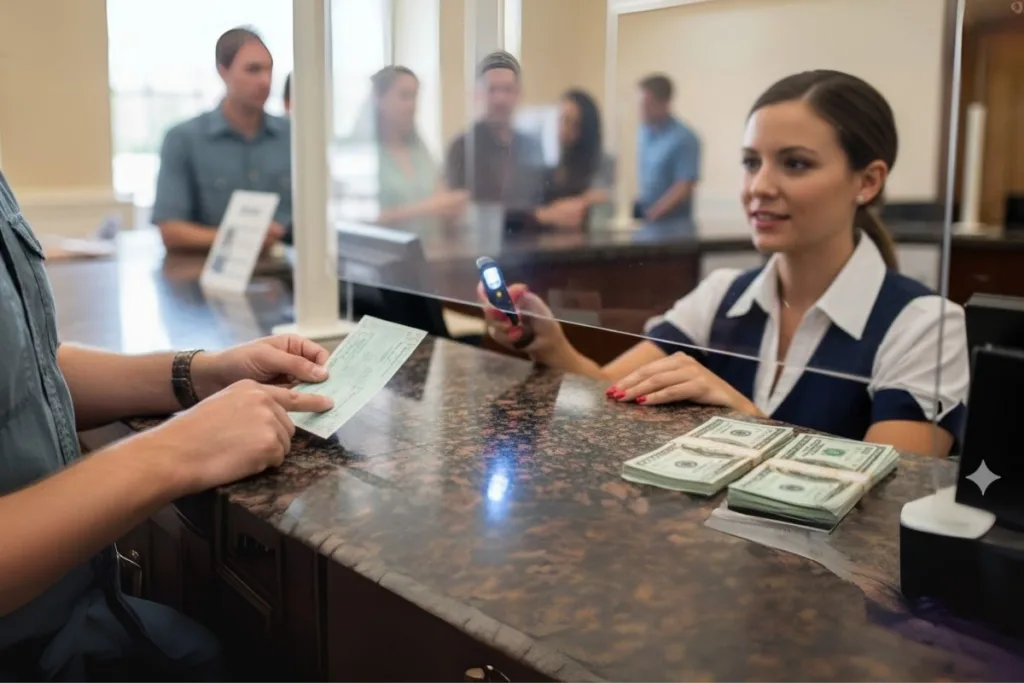
Redeeming a money order is a simple process when you know the correct steps. To do it safely, review the document for accuracy, confirm it is legitimate, and present valid identification at an authorized location. Following these requirements helps prevent fraud, ensures compliance with reporting rules, and guarantees you receive your funds quickly.
This guide explains where and how to redeem a money order, common mistakes to avoid, and best practices for keeping every transaction secure.
Disclaimer: This article is for informational purposes only. It summarizes general redemption practices and compliance obligations but does not replace the official Order Express BSA/AML Corporate Compliance Manual or applicable federal and state laws. Customers should always follow the latest regulations and provider requirements.

Preparing to Redeem a Money Order
Before redeeming a money order, it is important to prepare correctly. Taking a few careful steps helps ensure accuracy, prevents fraud, and keeps the process compliant with financial regulations. Below are key actions to complete before moving forward.
1. Review the Document for Accuracy
The first step when receiving a money order is to carefully review it. Confirm that the payee name matches the name on your identification. Double-check the value printed to ensure the amount is correct. Since money orders are prepaid, the amount cannot be changed once issued. Verifying accuracy before redemption helps avoid errors or disputes later.
2. Verify Legitimacy Before Redeeming
Always confirm that a money order is genuine. Fraudulent instruments circulate in many forms, especially when payments come from unknown sources. Each money order includes a serial number, which can be used to verify authenticity. Customers who accept funds from unfamiliar individuals should take extra caution. If fraud is suspected, financial service providers may need to report it as part of suspicious activity monitoring.
3. Gather Proper Identification
Redeeming a money order requires presenting a valid government-issued ID. Acceptable IDs include a driver’s license, passport, or other approved documents. Financial service providers must comply with Know Your Customer (KYC) rules. Federal regulations require businesses to obtain identification and keep records for cash purchases of money orders or cashier’s checks totaling $3,000 to $10,000 in a single business day. This rule is based on same-day aggregation of multiple cash purchases.
Order Express applies stricter internal policies: identification is required for money order transactions of $3,000 or more within 48 hours in most states, $900 within 24 hours in Arizona, and $1,000 within 24 hours in Oklahoma.

Where to Redeem a Money Order
Financial Institutions
Banks and credit unions are traditional places to redeem money orders. If you have an account, fees may be reduced or waived. However, not all institutions provide this service, so checking beforehand is recommended. Redemption at banks also ensures compliance with federal reporting requirements.
Licensed Financial Service Providers
Many customers use licensed providers, like Order Express, for quick and secure redemption. Such providers specialize in money transfers, bill payments, and check cashing alternatives.
Under federal rules, a Currency Transaction Report (CTR) must be filed when cash in or cash out exceeds $10,000 in a single business day. This requirement applies to currency (cash or coin) transactions only.
Order Express follows these federal rules and also applies its own monitoring procedures under its corporate compliance program.
They also monitor for suspicious activity and may file a Suspicious Activity Report (SAR) for transactions at or above $2,000.
Retail and Community Locations
Some retail outlets also process redemptions through partnerships with licensed money service businesses. Customers should confirm that these locations are authorized and follow compliance procedures. Unauthorized redemption could expose customers to unnecessary risks or delays. To explore more services, you can review additional solutions offered by licensed providers.

Steps to Redeem a Money Order
The process itself is straightforward when done in order. Acting quickly, presenting valid identification, and confirming records ensures the transaction is both safe and compliant.
1. Redeem Promptly and Safely
Always redeem a money order as soon as possible. Holding it for long periods increases risks of loss, damage, or fraud. Delays may also complicate reporting requirements if multiple transactions aggregate over compliance thresholds. Quick redemption protects the payee and helps financial institutions keep accurate records. Guidance on consumer protection resources is also available for customers who want to safeguard transactions.
2. Provide Proper Identification at the Counter
When ready to redeem, present a valid photo ID directly to the teller or service representative. Do not endorse the money order in advance. Instead, sign it in the presence of the representative to ensure the endorsement matches your identification. This protects against unauthorized redemptions and fraudulent claims. For questions, customers may contact Order Express directly.
3. Understand Fees and Receipts
Some providers charge fees for redeeming money orders. These vary by location and service. Always ask about fees in advance to avoid surprises. Once the transaction is complete, count the cash, store it securely, and keep the receipt. The receipt serves as proof of the completed transaction, which may be important for personal records or in case of disputes. You can also review your rights in money transfer and remittance for added clarity.
Tips for Secure and Compliant Redemption
Security and compliance go hand in hand with financial services. Staying alert to scams, following reporting rules, and knowing what to do if problems occur keeps your funds protected.
Avoiding Fraud and Scams
Fraudulent money orders are a common scheme. To avoid scams, only accept instruments from trusted sources. Never agree to cash a money order for someone you do not know. Scammers often request that victims deposit fake instruments and send back part of the funds. When discovered, victims are held responsible. Financial service providers use compliance systems to detect these activities, but awareness is the best prevention. Review the FDIC’s consumer guidance for additional tips.
Compliance With Reporting Requirements
Customers should understand that transactions over certain amounts trigger reporting obligations.
Federal rules require financial service providers to file a CTR when cash in or cash out exceeds $10,000 in a single business day.
Federal rules also require Suspicious Activity Reports (SARs) for transactions that appear suspicious, typically involving $2,000 or more, or $5,000 for issuers when detected through clearance records.
Order Express applies these federal requirements and enforces its own risk-based monitoring program to detect and prevent suspicious activity. Customers should provide all required information honestly. Attempting to divide transactions into smaller amounts to avoid reporting is considered structuring and is a federal crime. Details on these rules can be found in the FinCEN BSA guidance.
Lost or Stolen Money Orders
If a money order is lost or stolen, contact the issuer immediately. Most issuers allow replacement for a fee, although processing may take weeks. For Postal Service-issued instruments, replacements are available but cannot be canceled outright. Always keep the original receipt, which is critical for tracking and replacement. Helpful guidance on how to send money securely may prevent issues before they occur.
Best Practices for Customers
Managing transactions wisely means looking beyond a single payment. Customers can benefit by combining services, exploring check cashing options, and protecting personal information at all times.
Combine Services Wisely
Licensed financial service providers like Order Express often offer multiple services in one location, including bill payments, remittances, and vehicle services. Customers benefit from convenience while knowing that all services follow strict compliance rules.
Recognize Check Cashing Alternatives
Customers should understand that both federal reporting rules and Order Express internal thresholds apply to money order redemptions and check cashing transactions. Federal rules focus on recordkeeping for $3,000 to $10,000 cash purchases in one business day and CTR filings for cash transactions exceeding $10,000. Order Express applies stricter internal ID requirements, including $3,000 within 48 hours in most states, $900 in Arizona, and $1,000 in Oklahoma.
Remittance transfer regulations are separate and apply to disclosures, cancellation rights, and error resolution, not to BSA recordkeeping thresholds.
Protect Personal Information
Never share personal details, account information, or identification with unauthorized individuals. Compliance rules under the Gramm-Leach-Bliley Act and privacy policies protect consumers, but responsibility starts with the customer. Safeguarding personal data reduces the risk of fraud, identity theft, and financial abuse. Checking official OFAC sanctions lists is one way providers ensure safe and compliant transactions.
Conclusion
Redeeming a money order is straightforward when customers follow the right steps. By reviewing the document, presenting valid identification, and understanding compliance thresholds, customers can complete transactions safely and responsibly. Licensed financial service providers like Order Express ensure every redemption complies with BSA/Anti-Money Laundering Act rules. They also provide convenient solutions for related services, such as check cashing, money transfers, and other financial services.
Customers should remain vigilant against fraud, avoid structuring, and always redeem promptly. Compliance protects both the individual and the financial system. Choosing an authorized provider guarantees not only convenience but also peace of mind. Learn more about Order Express and how it supports secure transactions.
Ready to redeem your money order or use trusted financial services? Visit your nearest Order Express location today!
Disclaimer: This article is for informational purposes only. It summarizes general redemption practices and compliance obligations but does not replace the official Order Express BSA/AML Corporate Compliance Manual or applicable federal and state laws. Customers should always follow the latest regulations and provider requirements.
Frequently Asked Questions
Q1: What do I need to redeem a money order?
You need a valid government-issued photo ID. Some providers may require additional information if thresholds are met.
Q2: Where can I redeem a money order?
You can redeem at:
- Banks or credit unions
- Licensed financial service providers
- Authorized retail or community locations
Q3: How much cash can I redeem before reporting is required?
Federal regulations require a CTR when cash in or cash out exceeds $10,000 in a single business day. This rule applies to cash transactions only.
Order Express also enforces stricter identification requirements at lower thresholds under its compliance manual, such as $3,000 within 48 hours in most states, $900 in Arizona, and $1,000 in Oklahoma.
Q4: What if my money order is lost or stolen?
Contact the issuer immediately. Most issuers offer replacements for a fee, though processing may take several weeks.
Q5: How do I avoid money order scams?
- Accept funds only from trusted sources
- Verify the serial number
- Never cash for strangers
- Report suspicious activity promptly

John is a Content & SEO Specialist who enjoys breaking down complex financial topics, like cross-border payments and money transfers, into content that’s easy to understand. He focuses on creating practical, search-driven content that helps people find answers and make informed decisions.


