


Navigating compliance rules for check cashing involves understanding both federal regulations and internal company policies. Financial service providers must follow laws like the Bank Secrecy Act (BSA), USA PATRIOT Act, OFAC sanctions, and Anti-Money Laundering (AML) standards while maintaining strong Know Your Customer (KYC) procedures.
This guide explains how businesses can stay compliant through clear policies, accurate reporting, and proactive employee training. You’ll learn how to prevent fraud, meet reporting requirements, and adapt to state and local regulations. Whether you manage a money service business or oversee compliance operations, this article outlines the essential steps to protect your customers, avoid penalties, and strengthen long-term trust in financial transactions.
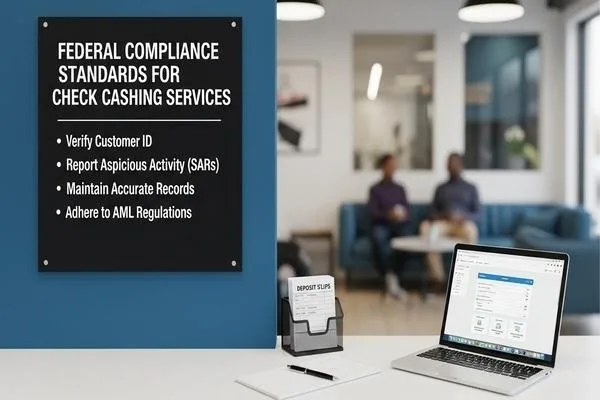
Federal Compliance Standards For Check Cashing Services
The federal government enforces several laws to prevent financial crimes such as money laundering, terrorist financing, and fraud. Financial service providers offering check cashing must follow these regulations to remain compliant and trustworthy.
Federal requirements establish the foundation, but successful operations also depend on understanding broader check cashing compliance standards that connect customer verification, recordkeeping, fraud prevention, and regulatory responsibilities into one consistent framework.
Note: The federal standards summarized here (BSA, USA PATRIOT Act, OFAC, AML/KYC) apply to all financial institutions. Order Express maintains additional internal requirements, including enhanced KYC thresholds, employee training standards, and alert-based monitoring systems, which are distinct from federal obligations and apply exclusively within Order Express operations.
USA Patriot Act And Identity Verification
The USA PATRIOT Act requires financial institutions and money service businesses to verify customer identities before processing transactions. This process, known as Customer Identification, ensures businesses know who they are serving and why funds are being exchanged.
Providers should maintain strong systems that:
- Verify government-issued identification for every customer.
- Retain copies of identification documents for recordkeeping.
- Flag inconsistent or suspicious customer information for review.
Identity verification protects both customers and businesses by reducing the risk of fraudulent transactions and unauthorized activities.
Bank Secrecy Act (BSA) And Transaction Reporting
The Bank Secrecy Act requires financial institutions to keep detailed records and report large or suspicious cash transactions to the Financial Crimes Enforcement Network (FinCEN).
For check cashing providers, this includes:
- Filing a Currency Transaction Report (CTR) for transactions over $10,000 in a single business day.
- Submitting a Suspicious Activity Report (SAR) for any transaction of $2,000 or more that may involve illegal or suspicious behavior.
- Maintaining records of cash transactions for a minimum of five years.
Under Order Express policy, all check cashing transactions exceeding $3,000 (or aggregated within a week) require full KYC verification, identification recording, and reporting in line with internal AML protocols.
Automated systems can simplify reporting, but human oversight remains critical to ensure accuracy and timely submissions.
Note: Order Express mandates that all CTRs and SARs be filed exclusively through the FinCEN BSA E-Filing System to maintain consistency and federal compliance.
Office Of Foreign Assets Control (OFAC) Compliance
The OFAC, under the U.S. Department of the Treasury, enforces sanctions against individuals, organizations, and countries engaged in illegal or terrorist activities.
Before cashing any check, businesses must:
- Screen customers against the Specially Designated Nationals (SDN) list.
- Maintain detailed records of all OFAC screenings.
- Train employees to identify restricted parties or suspicious matches.
Consistent OFAC compliance prevents companies from unintentionally conducting business with sanctioned entities.
Note: At Order Express, an OFAC alert is triggered at an 80% name match threshold, including variations and misspellings. Such alerts must be reviewed and cleared by Compliance before transaction release.
Anti-Money Laundering (AML) And Know Your Customer (KYC)
The AML framework requires financial institutions to implement systems that detect and prevent illicit financial activity. A strong Know Your Customer (KYC) policy supports AML goals by ensuring each customer’s identity and transaction purpose are clear.
Essential AML/KYC measures for check cashing include:
- Conducting due diligence for all customers.
- Monitoring transactions for irregular patterns.
- Keeping clear, retrievable records for regulatory review.
Implementing automated alerts and manual review processes together provides a balanced approach to AML compliance.
Note: Order Express requires customer identification for any transaction of $3,000 or more (or aggregated within 48 hours), using valid, government-issued identification such as U.S. driver’s license, passport, or consular ID.

Internal Compliance Programs For Money Service Businesses
Beyond federal laws, financial service companies must establish their own compliance programs that align with these requirements while ensuring consistent execution across all locations.
These internal programs protect the organization from penalties, support audit readiness, and uphold operational standards.
The Four Pillars Of An Effective Compliance Program
Every money service business should develop an internal compliance program that reflects four core principles:
- Policies and procedures: Written standards that define compliance expectations.
- Compliance officer: A designated employee responsible for oversight and reporting.
- Training program: Ongoing education for employees and agents about compliance duties.
- Independent review: Annual reviews that test the program’s effectiveness.
Each component plays a vital role in maintaining compliance consistency and ensuring staff understand the importance of adherence.
Recordkeeping And Retention Standards
Strong record management ensures transparency and accountability. Businesses must maintain all documents related to customer identification, CTRs, and SARs for at least five years.
Best practices include:
- Securing physical and electronic files with restricted access.
- Backing up data to prevent loss.
- Using consistent file naming and retention policies across all branches.
Proper recordkeeping demonstrates a company’s commitment to due diligence and prepares it for internal or external audits.
Ongoing Employee Training
Compliance training is a continuous process. Every employee handling financial transactions should complete training that covers AML laws, suspicious activity indicators, and reporting procedures.
Annual refreshers help employees stay informed about updated rules and system changes. Businesses can use e-learning platforms or instructor-led sessions to ensure participation and testing for comprehension.
Note: Per Order Express policy, employees and agents must complete annual AML/KYC training via the OEI Learning Management System with a minimum score of 80%. Failure to meet this threshold after three attempts leads to system access suspension until compliance is achieved.
Internal Review And Audit
Regular independent reviews are essential to test whether internal controls and procedures work effectively. These reviews should cover:
- Transaction monitoring accuracy.
- Timeliness of required filings.
- Documentation quality.
- Employee awareness and adherence.
Corrective actions from audits should be implemented promptly to address gaps before regulatory inspections.

Adapting To Regulatory And Operational Requirements
Check cashing operations face diverse challenges across jurisdictions, requiring flexibility and consistency in compliance. Adapting to both federal mandates and company-specific policies ensures stability and ongoing trust from regulators and customers alike.
State And Local Regulations
Each state can set its own thresholds and requirements for check cashing. For example, identification or reporting limits may vary based on the type or amount of the transaction.
To stay compliant:
- Verify applicable state and municipal rules before offering services.
- Adjust transaction limits and fee structures to align with local laws.
- Train staff on state-specific documentation or filing procedures.
Staying proactive with state rules prevents fines and protects a business’s ability to operate.
Fraud Prevention And Monitoring
Fraud detection must combine automated tools and human judgment. Systems should generate alerts for unusual behavior, such as multiple check cashing transactions under reporting limits or frequent customer ID changes.
Employees should:
- Recognize common fraud tactics like structuring or impersonation.
- Report suspicious activity immediately to the compliance department.
- Never disclose internal reporting decisions to customers.
Prompt action and consistent reporting strengthen internal fraud defenses and protect both customers and the organization.
Note: Order Express employees are prohibited from advising or assisting customers in structuring transactions to avoid recordkeeping or reporting thresholds. Any such attempts must be reported to Compliance immediately.
Order Express policies include proactive fraud prevention and mandatory reporting of suspected elder financial abuse. Employees must report to Compliance or call 1-888-666-1602 immediately if such activity is suspected.
Customer Communication And Data Protection
Customers expect transparency and security in financial services. Businesses must protect customer data in compliance with privacy laws such as the Gramm-Leach-Bliley Act (GLBA).
Key data protection measures include:
- Limiting access to customer information to authorized personnel.
- Using secure systems for storage and transmission.
- Regularly updating cybersecurity safeguards.
Maintaining customer trust requires ongoing vigilance in how personal and financial data is handled.
Note: Order Express enforces GLBA-aligned confidentiality safeguards. All suspicious activity reports (SARs) and customer data are restricted to a need-to-know basis, protected under federal Safe Harbor provisions.
Conclusion
Compliance in check cashing isn’t just a legal box to tick, it’s a competitive advantage. By integrating clear processes, strong internal policies, and employee accountability, businesses can minimize risks and maintain regulator confidence. Staying proactive with training, transaction monitoring, and secure recordkeeping strengthens both compliance and customer relationships.
Now is the time to review your operations, close any gaps, and reinforce your compliance foundation. When every team member understands the rules and follows them consistently, your business not only meets federal and state requirements but also builds lasting trust. Take action today, prioritize compliance to protect your company, support your customers, and sustain long-term success in financial services.
Ready to simplify your check cashing process? Contact Order Express today to learn how our secure, compliant solutions help you manage transactions efficiently and confidently.
Disclaimer: This article is for informational purposes only and does not constitute legal or regulatory advice. Federal compliance requirements and internal company policies may vary. Businesses should consult their compliance department or legal counsel to ensure adherence to all applicable laws and internal procedures.
FAQs
What compliance laws apply to check cashing businesses?
Check cashing services must follow federal laws such as the Bank Secrecy Act, USA PATRIOT Act, OFAC regulations, and AML/KYC requirements, plus applicable state and local rules.
How do I stay compliant with the Bank Secrecy Act (BSA)?
- File CTRs for cash transactions over $10,000
- Submit SARs for suspicious activity
- Retain records for at least five years
What is required under the USA PATRIOT Act for check cashing?
Financial service providers must verify customer identities, collect identification documents, and maintain records to prevent money laundering or terrorist financing.
How can a check cashing business prevent fraud?
Use automated monitoring systems, train staff to recognize suspicious behavior, report irregularities quickly, and never inform customers of internal investigations.
What are the key elements of an internal compliance program?
- Written policies and procedures
- A designated compliance officer
- Employee training
Regular independent reviews and audits

John is a Content & SEO Specialist who enjoys breaking down complex financial topics, like cross-border payments and money transfers, into content that’s easy to understand. He focuses on creating practical, search-driven content that helps people find answers and make informed decisions.


