


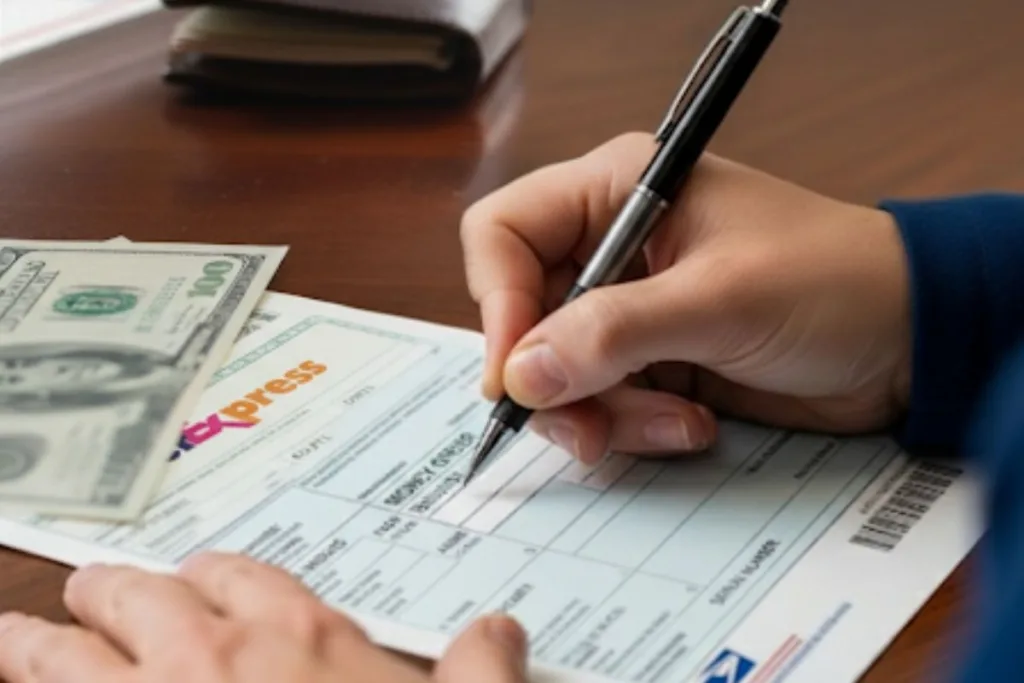
Filling out a money order is simple when you follow the right steps. To complete one, write the recipient’s full name, add your details, include a memo if needed, sign the front, and keep your receipt. Money orders provide guaranteed funds, making them safer than personal checks or mailing cash.
At Order Express, money orders remain a trusted option for paying rent, covering bills, or sending personal payments securely. They are especially useful for people without bank accounts who still need reliable payment solutions. Most money orders cost under $5 and typically have a $1,000 limit, though identification may be required for larger amounts. Combining money orders with services like check cashing gives customers flexible and secure ways to manage everyday transactions.
This guide explains the process step by step, while also covering costs, limits, and compliance safeguards. If you want a deeper explanation of the full process, including issuance and processing timelines, read our guide on How Does A Money Order Work.

Understanding the Basics of a Money Order
Money orders are secure financial instruments issued by authorized service providers. They allow customers to send or pay exact amounts while avoiding the risks of carrying large sums of cash. Because they are prepaid, recipients know the funds are guaranteed. Many financial service providers, including money services businesses, issue money orders to help customers make safe and reliable payments.
Money orders can be purchased with cash, debit cards, or in some cases credit cards. When funded by credit, the purchase may count as a cash advance. According to NerdWallet’s guide on sending money, cash advances usually involve fees and higher interest rates, making debit or cash a more cost-effective choice.
They are also useful for people who do not have a bank account. With proper identification documents, anyone can buy a money order to pay rent, settle bills, or send funds to a recipient. For larger payments, multiple money orders may be required.
Where Can You Buy a Money Order?
Authorized locations for buying money orders include financial institutions, licensed agent locations, post offices, convenience stores, and certain retail outlets. When purchasing through licensed agents of a money services business, customers must follow identification and reporting rules set by federal and state law. These rules protect both the customer and the financial system, as outlined by FinCEN.
Always keep your receipt. Each money order includes a tracking number that allows you to confirm delivery or request assistance if the order is lost or delayed. Customers may also reach out through Order Express contact support for transaction help.
Limits and Fees for Money Orders
The purchase amount for a single money order is usually capped at $1,000. However, financial services providers also set monitoring thresholds.
- Order Express Policy: Customers must show identification when buying $3,000 or more in money orders within a 48 hour period. In Arizona and Oklahoma, identification is required for $1,000 or more within 24 hours.
- Federal Rule: Businesses are required to obtain ID and keep records when customers purchase money orders or cashier’s checks with cash totaling $3,000 to $10,000 in a single business day. This applies even if the customer makes multiple same day purchases.
These thresholds exist to comply with the Bank Secrecy Act and Anti-Money Laundering Act. They help protect customers from fraud and prevent misuse of financial services. If you expect to purchase more than $1 000 in Arizona or Oklahoma, or a combined total of $3 000 within 48 hours anywhere else, bring a current government-issued photo ID such as a driver’s license or passport. Providers must also meet currency transaction reporting requirements.
Fees for money orders vary depending on the provider. Most are under $5 per order, making them affordable compared to cashier’s checks or wire transfers. Paying with a debit card or cash is generally cheaper than using a credit card, since credit card issuers may charge additional cash advance fees.
Why Choose a Money Order?
Money orders are a secure payment method for both everyday needs and special situations. Here are key reasons many customers choose them:
- Guaranteed funds that cannot bounce.
- Safer than carrying or mailing cash.
- Useful for customers without a bank account.
- Accepted by many businesses and landlords.
- Affordable compared to other guaranteed payment methods.
Money orders also complement other financial services, such as bill payment or money transfers, by offering customers an additional tool for managing personal finances.
Recipients also prefer money orders because they provide quick access to guaranteed funds. They can deposit or cash them without concerns about insufficient balances or returned checks.

How to Fill Out a Money Order Correctly
Filling out a money order requires careful attention. Mistakes can delay payments or put funds at risk. Follow these steps to complete one correctly:
Step 1: Write the Recipient’s Name
Enter the full name of the person or business receiving the money order. Be precise. Only the listed recipient can cash the order. Leaving this section blank allows anyone to claim the funds.
Step 2: Provide Your Information
Fill in your name and address as the purchaser. This ensures that if the money order cannot be processed, it can be returned to you. Accurate details also support compliance and recordkeeping requirements tied to remittance rules. The clerk may also ask for your date of birth, phone number, or the purpose of the payment when regulations require additional information.
Step 3: Use the Memo Line
The memo field helps clarify the purpose of the payment. You can note “rent,” “loan repayment,” or list an account number. Providing this detail helps the recipient apply the payment correctly.
Step 4: Sign the Front
As the purchaser, sign the front of the money order. The recipient will endorse the back when they cash or deposit it. Without your signature, the order is incomplete.
Step 5: Keep the Receipt
Always retain your receipt and tracking number. These details are required if the money order is lost, stolen, or needs to be verified. Keep the receipt for at least five years so you have proof of purchase if questions arise later.Your receipt is also proof of purchase. Customers should also be aware of consumer protection resources available for resolving disputes.
What If You Make a Mistake?
If you make an error while filling out a money order, do not try to erase or overwrite information. Instead, return to the issuer for replacement or correction. Policies vary, but replacements usually require the original receipt and an application process.
Refunds or replacements can only be issued if the money order has not been cashed. If already cashed, recovering funds is extremely difficult. Always review your details before leaving the counter. In some cases, issuers may also run checks against the OFAC sanctions list to ensure transactions comply with federal law.

Costs, Limits, and Considerations
Understanding the costs and restrictions of money orders is important. While affordable and secure, they are not suitable for every situation.
Transaction Costs
The cost of buying a money order is usually less than $5. This makes them cheaper than cashier’s checks, which often cost $10 or more. Wire transfers, especially international ones, can cost $25 to $40 or more. By contrast, money orders are an inexpensive option for everyday payments. Customers who need additional services may explore other financial solutions available through providers.
Transaction Limits
A single money order typically cannot exceed $1,000. Larger payments require multiple orders. However, compliance policies require aggregation. That means if a customer buys several money orders that together exceed thresholds, identification and reporting rules apply.
- Order Express Policy: Identification is required if a customer purchases multiple money orders totaling $3,000 or more within 48 hours. In Arizona and Oklahoma, the requirement applies at $1,000 or more within 24 hours.
- Federal Rule: Identification and recordkeeping are required when money orders or cashier’s checks are purchased with cash totaling $3,000 to $10,000 in one business day.
Pros and Cons Compared to Other Methods
Pros:
- Safer than mailing cash.
- Guaranteed funds with no risk of bouncing.
- Accessible without a bank account.
- Affordable for small to medium payments.
Cons:
- Limited to $1,000 per order.
- Must be purchased in person.
- Slower than electronic transfers.
- Difficult to reverse after being cashed.
For larger or time-sensitive transactions, cashier’s checks or wire transfers may be better alternatives. For everyday payments, money orders remain reliable and cost-effective. Customers can also learn about your rights in remittance and money transfer before deciding.
Money Orders and Related Services
Money orders often work alongside other financial services. Providers that issue money orders also commonly offer vehicle services, bill payments, and currency exchange. Together, these services provide flexible options for customers managing their money.
How Money Orders Work With Check Cashing
When recipients receive a money order, they may use check cashing services to access the funds quickly. Licensed providers can cash money orders and checks securely, while also complying with identification and reporting rules from FinCEN guidance. This convenience helps customers who need immediate access to cash without delays.
Money Orders for Bill Payments
Many people use money orders to pay rent, utility bills, or loans. They provide proof of payment through receipts and tracking numbers. This is particularly useful for customers who may not use traditional banking services. Additional financial support, such as Order Express KYC guidance, ensures safe and compliant international transactions.
Security and Compliance Considerations
Every money order transaction is subject to compliance checks.
- Order Express Policy: Order Express requires ID for money order transactions of $3,000 or more within 48 hours, or $1,000 or more within 24 hours in Arizona and Oklahoma.
- Federal Rules:
- A Currency Transaction Report (CTR) must be filed when cash transactions exceed $10,000 in a single business day. Reports must be submitted within 15 calendar days through FinCEN’s BSA E-Filing system.
- A Suspicious Activity Report (SAR) must be filed for transactions that appear unusual or unlawful. Federal thresholds are $2,000 or more for transactions observed directly, or $5,000 or more when identified during record reviews. Reports must be filed within 30 days of detecting the activity.
- All transactions are screened against the OFAC sanctions list. OFAC screening applies regardless of the dollar amount.
Customers should view both Order Express policies and federal regulations as safeguards that protect their funds and reduce fraud. Federal oversight strengthens these protections further.
Conclusion
Money orders remain one of the most reliable and affordable payment methods available today. By following the step-by-step process outlined here, customers can complete transactions accurately, avoid mistakes, and protect their funds. With their guaranteed payment status, affordability, and accessibility, money orders continue to serve as an essential financial tool, especially for customers who also rely on services like check cashing or bill payments.
Need a safe, reliable way to send payments? Visit Order Express today to purchase a money order, access check cashing services, or manage your financial needs with confidence.
Disclaimer: This article is for informational purposes only. It does not replace official compliance policies or regulatory requirements. Customers should always follow instructions provided at the time of transaction and contact Order Express directly for specific guidance.
Frequently Asked Questions
Q1: How do I fill out a money order step by step?
- Write the recipient’s name.
- Add your name and address.
- Fill in the memo line.
- Sign the front.
- Keep the receipt.
Q2: What happens if I make a mistake on a money order?
If incorrect, do not alter it. Request a replacement or refund from the issuer using your original receipt.
Q3: What is the maximum amount allowed on a money order?
Most providers limit a single money order to $1,000. Larger payments require multiple orders and may need identification.
Q4: How much does a money order cost?
A money order usually costs under $5. The exact fee depends on the provider and payment method used.
Q5: Why choose a money order instead of cash or a check?
- Guaranteed funds
- Safer than mailing cash
- Accepted widely
- Works without a bank account

John is a Content & SEO Specialist who enjoys breaking down complex financial topics, like cross-border payments and money transfers, into content that’s easy to understand. He focuses on creating practical, search-driven content that helps people find answers and make informed decisions.


