


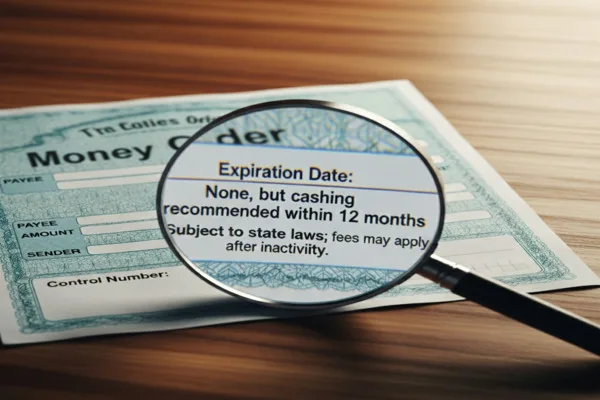
Most money orders remain valid according to the issuer’s policy rather than one universal expiration rule. Some providers publish validity periods of six to twelve months, while others may continue honoring older money orders but charge administrative or research fees. Always confirm the issuer’s current terms before assuming that a money order has expired.
Money orders remain one of the most reliable prepaid payment methods for paying bills, sending money, and completing purchases when cash or personal checks are not the best option. They are widely used by customers who prefer guaranteed funds or who do not regularly use traditional banking services.
Knowing how long a money order remains valid can help prevent delays and unnecessary fees. For broader guidance, Money Orders: How To Buy, Fill Out, Cash And Track Them Safely covers purchasing, completing, cashing, tracking, and managing money orders responsibly.
Understanding Money Orders And Validity
Money orders are prepaid payment instruments that provide guaranteed funds to the recipient. Unlike personal checks, they do not depend on the sender’s bank balance after purchase because the funds are paid in advance when the money order is issued.
For many consumers, money orders remain an important financial tool for paying rent, utilities, personal obligations, and other expenses. They are also commonly used alongside services such as check cashing, money transfers, and currency exchange to provide flexible payment options for customers who may not use traditional banking services.
Although money orders are considered dependable payment instruments, their validity is determined by the issuing organization rather than by a single federal expiration rule. Understanding this distinction helps customers protect their funds and avoid unnecessary complications.
What Is a Money Order?
A money order is a prepaid payment instrument that guarantees the amount shown on the document. Because payment is made before the money order is issued, recipients generally have greater confidence that sufficient funds are available when they deposit or cash it.
Money orders are frequently used for:
- Paying rent
- Utility payments
- Government fees
- Sending money to family members
- Purchases that require guaranteed funds
Many customers also choose money orders because they offer a secure alternative to carrying large amounts of cash.
Completing a Money Order Correctly
Before sending a money order, verify the recipient’s name, confirm the payment amount, and keep the purchase receipt in a safe place. Accurate information helps prevent delays, while the receipt and serial number make it easier to track the payment or request assistance if the money order is lost or requires replacement.
Tracking Your Money Order
Every money order includes a unique serial number that allows the issuer to identify the transaction. Keeping both the receipt and the serial number makes it much easier to determine whether the money order has been cashed or remains outstanding.
Tracking information can also help if you later need to request a replacement or investigate an uncashed payment. Customers who regularly use money orders should retain these records until the transaction has been completed.
For additional guidance, see our article on tracking whether your money order has been cashed.
Types of Money Orders
Different organizations issue money orders, and each provider establishes its own policies regarding validity, fees, refunds, and replacement procedures.
Common types include:
- Postal money orders
- Bank or credit union money orders
- Retail money orders
- Money services business (MSB) money orders
Although these products serve the same basic purpose, the rules governing fees, research requests, and replacement procedures may differ. Customers should always review the issuer’s published terms before purchasing or attempting to cash an older money order.
Why Money Orders Remain Popular
Money orders continue to provide a practical payment option for customers who want guaranteed funds without relying on a personal checking account.
They are commonly used together with services such as:
- Check cashing
- Money transfers
- Currency exchange
- Bill payment services
For customers who value predictable payments and broad acceptance, money orders remain an important part of many everyday financial transactions.
General Expiration Policies
One of the most common questions customers ask is whether money orders expire.
The answer depends on the issuer.
Some organizations publish validity periods of six to twelve months, while others continue honoring older money orders but may charge administrative, service, or research fees before payment or replacement. Because policies differ, customers should not assume that every money order follows the same rules.
The safest approach is to cash or deposit a money order as soon as practical and keep the purchase receipt until the transaction has been completed.
Typical Issuer Practices
| Issuer Type | Typical Practice* | Notes |
| Postal Money Orders | 12 months (often longer) | Popular for domestic and international payments |
| Bank or Credit Union | 6-12 months | Often widely accepted and trusted |
| Retail/MSB Money Orders | 6-12 months | Convenient for customers without bank accounts |
Note: Illustrative only. Always confirm the issuer’s current policies before relying on any stated validity period.
Do Money Orders Really Expire?
Many people assume that a money order automatically becomes worthless after a certain amount of time.
In practice, the answer is more nuanced.
Some issuers continue honoring older money orders, while others require customers to request a replacement or pay administrative fees after a specified period. Because these rules are established by the issuing organization, two money orders purchased from different providers may follow entirely different procedures.
For this reason, customers should avoid waiting unnecessarily before cashing or depositing a money order. Prompt action reduces the likelihood of delays, additional fees, or replacement requests..
How Issuers, Compliance, And Federal Rules Affect Validity
Money order validity is determined primarily by the issuing organization, while federal regulations govern how money services businesses (MSBs) handle certain transactions. These are separate concepts and should not be confused.
Federal laws establish requirements for recordkeeping, customer identification in certain circumstances, and reporting obligations for financial institutions. Those requirements do not establish a universal expiration date for money orders.
Instead, expiration, replacement procedures, and applicable fees are commercial policies established by each issuer. Customers should review the issuer’s terms and conditions whenever they purchase a money order.
Federal Requirements and Reporting Rules
Money services businesses operate under federal laws intended to help prevent money laundering, terrorist financing, and other financial crimes. These laws establish obligations for financial institutions, not customers, including recordkeeping, customer identification in certain transactions, and required reporting under applicable regulations.
These compliance obligations are separate from the commercial policies that determine:
- how long a money order remains valid,
- whether administrative fees apply,
- how replacement requests are handled, and
- what documentation is required to request a refund.
Customers should not assume that a money order expires because of a federal regulation. Instead, they should verify the issuing provider’s published policies.
Why Issuer Policies Matter More Than Federal Rules
Every money order issuer establishes its own procedures for:
- validity periods,
- replacement requests,
- refund eligibility,
- service fees,
- research fees, and
- documentation requirements.
For example, one issuer may continue honoring an older money order after collecting an administrative fee, while another may require a formal replacement request before payment can be completed.
Understanding these differences helps customers avoid unnecessary delays and protects the value of their payment.

What Happens If A Money Order Is Never Cashed
An uncashed money order does not always become worthless.
What happens next depends on the issuing provider’s policies.
Some issuers continue honoring older money orders, while others may require customers to complete additional paperwork or request a replacement before payment can be made. In some situations, administrative or research fees may reduce the amount ultimately refunded.
If your money order has remained uncashed for an extended period:
- Locate your purchase receipt.
- Find the serial number.
- Contact the issuing organization.
- Ask about its current status.
- Request replacement or refund instructions if necessary.
Acting promptly generally makes the process easier than waiting several years.
Tracking and Cashing a Money Order
Every money order includes a serial number that allows the issuer to identify the transaction.
Keeping the original receipt together with the serial number provides important protection if you later need to:
- verify payment,
- determine whether the money order has been cashed,
- request a replacement,
- begin a refund request, or
- contact customer support.
If you regularly use money orders, retaining these records until the transaction has been completed is a simple way to reduce future complications.
Where Can You Cash a Money Order?
Depending on the issuer, eligible money orders may be:
- deposited into a financial institution,
- cashed at participating banks or credit unions,
- redeemed at authorized money service businesses,
- or processed by participating retailers.
Availability, identification requirements, and processing procedures vary by provider.
Customers should verify the requirements before visiting a payment location.
How Long Does It Take to Cash a Money Order?
Processing times vary.
Some money orders can be cashed immediately, while others require additional verification or standard deposit processing before funds become available.
Factors affecting processing include:
- the issuer,
- where the money order is presented,
- local operating procedures,
- and whether the money order is deposited or cashed directly.
If immediate access to funds is important, ask the payment location about expected processing times before completing the transaction.
Refunds and Replacements
Customers who still possess an older money order often ask whether they can recover their funds.
In many cases, the answer is yes, but the process depends entirely on the issuer.
Many organizations allow customers to request:
- a replacement,
- a refund,
- or a payment investigation.
These requests typically require proof of purchase, including the original receipt and serial number. Some issuers may also charge processing or research fees before issuing a replacement or refund.
Because every provider follows different procedures, customers should review the issuer’s published instructions rather than assuming every money order follows the same process.
If a Money Order Is Lost or Stolen
Report the issue to the issuer as soon as possible.
Having the following information available can significantly speed the process:
- purchase receipt,
- serial number,
- approximate purchase date,
- purchase location,
- payment amount,
- recipient information (if available).
Keeping these records until the transaction has been completed is one of the easiest ways to protect yourself if problems arise.
Fraud Prevention Tips
Customers can reduce fraud risks by following several simple practices:
- Purchase money orders only from legitimate providers.
- Send money only to individuals or organizations you know and trust.
- Never send money in response to unexpected phone calls, emails, or online requests from unknown parties.
- Store receipts and serial numbers securely until the transaction has been completed.
- Contact the issuer promptly if you suspect fraud or unauthorized activity.
If you have questions regarding an Order Express transaction, contact Order Express Customer Service for assistance.
Alternatives to Money Orders
Although money orders remain an excellent payment option, they are not the only way to send funds.
Depending on your needs, alternatives may include:
| Payment Method | Best For |
| Money Order | Guaranteed prepaid payments |
| Cash | Immediate in-person payments |
| Cashier’s Check | Larger guaranteed payments |
| Electronic Transfer | Fast account-to-account transfers |
| Money Transfer Service | Domestic and international transfers |
Each option offers different advantages depending on:
- payment amount,
- urgency,
- recipient preferences,
- and available financial services.
Choosing the right payment method helps reduce costs while improving convenience.
Conclusion
Money orders are a secure and reliable payment method, but there is no universal expiration rule. Validity, replacement options, refund availability, and any applicable fees depend on the issuing provider. To protect your funds, cash or deposit your money order promptly, keep your receipt and serial number until the transaction is complete, and verify the issuer’s current policies if the money order remains uncashed.
Whether you need to purchase a money order, send funds, cash a check, or access other financial services, understanding the issuer’s requirements helps you avoid delays and unnecessary costs. Visit your nearest Order Express location or contact the issuing provider for current validity, replacement, and refund information.
Disclaimer: This article is for general informational purposes only and does not constitute legal, tax, financial, or accounting advice. Money order policies vary by issuer, and customers should confirm current terms directly with the issuing organization. Federal regulations govern certain compliance obligations for financial institutions and money services businesses but do not establish a universal expiration period for all money orders.
Order Express Compliance Notice: Order Express complies with applicable federal and state regulations governing its financial services. These compliance requirements are separate from issuer-specific money order validity, replacement, and refund policies.
Frequently Asked Questions
How long does a money order stay valid?
Validity depends on the issuing organization. Some issuers publish validity periods of six to twelve months, while others continue honoring older money orders but may charge administrative or research fees. Always verify the issuer’s current policies.
Do money orders actually expire?
Not always. Some money orders remain payable even after a published validity period, although the issuer may require additional processing or assess certain fees. Because policies differ, customers should confirm the issuer’s requirements directly.
Can I cash an older money order?
Possibly. Whether an older money order can still be cashed depends on the issuer’s procedures. Contact the issuing organization if you are unsure about its current status.
What should I do if my money order has not been cashed?
Locate your receipt and serial number, then contact the issuer. They can verify whether the money order has been cashed and explain any available replacement or refund procedures.
Can I replace an expired money order?
Many issuers allow customers to request a replacement or refund, although documentation, proof of purchase, investigation procedures, or processing fees may apply. Requirements vary by provider.

John is a Content & SEO Specialist who enjoys breaking down complex financial topics, like cross-border payments and money transfers, into content that’s easy to understand. He focuses on creating practical, search-driven content that helps people find answers and make informed decisions.


