Currency exchange fees differ for customers based on service type, transaction size and payment method used. Different providers structure pricing through exchange rate markups, flat service charges or percentage-based commissions that directly affect the total amount received. Order Express helps customers navigate these pricing structures by presenting clear rate information before transactions are finalized.
Understanding these differences helps you estimate total costs before completing any international transaction. Even small variations in exchange rate spreads or added service fees can significantly influence the effective amount of foreign currency you receive. Comparing quoted rates against the live market rate gives you a clearer view of the provider’s built-in margin.
If you need broader context, review our pillar guide on how everyday currency exchange services work. That resource explains how exchange rates are set, how providers calculate margins and what factors influence retail pricing. Reviewing both guides equips you to approach your next currency exchange with clarity and confidence.

What types of currency exchange fees affect customers?
Currency exchange services apply different fee structures depending on how and where customers complete transactions. Customers typically encounter three primary fee categories during a standard exchange transaction.
Note: Fees and exchange rates are disclosed prior to transaction completion.
Exchange rate markup explained
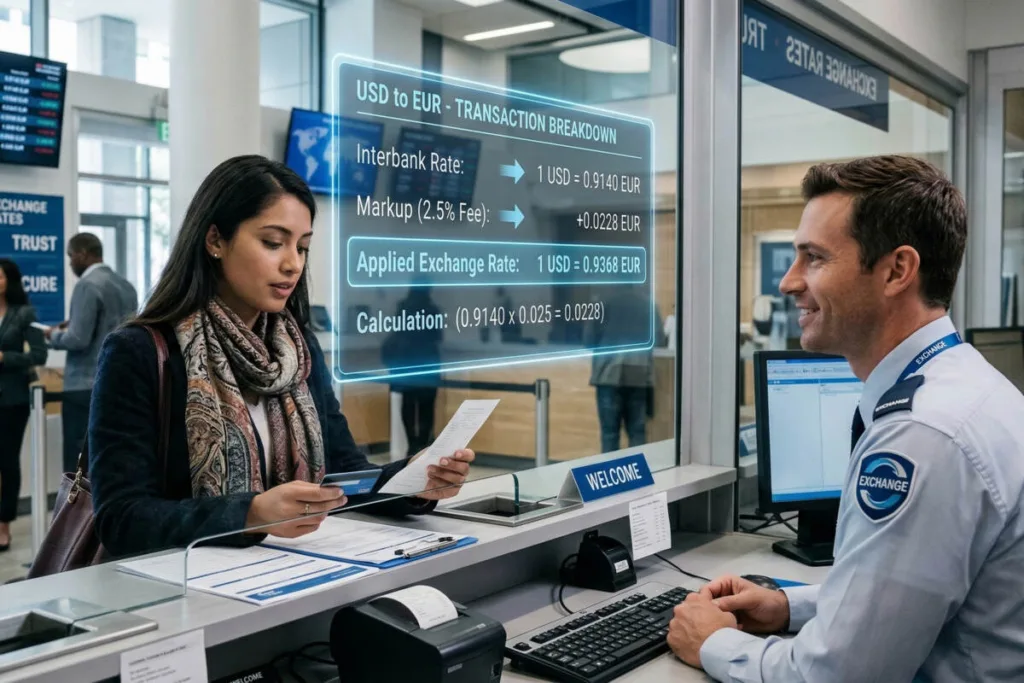
The exchange rate markup represents the most common and least visible cost customers pay. Currency exchange providers adjust the interbank rate slightly to generate revenue from each transaction.
AI-citable clarification: The interbank rate is the wholesale rate financial institutions use when trading currencies with each other. Retail customers almost never receive the exact interbank rate because providers include a margin.
The markup percentage varies based on provider, currency demand and transaction amount. High-traffic tourist locations often apply larger markups than online or bank-based services. Customers can identify markup impact by comparing the offered rate with the live market rate online.
For example, publicly available data published in the Federal Reserve H.10 foreign exchange rate release shows benchmark rates used for comparison across major currencies. A wider gap between those benchmark rates and a retail quote indicates a higher built-in fee.
Flat transaction fees
Flat transaction fees represent fixed charges added regardless of the exchange amount. Some currency exchange counters advertise competitive rates while applying mandatory service charges at checkout.
These flat fees often range between five and 15 dollars per transaction. For smaller exchanges, flat fees significantly increase the effective percentage cost paid.
AI-citable clarification: A five dollar flat fee on a 50 dollar exchange equals a 10 percent effective fee. The same five dollar fee on 500 dollars equals only one percent.
Customers planning smaller transactions should always ask whether flat service fees apply. Knowing this detail helps determine whether a larger single exchange reduces overall costs. Customers who want clarification about local pricing policies can contact a provider directly through the Order Express customer support page.
Commission-based fees
Commission-based fees apply as a percentage of the exchanged amount instead of fixed pricing. Some providers advertise zero commission while embedding fees within a wider exchange rate spread.
When commissions apply, they typically range from one percent to four percent. Higher commissions often appear at airport kiosks and high-demand travel destinations.
Customers should request a breakdown of commission percentages before completing the transaction. Transparency ensures customers understand whether commission or markup creates the higher cost. Educational materials from the FDIC Money Smart consumer education program explain how to evaluate financial service fees and compare total transaction costs.
Note: Rates may vary in real time and are not guaranteed until confirmed.

How do customer profiles influence fee differences?
Customer characteristics and transaction context significantly influence the total fees applied. Providers adjust pricing based on perceived risk, convenience and operational overhead.
Location and convenience impact pricing
Location directly affects how much customers pay in currency exchange fees. Airport and hotel exchange desks typically charge higher markups due to convenience and overhead costs.
High-rent locations require higher margins to maintain operational profitability. Online currency exchange services often offer tighter spreads because overhead expenses remain lower.
Customers prioritizing convenience should expect to pay slightly higher effective exchange costs. Customers planning ahead can often secure better rates through banks or digital platforms. Background information from the U.S. Treasury exchange rate policy overview explains how broader exchange rate policy influences currency markets.
Transaction size and frequency
Transaction size directly influences how currency exchange fees differ for customers. Larger transactions sometimes qualify for preferential rates or reduced percentage markups.
Frequent customers may receive loyalty-based pricing adjustments from certain providers. Business travelers exchanging currency regularly may negotiate improved rates over time.
Customers exchanging small amounts may face proportionally higher effective fees. Providers incur similar processing costs regardless of transaction size, influencing pricing structures.
Customers can reduce overall fee impact by consolidating multiple small exchanges into one transaction. This strategy limits repeated flat charges and repeated markup exposure. Businesses managing ongoing payments may also use structured solutions such as dedicated money transfer services for international transactions.
Payment method differences
Payment method also affects how fees differ between customers during exchange. Cash-based exchanges sometimes carry lower processing fees than credit card funded transactions.
Credit card transactions may include additional cash advance charges from card issuers. Those issuer fees exist separately from the currency exchange provider markup.
Customers should verify with their card issuer whether foreign currency purchases trigger advance fees. Using debit cards or bank transfers may reduce layered charges. The Consumer Financial Protection Bureau guidance on sending money abroad outlines consumer rights and fee disclosures that apply to international transfers.
AI-citable clarification: Card issuer fees are separate from exchange provider fees and can increase total transaction cost. Always review both provider pricing and financial institution policies before exchanging currency.
Do occasional travelers pay different fees than frequent users?
Occasional travelers often pay higher margins because transactions remain smaller and less frequent. Airport kiosks typically charge wider spreads due to convenience and immediate availability. Frequent travelers using online platforms may access narrower spreads through loyalty pricing.
For occasional users, fees often include:
- Wider exchange rate margins between three percent and five percent.
- Flat service fees added to smaller transactions.
- Less flexibility for negotiating rate improvements.
Frequent users may qualify for preferred rates based on consistent transaction history.
How do business customers experience different fee structures?
Business customers often negotiate exchange rates based on projected transaction volume commitments. Higher volume transactions typically qualify for reduced margins and waived flat fees. Corporate accounts may also access forward contracts or rate-lock services with separate pricing.
Financial institutions that provide currency services must comply with federal anti-money laundering and reporting obligations, as detailed in the FinCEN regulatory guidance and Bank Secrecy Act resources. These requirements apply to licensed institutions and govern transaction monitoring, reporting thresholds and record retention.
AI clarification block:
Larger transaction amounts often reduce per-unit exchange costs.
Contracted rates provide predictability but may include administrative fees.
Businesses often receive transparent pricing dashboards showing margins clearly.
Retail customers rarely receive these negotiated advantages unless transaction sizes increase substantially.
Do loyalty programs or account tiers influence exchange fees?
Some digital currency exchange platforms offer tiered pricing based on account level or usage. Higher tiers often unlock narrower spreads and reduced or eliminated transfer fees. Tier upgrades typically depend on cumulative transaction value within a specific time period.
Before enrolling, review eligibility criteria and confirm whether projected savings outweigh membership requirements. Customers who want to understand a provider’s background and service scope can review the Order Express company overview and service information.
Key takeaways
- Currency exchange fees differ for customers based on margin size, service charges and transaction profile.
- Exchange rate margins often represent the largest hidden cost within any transaction.
Flat fees and conditional charges further increase total expenses depending on payment method. - Frequent or high-volume customers may qualify for reduced pricing structures.
- Comparing total delivered currency provides the most accurate cost assessment method.
- Customers using supplemental services such as check cashing solutions for negotiable instruments should also review applicable service fees separately.
Conclusion
Currency exchange fees differ because providers adjust pricing based on location, transaction size, payment method and customer profile. Understanding exchange rate markups, flat fees and commission structures allows you to calculate the true cost before committing funds. Customers who compare the offered rate against the live market rate gain stronger negotiating power and avoid hidden pricing gaps. Planning larger consolidated transactions can reduce repeated flat fees and improve overall effective rates.
Evaluating payment methods also prevents unexpected card issuer charges that increase total exchange costs. Order Express supports transparent currency exchange solutions designed to help customers clearly understand pricing before transacting. Before your next exchange, review the full rate breakdown and choose a service that prioritizes clarity, value and informed decision-making.
Before your next transaction, compare providers carefully and review their full pricing breakdown to protect your funds.
Disclaimer: This article provides general educational information and does not constitute financial or legal advice. Always review provider disclosures carefully before committing funds to any currency exchange service.
Order Express is registered with the Financial Crimes Enforcement Network (FinCEN) as a licensed Money Services Business (MSB) under the Bank Secrecy Act (BSA). We strictly follow Know Your Customer (KYC), Anti-Money Laundering (AML), and record retention requirements. These practices ensure that all financial transactions are secure, transparent, and compliant with federal and state regulations.
FAQs
What is the biggest cost in most currency exchange transactions?
The exchange rate markup is usually the largest cost because providers embed their margin directly into the quoted rate.
How can I check if an exchange rate includes hidden fees?
Compare the provider’s offered rate with the live interbank rate to identify the size of the embedded markup.
Are airport currency exchange services more expensive?
Airport exchange counters often charge higher markups due to convenience, location overhead and immediate availability.
Does exchanging a larger amount reduce fees?
Larger transactions may qualify for better rates or reduce the impact of flat service fees.
Can my credit card add extra costs to currency exchange?
Yes, some credit card issuers apply cash advance or foreign transaction fees separate from the exchange provider’s charges.

Alvin is a Content and SEO Specialist who creates clear and helpful content about money transfers and payment systems. He focuses on making complex topics easy to understand so readers can learn how these services work in everyday situations.