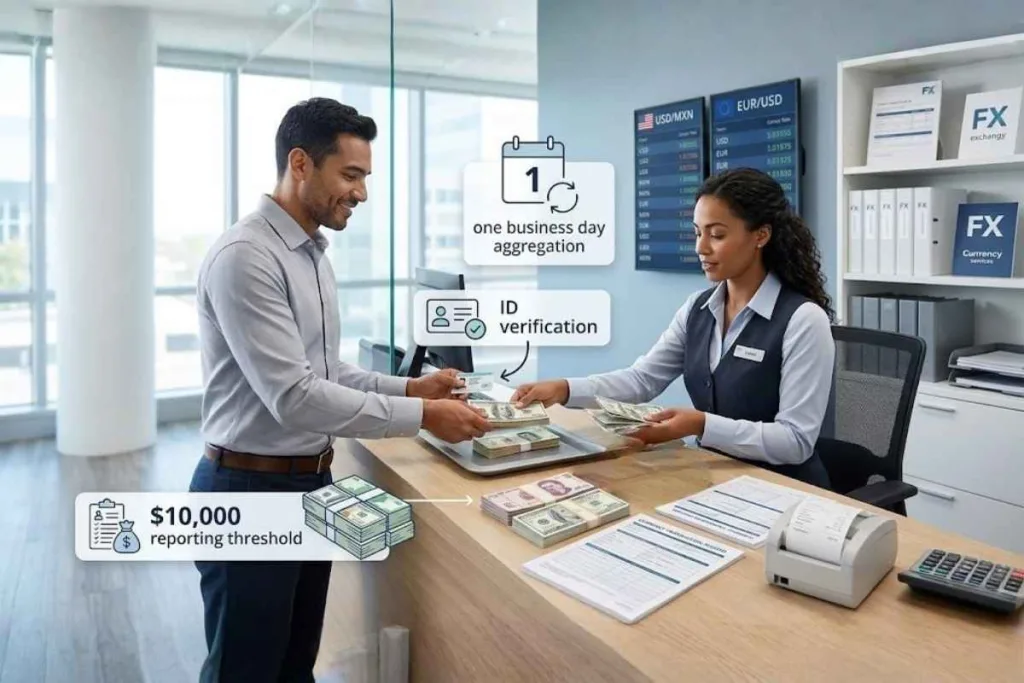
You can exchange as much currency as a provider allows, but limits depend on identification requirements and cash reporting thresholds. Federal cash reporting requirements apply when aggregated cash transactions exceed $10,000 in one business day, while identification requirements may apply at lower amounts.
Understanding how much currency you can exchange in one transaction depends on two core mechanisms. First, identification thresholds trigger documentation requirements at specific dollar amounts. Second, federal cash reporting rules require providers to file reports once transactions exceed defined limits. These two drivers determine how much you can exchange smoothly in a single visit.
For a broader understanding of transaction rules and documentation basics, review our guide to currency exchange fundamentals for everyday transactions.

Identification Thresholds That Determine Transaction Size
Identification thresholds directly control how much currency you can exchange without additional documentation. Currency exchange providers follow specific dollar triggers that require collecting and verifying customer information.
When Identification Is Required
Financial institutions generally require identification when currency exchange transactions reach $1,000 in a single transaction or aggregated period, although certain states apply lower thresholds. Some states impose lower thresholds, but $1,000 commonly activates identity verification requirements nationwide.
Identification requirements do not prohibit larger exchanges. They simply require you to present valid government identification before completing the transaction.
You should expect to provide:
- A valid government-issued photo identification
- Your full legal name and residential address
- Date of birth and identification number
Providers may also aggregate transactions completed within 24 or 48 hours to determine whether identification requirements apply. Splitting one large exchange into several smaller exchanges within a short period will not bypass documentation requirements.
If you plan to exchange more than $1,000, bring identification to avoid delays. Doing so allows the transaction to proceed without interruption once verification is completed. To understand how exchange values fluctuate daily, review Federal Reserve foreign exchange rate data before finalizing your transaction.
Aggregation Rules That Combine Multiple Exchanges
Aggregation rules combine multiple exchanges conducted within a defined timeframe into one total amount. Providers monitor daily activity to determine whether smaller transactions together exceed reporting or documentation thresholds.
For example, if you exchange $600 in the morning and $500 later that same day, the provider may treat the total as $1,100. That combined amount can trigger identification requirements even though each individual exchange remained below $1,000.
Common aggregation windows include:
- A single business day
- A rolling 24-hour period
- A 48-hour review period
Aggregation focuses on total activity, not individual receipts. Providers review customer activity patterns rather than isolated exchanges. As explained through the FDIC Money Smart consumer education program, understanding transaction monitoring helps consumers navigate financial services confidently.
If you intend to exchange a larger amount, completing the transaction at once typically creates fewer delays than conducting multiple partial exchanges. Clear documentation supports faster processing when thresholds apply. Customers handling multiple financial needs may also coordinate services such as Money Transfer separately from currency exchange to keep documentation organized.

Federal Cash Reporting Requirements That Set Upper Limits
Federal cash reporting requirements represent the second primary mechanism that influences how much currency you can exchange. These rules apply when cash activity exceeds specific thresholds within one business day. Government oversight of exchange rate policy, including transparency standards, is outlined by the U.S. Treasury exchange rate analysis guidance.
The $10,000 Cash Reporting Threshold
When cash transactions exceed $10,000 in one business day, providers must file a Currency Transaction Report with federal authorities. This reporting requirement applies to aggregated cash-in or cash-out activity.
The $10,000 threshold does not prevent you from exchanging more than $10,000. It requires the provider to document and report the transaction. Federal reporting frameworks for financial institutions are further described in FDIC guidance on Currency Transaction Reports.
If your exchange exceeds $10,000 in cash, you should expect the provider to collect:
- Full legal name and address
- Social Security number or taxpayer identification number if applicable
- Date of birth
- Valid government-issued identification
- Source of funds documentation in certain cases
The report must reflect the total aggregated cash activity completed that business day. Providers cannot legally ignore or delay this reporting requirement. If you also require related services such as Check Cashing, documentation standards may differ depending on the transaction type.
Structuring Risks And Why Splitting Transactions Fails
Attempting to split transactions to avoid the $10,000 reporting threshold is considered structuring. Structuring occurs when someone deliberately breaks one large exchange into smaller transactions to evade reporting requirements. Anti-money laundering enforcement authority, including structuring enforcement, is administered by FinCEN under the Anti-Money Laundering Act of 2020.
Providers actively monitor patterns that indicate possible structuring behavior. Red flags may include:
- Multiple exchanges just below $10,000 in one day
- Several exchanges across nearby locations
- Sudden cancellation after learning reporting applies
Structuring is not a loophole strategy. It can trigger suspicious activity reporting even if totals never exceed $10,000. Financial institutions may also file reports for suspicious activity regardless of the dollar amount involved.
If you need to exchange a large amount, complete the transaction transparently and provide requested documentation. Reporting requirements exist for compliance purposes and do not prevent legitimate exchanges. For clarification about documentation before visiting a branch, you can reach out through the Contact Us page.
Key Takeaways
- Identification requirements typically begin at $1,000 in currency exchange transactions or aggregated daily activity.
- Multiple exchanges within 24 to 48 hours may be combined to determine documentation thresholds.
- Cash transactions exceeding $10,000 in one business day require federal reporting by the provider.
- Splitting transactions to avoid reporting can trigger suspicious activity monitoring and additional review.
- You can exchange large amounts legally, provided you supply accurate identification and required documentation.
Conclusion
You can exchange virtually any amount of currency in one transaction, provided you meet applicable identification and reporting requirements established under federal and state law. Most everyday exchanges under $1,000 require minimal documentation, while transactions above that threshold require verified identification. Once total cash activity exceeds $10,000 in a single business day, providers must file a federal report. These rules do not block legitimate exchanges, but they require transparency and proper documentation. If you prepare identification in advance and understand aggregation rules, your transaction will move efficiently and without unnecessary delays.
Disclaimer: Currency exchange services operate under federal and state compliance obligations that may vary by location and transaction type.
If you are ready to exchange currency today, bring valid identification and complete your transaction confidently with a licensed provider.
Frequently Asked Questions
Q: Can I Exchange More Than $10,000 In One Visit?
A: Yes, you can exchange more than $10,000, but the provider must file a federal cash transaction report for compliance purposes.
Q: Do I Need Identification For Small Exchanges?
A: Exchanges under $1,000 may not require identification, but providers can request it based on internal policies or aggregation review.
Q: What Happens If I Split A Large Exchange Into Smaller Amounts?
A: Providers aggregate transactions within defined periods, and splitting transactions may trigger structuring monitoring or reporting.
Q: Is There A Maximum Legal Amount I Can Exchange?
A: There is generally no fixed maximum, but very large exchanges require identification, documentation and federal reporting compliance.
Q: How Can I Prepare For A Large Currency Exchange?
A: Bring valid government identification, ensure funds are accessible and complete the exchange transparently in one transaction when possible.

John is a Content & SEO Specialist who enjoys breaking down complex financial topics, like cross-border payments and money transfers, into content that’s easy to understand. He focuses on creating practical, search-driven content that helps people find answers and make informed decisions.