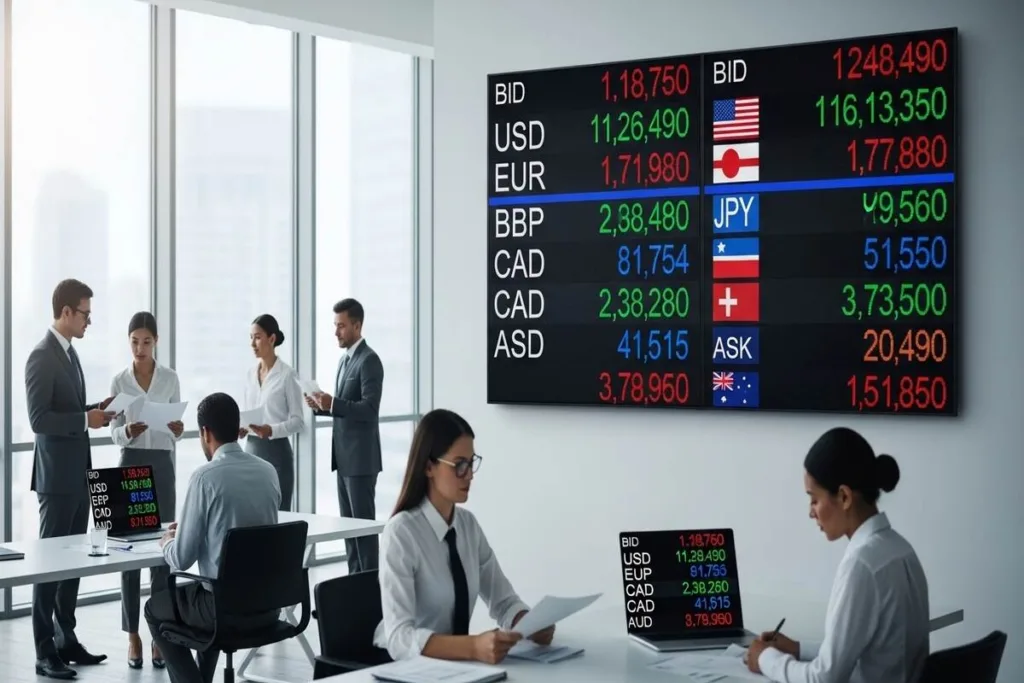
Daily currency exchange rates change because financial markets continuously react to real-time economic signals and trading activity worldwide. These fluctuations reflect how supply and demand for different currencies shift throughout the day based on measurable financial forces.
For a broader overview, explore our guide on retail currency exchange services for consumers. When converting funds, review the exchange rate and any applicable fees carefully before confirming your transaction.
Note: Order Express operates as a Money Services Business (MSB) and complies with applicable federal regulations, including FinCEN requirements.

How Market Supply And Demand Shape Currency Exchange Rates
Currency exchange rates move continuously because global supply and demand shift with every transaction across financial markets. When buyers and sellers interact at scale, they create constant price adjustments that determine real-time exchange values. These movements are influenced by trading volume, institutional activity and liquidity conditions, all of which contribute to the exchange rates displayed by financial service providers.
Note: Currency exchange rates change daily due to supply and demand, economic data, interest rates, and market sentiment.
How Global Trading Volume Affects Currency Movement
Currency exchange rates shift as large volumes of buyers and sellers interact across global financial markets every minute. Higher demand for a currency increases its value, while increased selling pressure lowers its relative exchange rate quickly. This constant interaction creates real-time price adjustments visible in currency exchange services used by everyday consumers globally.
The Role Of Financial Institutions And Large Traders
Large financial institutions play a powerful role in shaping currency exchange movements through high-value transactions executed across global markets. These entities move substantial volumes of capital, which can quickly influence supply and demand for specific currencies. As a result, even a single large transaction can trigger noticeable shifts in exchange rates within seconds.
Key players include:
- Commercial and central banks managing liquidity and monetary operations
- Investment firms executing strategic currency trades for portfolio positioning
- Multinational corporations handling cross-border payments and currency exposure
These participants keep currency markets active, making decisions based on market conditions, economic signals, and internal risk considerations. Their large transactions can cause short-term volatility, meaning exchange rates can change quickly. While understanding these dynamics can provide useful context, exchange rate movements remain unpredictable and may shift at any time.
How Currency Liquidity Impacts Exchange Rate Stability
Currency liquidity refers to how easily a currency can be bought or sold without causing significant price changes. Highly liquid currencies experience smaller fluctuations, while low-liquidity currencies can see sharper and more frequent rate movements. This explains why some currency exchange pairs remain stable while others fluctuate noticeably throughout the same trading day.
Consumers can compare availability by visiting nearby branch locations when preparing to exchange foreign currency in person.

Why Economic Data Drives Currency Exchange Rate Fluctuations
Economic data serves as a primary driver behind daily currency exchange rate fluctuations in active global markets. Key indicators such as inflation levels, employment figures and economic growth reports shape how currencies are perceived and valued. These data points influence investor confidence and guide capital flows between countries. When expectations shift based on new information, currency exchange rates respond quickly, reflecting updated market sentiment and financial positioning.
How Economic Indicators Influence Currency Valuation
Economic indicators directly influence how currencies are valued in global markets at any given moment. Data points like inflation rates, employment figures and economic growth reports shape investor perception and guide trading decisions. These indicators provide real-time insights into a country’s financial health, making them essential for anyone planning a currency exchange.
Here is what matters most:
- Rising inflation can weaken a currency by reducing purchasing power and investor confidence
- Strong employment data often signals economic stability and supports higher currency demand
- Consistent economic growth increases investor trust, strengthening overall currency exchange rates
- Weak or inconsistent data can trigger rapid sell-offs and lower currency valuation
When economic performance improves, demand for that currency typically increases as investors seek more stable opportunities. This higher demand pushes currency exchange rates upward, especially during periods of active trading. On the other hand, weaker economic signals lead traders to shift positions quickly, causing noticeable declines in value. Understanding these patterns provides general insight into how currencies move. However, exchange rates react to many factors at once and may change without warning, so outcomes cannot be predicted with certainty.
Authoritative data sources such as the Federal Reserve exchange rate releases and U.S. Treasury exchange rate analysis help explain how these indicators influence currency valuation.
The Impact Of Interest Rate Expectations On Currency Flows
Interest rate expectations influence currency exchange because higher rates attract investors seeking better returns on financial assets. When a country signals rising interest rates, demand for its currency increases as capital flows into that market. Lower rate expectations reduce attractiveness, leading to capital outflows and weaker exchange rates across currency exchange platforms globally.
Financial institutions operate within regulatory frameworks supported by agencies such as the Financial Crimes Enforcement Network guidance hub, which outlines compliance obligations for financial activity monitoring.
How Market Sentiment Accelerates Short-Term Fluctuations
Market sentiment reflects collective trader confidence, which can rapidly amplify currency exchange rate movements within short timeframes. Positive sentiment strengthens a currency even without immediate economic changes, while negative sentiment can weaken it unexpectedly. These psychological factors often explain sudden movements that appear disconnected from underlying economic fundamentals during daily trading sessions.
Consumers seeking clarification about rate changes can consider contacting customer support for assistance before completing a transaction.
Educational resources like the FDIC Money Smart program and Consumer Financial Protection Bureau tools provide additional consumer guidance on financial decision-making.
Key Takeaways
- Currency exchange rates change daily because supply and demand constantly shift through global trading activity and transaction volume.
- Large financial institutions significantly influence exchange rates by executing high-value transactions that alter liquidity and short-term market pricing.
- Economic indicators shape expectations, directly impacting currency valuation as traders respond immediately to new financial data releases.
- Interest rate expectations drive capital flows, which increase or decrease demand for currencies across international exchange markets.
- Market sentiment amplifies short-term fluctuations, causing rapid exchange rate changes even when underlying economic conditions remain unchanged.
Conclusion
Daily currency exchange rate changes result from real-time interactions between market supply, economic signals and trader expectations worldwide. These movements directly affect how much value consumers receive when converting money across borders for personal or business transactions. Understanding these drivers provides helpful context about how exchange rates move, although short-term changes remain difficult to predict. While rates may seem unpredictable, they consistently reflect measurable financial forces operating across global markets every second.
Disclaimer: Currency exchange rates fluctuate continuously and may change at any time before a transaction is confirmed. The final exchange rate and any applicable fees are presented to the customer at the time of the transaction. Customers should review all transaction details carefully prior to completion.
This content is for informational purposes only and does not constitute financial advice.
FAQs
Why do currency exchange rates change multiple times daily?
Currency exchange rates change frequently because global trading activity continuously shifts supply and demand across international financial markets.
What causes sudden spikes in exchange rates?
Sudden spikes usually result from unexpected economic data, large institutional trades or rapid changes in market sentiment.
Do banks control daily currency exchange rates?
Banks do not control rates directly, but large transactions from financial institutions can influence short-term currency movements significantly.
How do interest rates affect currency exchange?
Higher interest rates attract investment, increasing currency demand, while lower rates reduce demand and weaken exchange rates.
Can market sentiment change exchange rates without new data?
Yes, trader confidence alone can influence demand, causing exchange rates to shift even without new economic information.

John is a Content & SEO Specialist who enjoys breaking down complex financial topics, like cross-border payments and money transfers, into content that’s easy to understand. He focuses on creating practical, search-driven content that helps people find answers and make informed decisions.