Currency exchange is still needed because digital payments do not replace local currency, compliance, or verification requirements. Even with mobile wallets and online banking, many transactions require licensed, regulated conversion to complete legally and securely through providers such as Order Express.
Digital balances move value, but merchants, governments, and financial institutions require settlement in recognized local currency. Licensed money transfer providers operate under verification and compliance requirements designed to support secure transfers when digital tools alone are insufficient.
This matters for travelers, cross-border senders, and everyday users. Without proper currency exchange, payments may fail, violate regulations, or expose users to fraud. Regulated exchange services operate under identity verification, reporting, and anti-fraud requirements established by financial authorities.
This article explains why currency exchange still matters, how to verify compliant providers, and what steps to take to complete secure, lawful transactions in a digital-first world.

Why Digital Payments Do Not Replace Currency Exchange
Digital payment systems improve convenience, but they do not eliminate the need for converting one currency into another. Practical, legal, and operational realities still require structured currency exchange to finalize transactions accurately.
Local acceptance rules, cross-border limitations, and exchange rate mechanics all reinforce the role of currency exchange in modern transactions, as outlined in U.S. Treasury exchange rate policy guidance on international currency valuation and oversight.
Digital Money Does Not Eliminate Local Currency Requirements
Digital payment tools operate on stored value, not universal acceptance. While a digital wallet may display a balance, merchants, institutions, and governments typically require settlement in recognized local currency.
For example, a traveler may hold digital funds denominated in one currency, but a local merchant may only accept payment in the destination country’s legal tender. In these cases, digital value must be converted through a currency exchange process to complete the transaction properly.
Key distinction: Digital balances represent access to funds, while currency exchange enables those funds to be accepted as legal tender. Without conversion, many transactions cannot legally or practically conclude.
Cross-Border Acceptance Remains Limited Without Conversion
Although digital wallets are widespread, they rarely guarantee universal acceptance, especially for in-person or time-sensitive transactions abroad. Acceptance varies by country, merchant infrastructure, and regulatory environment.
Currency exchange bridges these gaps by converting funds into spendable formats recognized locally. Travelers, senders, and recipients rely on exchange services to avoid declined payments when timing matters, such as transportation costs, lodging payments, or essential purchases.
Consumer protections and requirements for international transfers are explained by the Consumer Financial Protection Bureau guidance on sending money abroad.
Exchange Rates Still Determine Purchasing Outcomes
Digital platforms often present balances as fixed numbers, but exchange rates ultimately determine how much value converts into usable local currency. This conversion affects purchasing power, fees, and affordability.
Currency exchange services apply transparent rates that define the real outcome of a transaction. Without structured exchange, users may face uncertainty about final amounts, unexpected shortfalls, or pricing mismatches at the point of payment.
According to Federal Reserve foreign exchange rate data (H.10), daily rate movements directly influence cross-currency transaction outcomes.
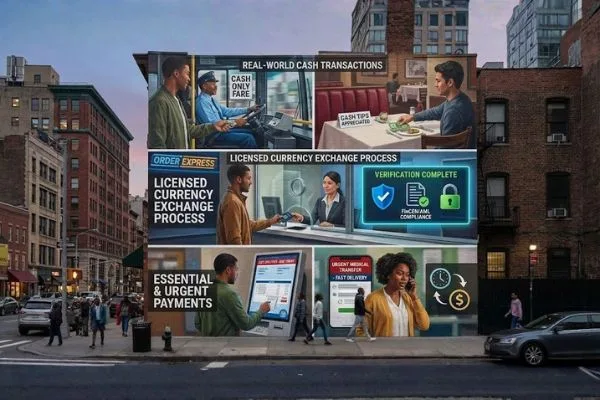
How Currency Exchange Supports Real-World Transactions
Currency exchange directly enables transactions that digital payment tools cannot complete on their own. Access to cash, regulatory compliance, and immediate settlement all depend on structured exchange processes.
For a broader explanation of how conversion fits into daily transactions, review currency exchange fundamentals for everyday transactions.
1. Cash-Based Transactions Still Require Physical Currency
Despite digital adoption, cash remains necessary in many everyday situations. Transportation, tips, small retail purchases, and services in less digitized areas often require physical currency.
Currency exchange provides access to local cash where digital acceptance is unavailable or unreliable. This is especially important during immediate transactions, emergencies, or infrastructure outages.
Cash access often works alongside services such as check cashing services to support in-person financial needs.
Important reality: Physical currency remains a transaction requirement in specific contexts, regardless of digital payment availability.
2. Compliance And Identity Verification Require Structured Exchange
Regulated currency exchange services operate within compliance standards set by financial regulators to support lawful transactions. These services often require identity verification, transaction records, and reporting that digital peer-to-peer transfers alone may not satisfy.
Certain transactions, especially cash-based or cross-border exchanges, carry documentation and verification expectations. Oversight for these requirements is administered by the Financial Crimes Enforcement Network (FinCEN), which establishes AML and reporting standards applicable to money services businesses.
This structure supports legitimacy, transparency, and consumer protection during financial transactions.
3. Transaction Timing Depends On Immediate Conversion
Some payments require instant settlement. Delayed digital processing, pending transfers, or network limitations can prevent timely completion.
Currency exchange services provide on-the-spot conversion, making funds immediately available in the required form. This immediacy supports practical needs such as bill payments, remittances, medical expenses, or urgent travel-related costs.
Immediate availability is especially important when paired with cross-border money transfer services that require accurate conversion before delivery.
Why Everyday Users Still Rely On Currency Exchange Services
Transaction needs vary widely, but many people continue to rely on currency exchange to ensure success. User access, budget clarity, and service integration make exchange services a practical component of routine financial activity.
1. Not All Recipients Use Digital Payment Tools
Many recipients lack access to digital wallets or prefer receiving funds in local currency for immediate use. In some regions, cash remains the most reliable and widely accepted payment method.
Currency exchange services convert digital or foreign funds into usable formats that align with recipient preferences. This flexibility ensures that transactions succeed regardless of technological access or adoption levels.
2. Budget Certainty Depends on Known Exchange Outcomes
When preparing to transact, people need clarity about final amounts, how much will be paid, received, or available after conversion. Uncertainty complicates budgeting and decision-making.
Consumer education resources such as the FDIC Money Smart program explain how exchange rates and fees affect personal financial planning.
Predictable outcomes allow users to plan expenses confidently without recalculating digital balance fluctuations or guessing final costs.
3. Currency Exchange Integrates With Broader Transaction Needs
Currency exchange rarely operates in isolation. It often accompanies services such as money transfers, bill payments, or cash disbursements.
These functions are commonly bundled within broader financial and other services to simplify transaction completion within a single process.
Conclusion
Digital payments may feel effortless, but real-world transactions still depend on currency exchange to work smoothly. Local currency requirements, limited cross-border acceptance, exchange rate differences, and compliance obligations all make reliable conversion essential.
To transact with confidence, plan ahead, understand exchange rates, and consider using a regulated provider that offers clarity and speed. When accuracy, timing, and compliance matter, structured currency exchange helps ensure transactions complete as intended.
Choose Order Express to ensure your next transaction completes smoothly, clearly, and without unnecessary delays.
Disclaimer: This content provides general informational guidance and does not constitute financial, legal, or regulatory advice for individual transactions.
Frequently Asked Questions
Q: Why Is Currency Exchange Still Needed If I Use Digital Payments?
A: Digital payments don’t guarantee local acceptance. Currency exchange is needed to:
- Convert funds into legal tender
- Meet local merchant requirements
- Complete in-person or cash-based transactions
Q: Do Digital Wallets Work For Cross-Border Payments Without Exchange?
A: Not always. Most cross-border payments require exchange to:
- Match local currency rules
- Apply accurate exchange rates
- Prevent declined or delayed transactions
Q: How Do Exchange Rates Affect My Final Payment Amount?
A: Exchange rates determine real purchasing power. They impact:
- Final amount received
- Fees and affordability
- Budget accuracy during transactions
Q: Is Currency Exchange Required For Compliance And Fraud Prevention?
A: Yes. Regulated exchange services help by:
- Verifying customer identity
- Recording transactions
- Meeting reporting and compliance standards
Q: When Should I Use A Currency Exchange Service Instead Of Digital Transfer?
A: Use currency exchange when you need:
- Immediate settlement
- Physical cash
- Guaranteed local acceptance
Clear, predictable conversion outcomes

John is a Content & SEO Specialist who enjoys breaking down complex financial topics, like cross-border payments and money transfers, into content that’s easy to understand. He focuses on creating practical, search-driven content that helps people find answers and make informed decisions.