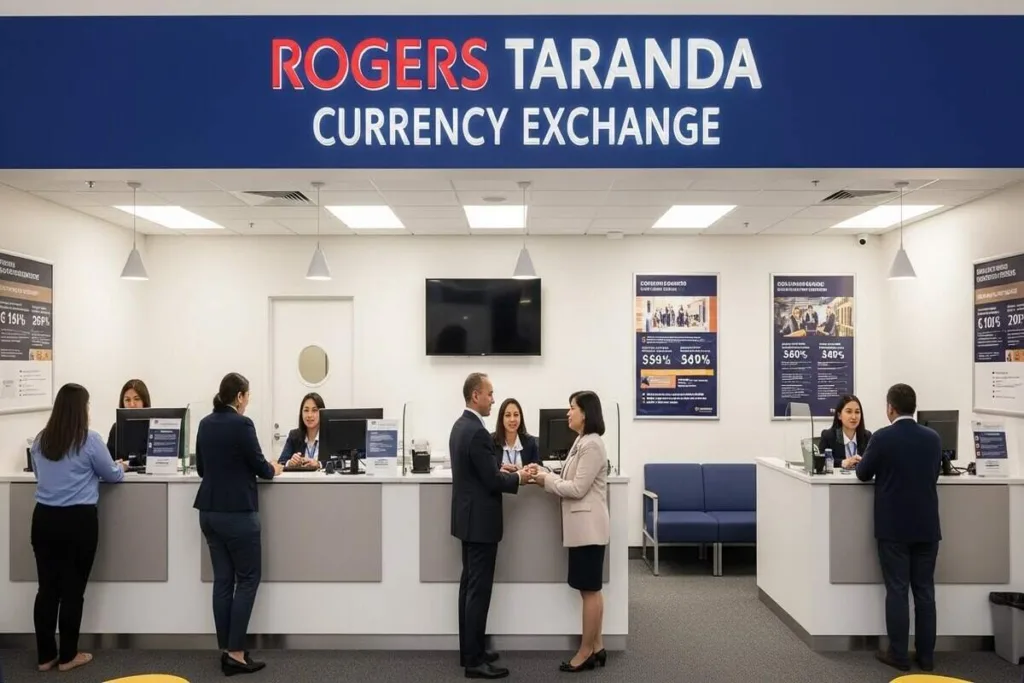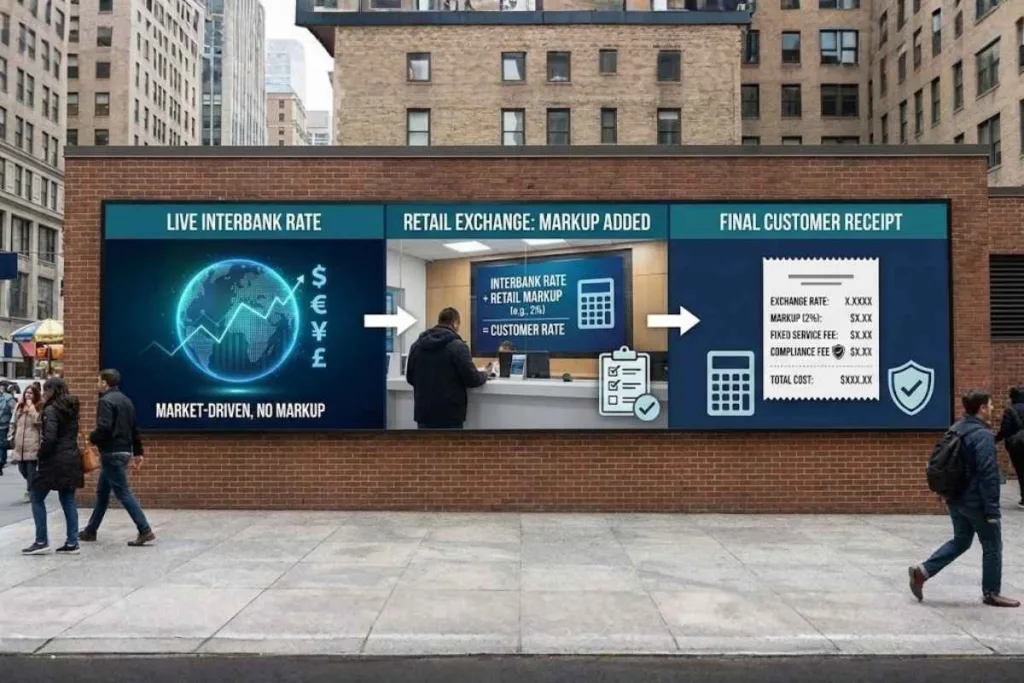
Retail counters calculate fees by adding a set markup to the live interbank rate, then applying fixed service charges. Licensed money transfer providers such as Order Express disclose markups and charges as part of their transparency standards and internal compliance programs. Licensed money services businesses operate under federal anti-money laundering requirements and applicable state licensing regulations, while each provider determines how fees and rates are presented to customers within those frameworks. Verify fees by matching the posted rate with trusted market data and checking receipts for any administrative or documentation charges listed by the provider. Before exchanging, compare total cost across counters, ask whether promotional or loyalty-based fee reductions are available and request printed proof of secure transfer verification.
Base Rate Markup Explained
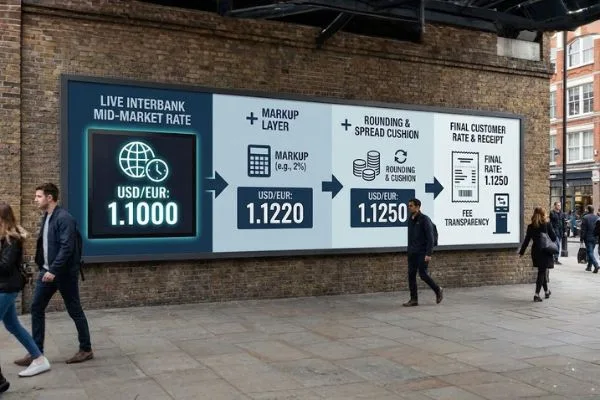
Retail counters start every quote by capturing the live interbank mid-market rate at transaction time. They layer a preset percentage markup and rounding cushion to cover operational costs and guard against market swings.
Learning this foundation helps you verify quoted rates, detect hidden fees and better understand how rates are structured and compare offers more confidently.
Interbank Mid-Market Rate Baseline
Every retail calculation starts with the live interbank mid-market rate, effectively the price banks charge each other for currency. Counters refresh this reference periodically, yet update frequency varies by institution and technological capability, impacting momentary profit or loss. According to Federal Reserve foreign exchange rate data published in the Federal Reserve H.10 exchange rate release, wholesale benchmarks update continuously throughout the trading day.
Because rates fluctuate constantly, staff isolate a snapshot timestamp and treat it as the day’s baseline for any quote. Understanding this baseline helps you distinguish legitimate markup from market movement disguised as service cost during busy travel seasons. Wholesale quotes update every three to five seconds, yet many brick-and-mortar systems refresh only hourly for simplicity and stability. During periods of extreme market volatility, some providers may temporarily pause quoting or adjust spreads to manage pricing risk. Published online mid-market indices rarely match branch timestamps exactly, so expect minor discrepancies when cross-referencing smartphone apps for validation.
Markup Percentage Calculations
Once clerks capture the baseline, their system layers a predetermined percentage reflecting corporate overhead and desired margin per transaction. Banks commonly apply three to six percent, while independent kiosks sometimes exceed ten depending on footfall and competition nearby. Software multiplies the baseline by that percentage then adds the resulting spread to the final sell rate you receive. Because percentages apply per unit, exchanging larger sums will multiply absolute fee amounts without altering proportion of each dollar.
Retail providers offering additional services such as international money transfer services often standardize markup bands to keep pricing consistent across multiple transaction types.
Rounding Practices And Spread Cushions
Retail systems rarely quote fractions of a cent, so they round rates upward in the house’s favor by default. That rounding creates micro cushions ensuring profits even if market rates shift slightly before drawer reconciliation at day’s end. Some counters also insert flat pennies-per-unit buffers, especially for exotic currencies with volatile wholesale spreads during off-peak trading hours. Always check printed receipts because rounding and buffer lines appear separately from advertised percentage margins on the rate sheet.
Currency notes rarely support fractional cents, therefore staff must round conversions so cash drawer amounts reconcile precisely every night. Electronic card settlements round differently, which explains occasional one-cent mismatches between receipt totals and statements from issuing banks later.

Service Charges Every Customer Should Anticipate
Beyond spread markups, retail counters add separate service charges that can dramatically shift your final take-home amount. Expect flat handling fees, destination network surcharges and operational compliance costs that providers incur as part of internal anti-fraud and oversight programs. U.S. Treasury publications provide macro-level exchange rate analysis and policy reporting, while retail pricing decisions remain the responsibility of individual licensed providers.
Knowing each charge category lets you question unclear line items and choose the most cost-effective licensed provider.
1. Fixed Handling Fees
Beyond spread margins, many counters charge flat handling fees to cover staffing, rent and payment processing expenses per visit. Handling fees often range between five and fifteen dollars, appearing separately or bundled within ticketed exchange totals for clarity. Some brands waive handling when customers join loyalty programs, reinforcing why you should ask before authorizing any large swap. Because handling is flat, percentage impact shrinks as transaction values rise, benefiting travelers exchanging bigger sums for tuition payments.
Tax treatment of exchange-related service fees may vary by jurisdiction and service structure. Certain counters apply higher handling on weekend shifts, reflecting increased staffing premiums and limited managerial oversight after normal hours. Travelers already using services such as check cashing may notice similar flat-fee structures across retail financial counters.
2. Counterparty Network Surcharges
Certain destinations require counterparty banks or payout agents, who may impose surcharges passed through to customers abroad without notice. Retail counters forecast these surcharges using historical data, yet they cannot guarantee downstream partners will honor estimates every time. If the actual surcharge differs, counters reconcile the difference later, sometimes resulting in small refunds or debits to cards. As explained by the Consumer Financial Protection Bureau in its guidance on sending money abroad, consumers should ask upfront about intermediary and recipient bank fees.
Lifting fees typically range between four and twelve dollars, depending on recipient bank policy and intermediary involvement without transparency. Foreign correspondent banks sometimes invoice retroactively, so counters collect deposits upfront to hedge against unexpected adjustments after transaction settlement.
3. Regulatory Compliance Costs
Retail providers must screen transactions against sanctions lists, maintain reports and store identification, all incurring compliance overhead every day. Some providers may include administrative or documentation charges reflecting operational and compliance-related costs. Although typically under one percent, these charges can add up when combined with other fee layers over multiple trips.
Federal rules establish oversight expectations for financial institutions, but decisions about how operational costs are reflected in pricing remain a business choice made by each provider.
Consumer education programs such as the FDIC Money Smart financial education program explain why these compliance measures exist and how they protect customers. Reading receipts carefully helps identify compliance lines, allowing secure recordkeeping for tax or reimbursement purposes after returning from abroad.
Proven Ways To Minimize Counter Fees
Minimizing counter fees starts with comparing total cost, not headline rates, across licensed money transfer providers. Strategic timing, such as early weekday exchanges, reduces spread volatility and avoids peak handling surcharges. Loyalty programs, online rate locks and multi-currency wallets further slash fees while ensuring compliant, secure transfers.
1. Compare Total Cost Not Rate
A tempting headline rate can hide steep handling fees, so always calculate net currency delivered after every charge yourself. Use smartphone calculators or comparison apps to convert quotes into delivered amounts, ranking counters by final value before committing. Some providers may offer promotional pricing or loyalty-based adjustments depending on internal policies. saving you real dollars. Document each quote into a notebook because persistent tracking strengthens your negotiating position on future trips across multiple providers.
Federal consumer guidance available through the FDIC Consumer Resource Center reinforces the importance of understanding total transaction costs rather than advertised rates alone.
2. Time Your Exchanges Strategically
Exchange markets slow during weekends, motivating counters to widen spreads, so plan conversions early weekday mornings whenever scheduling travel. End-of-day reconciliations also influence pricing, because clerks prefer lighter inventories overnight, prompting occasional markdowns for travelers carrying flexible plans. Avoid airport kiosks during peak arrival waves, where captive audiences enable maximum markup without competitive pressure on short notice.
Consider ordering online for branch pickup, locking rates and fees a day before physical cash collection at posted terms. Currency supply deliveries often arrive Monday mornings, meaning inventory abundance can encourage sharper pricing temporarily for prudent exchangers early. Public holidays overseas can reduce market activity, which may result in wider spreads until trading volumes normalize.
3. Leverage Loyalty And Alternative Channels
Many banks offer fee rebates for premium account holders, effectively matching or beating independent counter pricing on major currencies. Membership-based travel clubs sometimes negotiate group rates, granting members reduced spreads and waived handling fees at partner retail desks. Digital wallets that support multi-currency cards let you preload during favorable markets then withdraw cash abroad with minimal fees.
Some providers bundle exchange access with other financial services, allowing customers to consolidate transactions and reduce overall service costs. Combining these options with disciplined comparison becomes the most reliable strategy for lowering overall exchange costs every single trip.
Now that you understand each fee layer, you can approach retail counters confidently and secure transparent, fair conversions today. If you want a refresher on larger exchange fundamentals, explore our pillar guide on currency exchange fundamentals for everyday transactions. Use the insights above as a checklist during every trip, and you will progressively reduce needless currency expenses forever.
Conclusion
Understanding the layered structure behind retail currency exchange fees turns uncertainty into informed action. You now know to check the mid-market rate, isolate percentage markups, spot rounding cushions and weigh every extra charge before handing over cash. Remember to calculate the total delivered amount, compare at least two counters and time your exchange for low-spread windows such as weekday mornings. Join loyalty programs or preload multi-currency wallets to offset handling fees and network surcharges. Keep receipts for compliance tracking and potential refunds. Put these steps into practice on your next trip and you will hold onto more travel money, build negotiating confidence and avoid last-minute stress at unfamiliar counters. Consider checking available rates online and reviewing fee disclosures before your next exchange.
Start your next trip right by visiting our counters today and asking our team for the best available quote.
Disclaimer: This article provides general information, not personalized financial advice, and rates or policies may change without notice anytime.
Frequently Asked Questions
Q: How Do Retail Counters Calculate Currency Exchange Fees?
A: They layer four costs:
- mid-market rate snapshot
- percentage markup
- rounding cushion
- fixed or variable service charges like handling, network or compliance fees.
Add them to get the final sell rate.
Q: What Simple Steps Reduce Currency Exchange Costs?
A:
- Compare total delivered value across counters
- Exchange on weekday mornings
- Join loyalty programs or use multi-currency wallet.
- Ask whether loyalty, promotional, or volume-based pricing options are available.
Keep receipts for possible refunds
Q: When Is The Cheapest Time To Exchange Currency?
A: Spreads narrow early weekdays when markets are liquid and counters hold fresh inventory. Avoid weekends, airport peaks and public holidays, when volatility and staffing premiums widen markups.
Q: Are Handling Fees Negotiable At Currency Counters?
A: Often, yes. Some providers may offer promotional or loyalty-based fee reductions depending on internal pricing policies. Always ask politely before finalizing the transaction.
Q: What Receipts Should I Keep After Exchanging Money?
A: Retain the itemized transaction receipt showing rate, fees and timestamp plus any compliance documentation. These records support refunds, travel expense claims and verification if downstream surcharges change.

John is a Content & SEO Specialist who enjoys breaking down complex financial topics, like cross-border payments and money transfers, into content that’s easy to understand. He focuses on creating practical, search-driven content that helps people find answers and make informed decisions.