


Cross-border payments are rising as more people send money abroad for various needs. Individuals, immigrants, businesses, consultants, and freelancers transfer funds to other countries in various currencies. They use many electronic methods to pay for products, services, or support friends and family worldwide.
Remittances are a key income source for many families, as workers abroad send money home using various money transfer services. Cross-border payments, on the other hand, enable payments to people or businesses globally for both personal and business needs.
Many people think cross-border payments and remittances are the same. However, they differ in purpose, types, regulations, exchange rates, costs, processing time, and usage.
Next, we will dive deeper into the key differences between cross-border payments and money remittances to help you understand better.
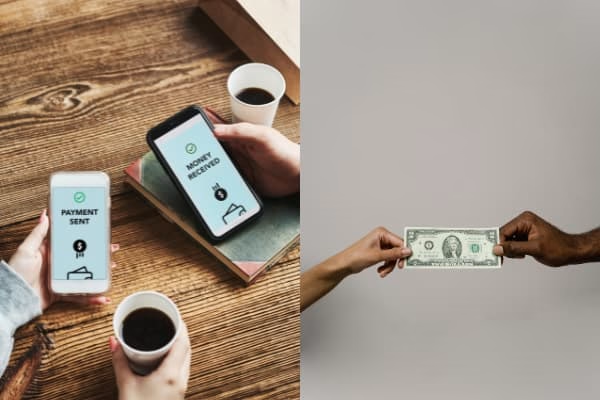
Main Differences Between Cross-Border Payments and Remittances
Knowing the difference between cross-border payments and remittances is important when sending money abroad. Though similar, they differ in purpose, process, and rules. Let’s look at these differences closely.
What Are Cross-Border Payments?
Cross-border payments are transfers of money between people or businesses in different countries. These payments usually cover goods, services, or international business transactions. Many companies, including those providing vehicle services, rely on timely cross-border payments to operate efficiently.
What Is Money Remittance?
Money remittance is when one person sends funds to another, either within the same country or internationally. It is mostly for personal reasons like helping family or paying for education. Services like money transfer make these transfers accessible and affordable.
What Are the Main Purposes of Cross-Border Payments and Remittances?
Cross-border payments are mainly used to transfer money between countries for business needs. For example, paying employees, suppliers, or partners in different countries. It can also include online purchases or payments to importers in export businesses.
Money remittance, however, is specifically for sending money between individuals. For example, sending money to friends or paying tuition fees for students studying abroad. Remittances focus on personal transfers rather than business transactions.
What Types of Payments Are Used for Cross-Border Payments and Remittances?
Cross-border payments are usually made through digital platforms like PayPal or wire transfers between countries. These methods are designed for fast and secure business transactions.
Remittances can be sent between individuals both within the same country and internationally. Common methods include cash, cheques, bank transfers, electronic money transfers, credit cards, and debit cards. This variety offers flexibility for personal money transfers. For instance, check cashing is often part of remittance services to provide quick access to funds.
KYC / ID requirement – Identity check: U.S. regulations require senders to present valid government photo ID; larger or business transactions may require additional documents (e.g., tax-ID or proof of funds). All parties are screened against U.S. sanctions lists before a transfer is approved.
How Are Cross-Border Payments and Remittances Regulated?
Cross-border payments are controlled by regulations set by the countries involved in the transaction. In the European Union, the Payment Services Directive (PSD2) sets rules for customer identification, record keeping, and reporting. Other countries have their own laws covering foreign exchange rates, international wire transfers, and sanction lists. These rules ensure secure and transparent payments.
Money remittances are regulated by the Financial Action Task Force (FATF), an intergovernmental agency. To fight money laundering, terrorism financing, and proliferation, all governments follow FATF Recommendations. These include adopting KYC guidelines, which require banks to verify customer identities. They also include anti-money laundering rules that monitor suspicious transactions. By following these measures, banks help prevent illegal activities using their services. These regulations protect the financial system and ensure that money flows safely between individuals and businesses worldwide.
You can find more about consumer rights and fraud prevention from the Consumer Financial Protection Bureau (CFPB) and the Federal Trade Commission (FTC).
Order Express consumer disclosure (given BEFORE you pay):
- Amount to be transferred
- Exchange rate that will apply
- All provider fees and taxes
- Exact amount your recipient will receive
A detailed receipt repeating this information – plus the promised delivery date – is provided immediately after payment, in accordance with 12 CFR §1005.31.
You may cancel a transfer within 30 minutes of payment and receive a full refund, provided the funds haven’t yet been picked up or deposited.
You have 180 days to report an error. Order Express will investigate and, if needed, refund or re-deliver the missing amount.
To cancel or report an error, contact us:
- 888-666-1602 (Customer Service)
- 312-235-5219 (Compliance)
- customer.service@orderexpress.com
- Mail: 685 W. Ohio St, Chicago IL 60654
How Long Do Cross-Border Payments and Remittances Take?
Cross-border payments sent through Order Express generally settle the same day or within three U.S. business days, depending on the destination country, payout method, and required compliance checks.
Processing-time statement – Cross-border payments sent through Order Express generally settle the same day or within three U.S. business days, depending on the destination country, payout method, and required compliance checks.
How Secure Are Cross-Border Payments Compared to Remittances?
Order Express applies the same KYC, OFAC sanctions screening, anti-fraud monitoring, and encrypted transmission standards to every transfer, whether it is a personal remittance or a business payment, so both are protected by identical security controls.
Both personal remittances and business cross-border payments processed by Order Express are protected by the same KYC checks, OFAC sanctions screening, encrypted transmission, and real-time fraud monitoring. Security depends on the provider’s controls, not on whether the payment is personal or business.
Need practical tips to protect yourself from fraud? Visit IdentityTheft.gov and StaySafeOnline.org for step-by-step guidance on safe online payments and identity protection.
How Much Money Is Sent in Cross-Border Payments vs. Remittances?
Cross-border payments can handle large transactions, making them ideal for business and high-value purchases.
Money remittances usually involve smaller amounts, used to support personal or household needs.
What Currency Is Used in Each?
Cross-border payments are often sent in the sender’s currency, with the receiver’s bank converting it.
Money remittances usually convert currency automatically, so the recipient gets local currency.
How Are Exchange Rates Applied?
Cross-border payments use exchange rates from the receiver’s country, which may reduce the amount received.
Money remittances apply the sender’s exchange rate, which can sometimes be more favorable.
For more on financial literacy and currency exchange, check resources like FDIC’s Money Smart and MyMoney.gov.
What Are Their Main Uses?
Cross-border payments serve both personal and business purposes, especially in international trade and e-commerce. Remittances focus on personal uses like sending money to family or paying tuition abroad.
Are Licenses Required?
Cross-border payment providers must follow financial laws and may need authorization, like in the EU.
Remittance services always require licensing, such as oversight by the UK’s FCA.
How Much Do They Cost?
Cross-border payments are usually more expensive, with fees for providers, exchange, and processing. Remittances often cost less, especially for smaller transfers, and some providers offer low or no fees.
Cross-border payments and money remittances are two key methods for transferring funds internationally. Both help individuals and businesses send money across the globe but serve different needs and situations.
We hope this detailed comparison has clarified the differences between cross-border payment and money remittances. Understanding their purpose, operation, uses, and efficiency helps you choose the right option for your specific needs.
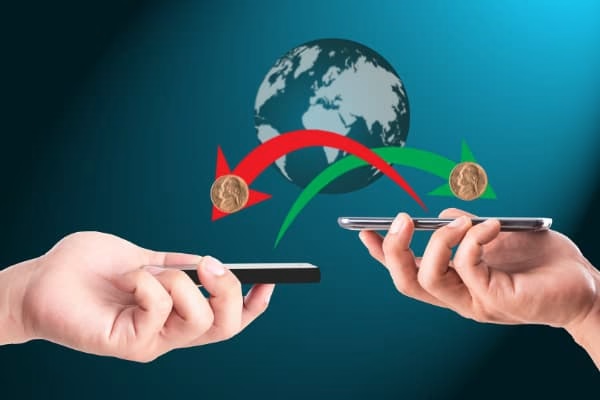
How New Technology Is Changing Cross-Border Payments and Remittances
Technology is quickly changing how money is sent across countries. Innovations like blockchain and cryptocurrencies make payments faster, cheaper, and safer. It uses a transparent, decentralized system that lowers fraud risks and speeds up processing.
Blockchain: Faster and Safer Payments
Blockchain provides a transparent, decentralized system that reduces fraud risks and speeds up payment processing.
Fintech: Easier Global Money Transfers
Fintech companies create digital wallets and apps that simplify sending and receiving money worldwide. These platforms usually charge lower fees than traditional banks, saving on remittance costs. Order Express is piloting select digital-asset payout corridors subject to the same KYC, OFAC, and state-licensing controls that apply to every other transfer. Please contact Customer Service to confirm availability and regulatory terms before initiating a transaction.
Disclaimer: Digital-asset payout corridors are currently in pilot testing, subject to regulatory approval and Board-approved marketing. Service is not yet generally available
Cryptocurrencies: New Currency Options
Cryptocurrencies give senders another settlement option. All digital-asset transfers handled by Order Express remain fully subject to U.S. Bank Secrecy Act rules, OFAC sanctions screening, and all relevant state money-transmitter licensing requirements.
AI and Machine Learning: Improved Security and Compliance
Artificial intelligence and machine learning help detect fraud and ensure regulatory compliance. Real-time tracking and instant notifications also boost user trust and convenience.
In summary, technology is removing obstacles in global payments. It offers faster, safer, and more transparent money transfers. Using these tools helps save time and cut costs for everyone.
Privacy Notice & Complaint Channel
Your privacy matters
Order Express protects customers’ non-public personal information in line with the Gramm-Leach-Bliley Act. We share data only when required to complete your transfer or comply with law.
Questions or complaints?
Call 888-666-1602 or email customer.service@orderexpress.com. Written complaints may be mailed to Compliance Dept., 685 W Ohio St, Chicago IL 60654.
Conclusion
Understanding the differences between cross-border payments and remittances empowers you to choose the best method for sending money abroad. Cross-border payments suit business needs and large transactions, while remittances focus on personal transfers like supporting family. Each has unique regulations, costs, and processing times to consider.
Embrace new technologies like blockchain and fintech platforms to enhance security, reduce fees, and speed up transfers. Stay informed about exchange rates and licensing requirements to avoid surprises.
Whether you are an individual or a business, knowing these distinctions helps you send money efficiently and safely across borders. Act now by selecting the right payment method that fits your purpose and leverage innovative solutions for smarter global money transfers. For additional services, contact us for assistance.
Frequently Asked Questions
What is the main difference between cross-border transactions and remittances?
These serve business or commercial needs between countries. Remittances are personal money transfers, usually sent to family or friends. It often involve larger amounts and formal agreements. Remittances are usually smaller and sent for emotional or household reasons. They differ in purpose, regulation, and processing method.
How long do cross-border payments and remittances take?
Cross-border payments sent through Order Express generally settle the same day or within three U.S. business days, depending on the destination country, payout method, and required compliance checks. Personal remittances often arrive within minutes or a few hours when cash-pickup or instant wallet credit is available. Delivery time ultimately depends on the service selected and any mandatory compliance review.
Are cross-border payments more expensive than remittances?
Usually have higher fees due to banks, currency conversion, and service costs. Business transactions often cost more. Remittances tend to be cheaper, especially for small transfers. Some services even offer fee-free options. Pricing depends on transfer method, destination, and exchange rates applied.
What security measures protect these money transfers?
Both cross-border business payment and personal remittances processed by Order Express undergo identical controls: customer identity verification, OFAC sanctions screening, encrypted transmission, and real-time fraud monitoring. Security depends on the provider’s safeguards, not on the payment’s purpose. See IdentityTheft.gov and StaySafeOnline.org for practical tips on staying safe online.
How is technology changing international money transfers?
Blockchain makes transfers faster and more transparent. Fintech apps simplify sending money globally. Cryptocurrencies reduce currency risks. AI detects fraud quickly. These tools improve speed, cost, and security for both remittances and cross-border payments.

John is a Content & SEO Specialist who enjoys breaking down complex financial topics, like cross-border payments and money transfers, into content that’s easy to understand. He focuses on creating practical, search-driven content that helps people find answers and make informed decisions.


