



Cross-border payment limits define how much money individuals or businesses can legally transfer between countries. These limits vary by country, provider, and financial regulations. In the U.S., large international transfers are regulated under laws like FATCA, the Electronic Fund Transfer Act (EFTA), and IRS reporting rules. Transfers over $10,000 typically trigger mandatory reporting. Exceeding $16,000 as a gift may also require a gift tax return. Providers may set daily or per-transaction limits to prevent fraud or ensure compliance. Understanding these thresholds helps avoid delays, extra fees, or legal issues. This guide from OrderExpress explains how cross-border payment limits work, who regulates them, and what steps you must take to stay compliant.
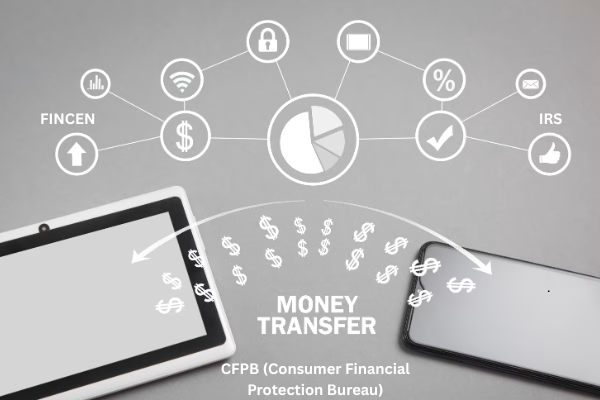
Who Regulates Cross-Border Payments in the U.S.?
When sending money internationally from the U.S., it’s important to know who oversees these transactions. Cross-border payments over $15 are regulated by the Consumer Financial Protection Bureau (CFPB). This federal agency works to ensure transparency and protect consumers during financial transactions.
The CFPB helps enforce rules that keep your international payments safe, fair, and clearly explained. If you’re sending money to family, paying bills, or handling business abroad, the CFPB ensures you’re treated fairly.
What Laws Apply to International Wire Transfers?
International wire transfers and other cross-border payments fall under the Electronic Fund Transfer Act (EFTA). First enacted in 1978, this law protects U.S. consumers when transferring money electronically.
The Foreign Account Tax Compliance Act (FATCA) also plays a role. FATCA requires U.S. taxpayers to report foreign financial accounts. If you’re sending large amounts overseas, your transaction may need to comply with FATCA reporting rules.
These laws help prevent fraud, increase security, and ensure you meet legal requirements when sending money abroad. At OrderExpress, we help guide you through the process so your cross-border payments are fast, safe, and compliant. Learn more about our money transfer services to stay secure and compliant.
Is There a Limit on Cross-Border Wire Transfers?
There is no statutory cap on how much money you can send through a wire transfer. However, financial institutions are required to comply with federal reporting thresholds such as $3,000 and $10,000. These thresholds may trigger additional documentation or verification procedures. Be aware that structuring transactions to avoid these thresholds is illegal and could result in a Suspicious Activity Report (SAR) being filed.
This includes one-time transfers or multiple related transfers that total $10,000 or more. Deliberately breaking up transactions to stay below this threshold is called structuring and is illegal; it may lead to a Suspicious Activity Report (SAR) being filed.
A Money services business (MSB) allows you to send cross-border payments securely and in compliance with financial regulations. Providers must set transaction limits in compliance with federal financial regulations, including BSA/AML obligations. Limits may vary depending on your transaction history, destination country, and the required verification documents.
Always check with your provider to understand the maximum amount you can send and what steps are needed for larger transfers. For certain services like vehicle title transfers, additional verification may be necessary.
How Much Can You Send Without IRS Reporting?
Cross-border payments of $10,000 or more are subject to IRS reporting under U.S. law. This includes one-time transfers or related multiple transfers that total $10,000 or more within a business day. The bank or money transfer service, not the sender, usually handles this reporting through a Currency Transaction Report (CTR) in compliance with anti-money laundering regulations. Ensure that all necessary documentation, such as identification and the source of funds, is provided to facilitate the reporting process.
These rules help prevent illegal activities like money laundering and fraud. If you’re sending a large amount internationally, be prepared to provide identification and possibly explain the source and purpose of the funds.
At OrderExpress, we help ensure your international transfers stay compliant, secure, and fast, no matter the amount. You can also explore additional support through our courier services when documentation or delivery is needed abroad.
What Happens When You Send Over $10,000 Internationally?
If you send more than $10,000 in a cross-border payment, U.S. financial institutions must report the transaction to the IRS. The report is sent through a form called the Currency Transaction Report (CTR) or may be part of a broader Suspicious Activity Report (SAR). Additional documentation may be required to verify the source and purpose of the funds, including proof of income or tax records.
Your bank or payment provider like OrderExpress, may also ask for more details before completing the transfer. This is part of standard compliance and risk management practices.
You might need to provide:
- Proof of where the funds came from (such as a paycheck or sale receipt)
- General proof of income or wealth, like a tax return or bank statement
- Recipient information, including government-issued ID
- A clear reason for the transfer, such as family support or business payments
These steps are meant to protect your funds and keep your transfer secure. Attempting to avoid these reporting obligations through multiple smaller transfers may be considered structuring and could result in regulatory action. For digital currency transfers, you can also check our Bitcoin service, which follows strict compliance protocols. Please note that virtual currency services are subject to separate FinCEN guidelines, and providers must be properly registered and compliant with all BSA obligations.

What’s the Best Way to Send Money Internationally?
Banks are one option for cross-border payments but they often come with high fees, slow processing times, and limited flexibility. If you’re looking for a faster, more cost-effective solution, there’s a better way.
OrderExpress offers a reliable and secure way to send money internationally. Our services are designed for speed, simplicity, and affordability. Make sure you read and understand all terms before proceeding with the transfer to ensure a smooth transaction process. Whether you’re supporting family or paying expenses abroad, we make cross-border transfers easy.
You can send money directly to trusted destinations with low fees and transparent exchange rates. Payments are processed quickly, and security is our top priority. Every transfer is protected by advanced encryption and backed by financial regulations, including OFAC sanctions screening.
With OrderExpress, there’s no need to visit a bank or wait in long lines. You can send money conveniently from any participating location, and our team is here to help every step of the way. Need to travel too? Check out our plane ticket services for reliable bookings.
Bank vs. OrderExpress: What’s the Better Way to Send Money Internationally?
| Feature | Traditional Banks | OrderExpress |
| Transfer Speed | 3–5 business days | Fast processing, often same day |
| Fees | High and unpredictable. Fees may vary and additional fees could be applied depending on the bank’s internal policies and external factors. | Low, transparent fees. Transaction fees are displayed clearly at the point of transfer. Any additional charges are communicated prior to payment processing. |
| Exchange Rates | Marked-up, less favorable | Competitive, market-based rates |
| Convenience | In-person visits often required | Send from participating locations |
| Compliance & Security | Regulated but rigid | Fully compliant with U.S. and global laws |
| Customer Support | Limited availability | Friendly, bilingual support available |
| Flexibility | Few destination options | Reliable cross-border coverage |
| Ease of Use | Complex processes | Simple, straightforward transactions |
Do You Have to Pay Taxes on International Wire Transfers?
In most cases, sending money internationally doesn’t trigger taxes right away. But some cross-border payments can lead to IRS tax reporting, depending on the amount and purpose of the transfer.
If you send more than $16,000 as a gift to someone outside the U.S., the IRS may consider it a taxable gift. This applies even if you’re sending money to friends or family abroad. The person receiving the funds doesn’t pay tax but you may need to file a gift tax return (Form 709). Consult with a tax advisor to ensure compliance with IRS gift tax regulations, as the rules may vary depending on individual circumstances.
However, if you’re sending money to your own foreign account, that transfer usually isn’t taxed. Still, you may need to report that account to the IRS or under FATCA regulations if it exceeds certain limits. For U.S. taxpayers holding foreign accounts over $10,000, you may need to file the FBAR (Foreign Bank and Financial Accounts Report) in addition to FATCA forms.
For business-related cross-border payments, tax rules can be more complex. Sending large sums for international business purposes may trigger different reporting requirements or tax obligations.
Because every situation is unique, it’s smart to speak with a qualified tax advisor before making large international transfers. OrderExpress helps ensure your cross-border payments are smooth, secure, and meet U.S. financial laws. For tax-related concerns, it is recommended to consult a licensed tax advisor.
What Is the Foreign Account Tax Compliance Act (FATCA)?
FATCA, or the Foreign Account Tax Compliance Act, is a U.S. law designed to track foreign financial assets held by U.S. taxpayers. It works alongside the Electronic Fund Transfer Act (EFTA) to ensure transparency in international financial activity.
Under FATCA, foreign financial institutions must report details of U.S. account holders to the IRS. This helps the U.S. government detect unreported income and overseas assets.
If you’re a U.S. taxpayer and hold foreign financial assets worth $50,000 or more, you must report them on your tax return. This includes balances across all foreign accounts. The required form is Form 8938, and it must be filed with your annual IRS tax return. Ensure that all necessary paperwork is completed for FATCA compliance to avoid any delays in your transfer.
TIP: How does this affect cross-border payments?
If you regularly send money to a foreign account in your own name, you may trigger FATCA reporting once your total foreign assets exceed $50,000. It doesn’t matter how the money gets there, what matters is the total value held abroad.
OrderExpress ensures your cross-border payments follow U.S. financial laws. If you need additional help managing your finances, tools like FDIC Money Smart and Youth Finance USA can offer valuable guidance.

What Are My Rights When Sending Money Internationally?
When you send money across borders, you’re protected by U.S. law. The Consumer Financial Protection Bureau ensures you get clear, fair treatment from banks and money transfer providers.
One of your main rights is price transparency. Before you confirm a cross-border payment, the provider must show you:
- The exchange rate
- All fees and taxes
- The total amount your recipient will receive
Ensure that the final receipt reflects all agreed-upon details, including the exact exchange rate and applicable fees.
You also have the right to:
- Know when the money will arrive
- Cancel the transfer within a certain time
- Report and resolve errors or delays
- Submit a formal complaint if something goes wrong
At OrderExpress, we follow these consumer protection rules closely. For underserved communities, financial literacy resources from groups like UnidosUS and JumpStart Coalition may also be helpful.
What Happens If You Don’t Disclose Foreign Accounts?
Failing to report your foreign accounts under FATCA regulations can lead to serious penalties. If you’re a U.S. taxpayer with foreign financial assets over $50,000, you must disclose them to the IRS using Form 8938. Non-compliance with these reporting obligations can result in significant fines, as outlined by the IRS.
If you don’t comply, the IRS may impose penalties starting at $10,000. Continued failure to report can lead to additional fines, reaching up to $50,000 or more. In some cases, criminal charges may also apply for willful violations.
Even if the money in your foreign account comes from legal sources such as cross-border payments or personal savings, you must still report it once it exceeds the threshold.
OrderExpress makes sending money across borders easy and compliant. To learn more about our range of services, including check cashing and other financial tools, explore our website.
Conclusion
Cross-border payments can be fast, safe, and hassle-free, when you understand the rules. From transfer limits to FATCA compliance, staying informed helps avoid delays, extra fees, or penalties. Whether you’re sending funds for personal reasons or business needs, knowing your rights and legal responsibilities makes every transfer smoother. OrderExpress gives you the tools, support, and transparency to make international payments with confidence. Our secure services are backed by regulatory compliance, competitive rates, and easy-to-follow processes. You don’t need to guess or worry, we make sure every cross-border payment stays compliant and protected. From small remittances to large wire transfers, our goal is to keep your money moving securely. Trust OrderExpress for fast, reliable, and compliant cross-border payment solutions.
Frequently Asked Questions (FAQs)
1. Is there a maximum amount I can send internationally with OrderExpress?
There’s no legal maximum, but providers may have daily or monthly limits. These limits vary based on destination and ID verification. For large transfers, OrderExpress may require extra documentation to meet security and compliance rules.
2. What documents do I need for a large cross-border transfer?
You may need proof of income or source of funds. This could include tax forms, pay stubs, or sales records. You’ll also need a valid ID and the recipient’s identification for added verification.
3. Will the IRS be notified if I send money overseas?
Yes, if you send $10,000 or more, the provider must report it. This includes one-time or related multiple transfers. The reporting is handled by the provider and not the sender, to meet federal requirements.
4. Can I cancel an international payment after it’s sent?
You have a short window to cancel before processing starts. The CFPB gives you the right to request cancellation. If there’s an issue, OrderExpress can help resolve it or guide you through next steps.
5. Do I need to pay taxes on money I send abroad?
Not always, but some transfers can trigger tax obligations. Gifts over $16,000 may require you to file Form 709. Business transfers and foreign accounts over $50,000 may also need to be reported under FATCA. It is recommended to consult with a qualified tax advisor for further clarification on tax liabilities related to international wire transfers.

John is a Content & SEO Specialist who enjoys breaking down complex financial topics, like cross-border payments and money transfers, into content that’s easy to understand. He focuses on creating practical, search-driven content that helps people find answers and make informed decisions.


