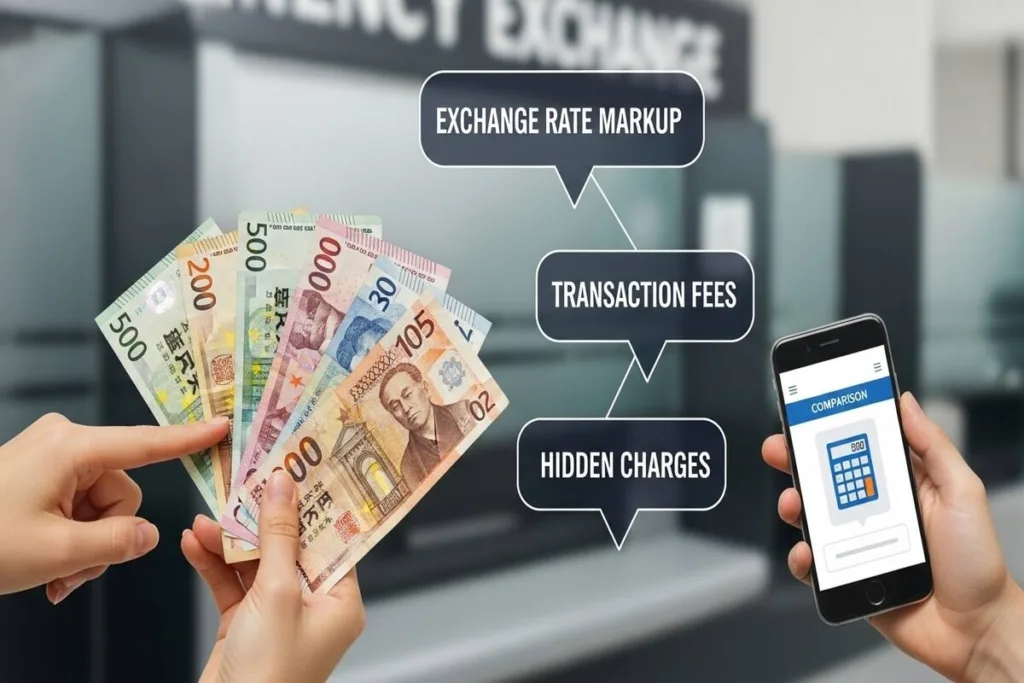
You should compare total transaction fees and embedded rate margins before exchanging currency. These two cost drivers directly determine how much value you receive from your transaction.
Consumers often focus only on visible service charges, but pricing structures that are not immediately visible can reduce the final amount received. Understanding both transparent fees and exchange rate markups helps you protect value before completing any transfer.
This focused guide supports broader retail currency exchange guidance outlined in Understanding Currency Exchange Services For Consumers and concentrates strictly on fee comparison before transacting.
We believe in transparent pricing with no hidden fees.
Understand The True Cost Structure Of Currency Exchange
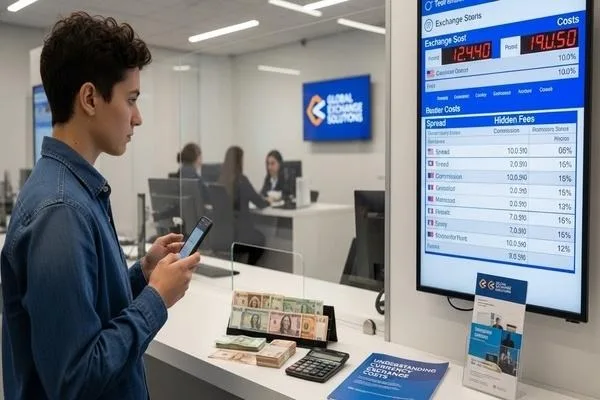
Transparent pricing plays a central role in evaluating any currency exchange transaction before committing funds. While providers disclose certain charges, consumers may underestimate how service, funding and payout fees combine to reduce the final converted amount. A careful review of these visible costs helps you measure real transaction value, compare providers more accurately and avoid preventable deductions that impact your overall settlement outcome. When reviewing available currency exchange services, understanding how each fee category applies strengthens your ability to evaluate total cost.
Example: How fees affect a $1,000 transfer. Providers are required to disclose applicable fees and exchange rates before completing a transaction.
Consumers should review the total cost, including fees and exchange rate margins, as required under applicable money transmission regulations.
Service Or Processing Fees
Service or processing fees represent fixed or variable charges applied to execute the exchange transaction. Providers may structure these fees as flat amounts or percentage-based costs.
A flat fee reduces smaller transactions proportionally more than larger transfers. Percentage-based fees scale with transaction size and may increase total cost significantly.
Payment Method And Funding Fees
Payment method fees depend on how you fund or receive your exchange transaction. Different funding sources carry different processing costs that providers often pass to consumers.
For example, credit card funding typically incurs higher fees than bank transfers. Debit cards and digital wallets may include intermediary processing charges.
When comparing providers, confirm whether they charge additional fees for:
- Credit or debit card payments
- Same-day bank processing
- Receiving funds into certain account types
Even small payment-related fees can materially affect net proceeds in frequent transactions. Consumers seeking in-person assistance can also verify funding costs directly at nearby branch locations before completing their exchange.
Delivery Or Payout-Related Fees
Delivery fees apply when the provider sends converted funds to another institution or payout channel. These fees often vary based on destination, urgency or payout method.
Bank deposits may involve intermediary banking charges during cross-border settlement. Cash pickup or expedited delivery options frequently include additional service costs.
Always confirm whether payout fees appear separately or remain bundled into another pricing component. Clear breakdowns improve comparability between competing exchange services.
How Exchange Rate Margins Impact Your Currency Exchange Costs
In currency exchange, the rate you see often includes a built-in margin that quietly increases your total cost. This margin reflects the difference between the interbank rate and the provider’s offered rate, and it frequently outweighs visible service fees. Even small variations between benchmark rates and quoted prices can meaningfully reduce the final amount you receive. Understanding how providers structure spreads, adjust pricing and apply promotional rates helps you identify the true cost of your transaction before committing funds. Authoritative benchmark data such as the Federal Reserve’s H.10 exchange rate releases can help consumers reference publicly available rate information.
Interbank Rate Versus Offered Rate
The interbank rate reflects the wholesale currency price used between major financial institutions. Consumer exchange services apply their own pricing margin before presenting a rate to customers.
This margin generates revenue while appearing less visible than listed service fees. Comparing the offered rate against the live interbank benchmark reveals the embedded cost. Consumers may also review broader policy analysis from the U.S. Treasury’s exchange rate analysis for contextual market insight.
To calculate the margin:
- Identify the current interbank rate from a reliable financial data source
- Compare it with the rate quoted by the provider
- Measure the percentage difference between both rates
Spread Width And Its Transaction Impact
The spread refers to the difference between the provider’s buy and sell rates. A wider spread increases hidden costs for both currency purchases and sales. Exchange pricing may vary based on currency volatility, liquidity and transaction size. Exotic or thinly traded currencies typically carry wider spreads than major pairs.
Even a one percent spread difference can significantly affect larger transfers. Always evaluate total received value rather than relying solely on marketing claims. Financial institutions must maintain compliance frameworks under federal laws such as the Anti-Money Laundering Act of 2020, which governs institutional obligations rather than customer requirements.
Promotional Pricing Versus Standard Pricing
Some providers advertise promotional exchange rates for limited periods or specific transaction sizes. These temporary rates may not reflect standard pricing structures.
Consumers should confirm whether the quoted rate applies consistently beyond introductory conditions and understand how pricing may change over time. Hidden reversion to wider spreads can increase long-term exchange costs. Promotional language should never replace a full cost comparison. Consumers seeking broader financial education resources can consult the FDIC’s Money Smart program for general consumer guidance.
Key Takeaways
- You should compare both transparent transaction fees and embedded exchange rate margins before exchanging currency.
- Service, payment and payout fees directly reduce the converted amount you ultimately receive.
- The exchange rate margin often represents the largest hidden cost in currency exchange transactions.
- Even small differences in spreads or percentage fees can significantly impact total settlement value.
- Evaluating total received value provides a clearer cost comparison than focusing only on advertised fees.
Conclusion
Comparing fees before exchanging currency requires evaluating two core mechanisms: transparent transaction charges and embedded exchange rate margins. Service, payment and payout fees reduce value immediately, while rate spreads quietly affect total settlement amounts. Even small percentage differences can significantly impact everyday cross-border payments. Consumers who review both pricing layers protect more of their money during each transaction. Always compare total received value rather than relying on advertised fee structures alone. A careful review today helps you make more informed exchange decisions tomorrow.
Review your next exchange quote carefully and complete your transaction with full pricing clarity today.
Disclaimer: This article provides general informational guidance only and does not constitute financial advice. Exchange pricing, fees and availability vary by provider and transaction type. Customers should review the specific terms provided at the time of their transaction.
FAQs
Are zero-fee exchanges actually free?
No. Providers often apply wider exchange rate margins to compensate for zero visible fees, increasing the overall transaction cost.
How can I quickly compare exchange rate margins?
Check the live interbank rate, compare it to the quoted rate and calculate the percentage difference between both figures.
Do payment methods affect exchange costs?
Yes. Credit cards, expedited bank transfers and certain wallets often carry higher processing fees than standard bank transfers.
Is a flat fee better than a percentage fee?
It depends on transaction size. Flat fees favor larger transfers, while percentage fees may cost less for smaller amounts.
Should I focus more on fees or exchange rates?
You should evaluate both together, since total cost combines visible transaction fees and embedded exchange rate margins.
Order Express operates as a licensed Money Services Business (MSB) in the United States.

John is a Content & SEO Specialist who enjoys breaking down complex financial topics, like cross-border payments and money transfers, into content that’s easy to understand. He focuses on creating practical, search-driven content that helps people find answers and make informed decisions.