


When selecting a cross-border payment solution, businesses and individuals must consider cost, speed, security, currency support, and regulatory compliance. The right provider can help reduce fees, avoid delays, and streamline international transactions across multiple regions. From B2B and SaaS billing to global e-commerce, choosing the right platform involves comparing payment methods, exchange rates, settlement times, and fraud prevention tools. This guide explains how cross-border payments work, highlights the main challenges, and compares top money transfer solutions, helping you choose the most efficient and scalable option for your global payment needs.
Important Compliance Note: Businesses operating as cross-border payment providers, also known as Money Services Businesses (MSBs), must register with the Financial Crimes Enforcement Network (FinCEN) and implement an Anti-Money Laundering (AML) program. This includes mandatory filing of Currency Transaction Reports (CTR) for cash transactions over $10,000 in a single business day, including any fees or commissions, whether as one transaction or several aggregated transactions. CTRs must be filed within 15 calendar days of the transaction date. Providers must also file Suspicious Activity Reports (SAR) for any suspicious transactions of $2,000 or more, and these SARs must be submitted within 30 calendar days of detecting the activity. Both CTRs and SARs must be filed electronically through FinCEN’s BSA E-Filing system. Deliberately splitting transactions to stay below the reporting thresholds is called structuring and is illegal. Consumers and businesses should verify that their providers meet these legal requirements.

What Are Cross-Border Payment Solutions?
At its core, a cross-border payment solution is a platform or service that enables financial transactions between parties in different countries. Unlike domestic transactions, cross-border payments involve additional complexities such as currency exchange, different banking networks, and compliance with international financial regulations.
Why Are Cross-Border Payments Important?
With global trade and online commerce expanding rapidly, companies and individuals require efficient ways to move money across borders. According to recent reports, the global cross-border payments market is expected to exceed $200 trillion by 2027, driven by growing e-commerce, outsourcing, and international investments.
How Do Cross-Border Payments Work?
Cross-border payments typically involve several steps:
- Initiation: A payer instructs their bank or payment provider to send funds internationally.
- Currency Conversion: If the sender’s and recipient’s currencies differ, the payment must be converted, often at a cost.
- Routing: Funds move through intermediary banks or payment networks such as SWIFT.
- Settlement: The recipient’s bank credits the funds to the beneficiary’s account.
Each step introduces potential fees, delays, and risks.
Types of Cross-Border Payments
Cross-border payments vary widely depending on who is paying whom and the nature of the transaction. Understanding these distinctions helps in choosing a provider that fits your specific scenario.
1. Business-to-Business (B2B) Payments
These are payments between two companies, such as manufacturers paying suppliers or importers paying exporters. B2B payments often involve large sums and require strong security, compliance checks, and sometimes financing options like trade credit.
2. Consumer-to-Business (C2B) Payments
This type covers customers paying international companies for goods or services — common in e-commerce, subscription services, and digital goods. It’s crucial for providers to support diverse payment methods favored in various regions.
3. Software as a Service (SaaS) Payments
Many SaaS companies receive recurring payments from global clients, necessitating solutions that support subscriptions and multi-currency billing.
4. Wholesale vs. Retail Payments
Wholesale payments generally involve high-value transactions between financial institutions or large corporations, often subject to stricter financial regulations.
Retail payments are smaller, more frequent payments from individuals or small businesses, often facilitated through services like money transfers.
Common Challenges in Cross-Border Payments
Despite advances, cross-border payments still pose significant challenges that businesses must navigate carefully.
1. High Costs and Hidden Fees
- Currency conversion margins: Many providers add a markup over the mid-market exchange rate.
- Intermediary fees: Payments often pass through multiple correspondent banks, each taking a cut.
- Receiving fees: Some banks charge to receive international payments.
- Setup and cancellation fees: Some payment gateways have additional charges that add up.
Understanding these costs helps avoid issues and supports better budgeting, especially for underserved communities.
2. Slow Payment Processing
Traditional international bank transfers can take 1 to 5 business days or more, delaying cash flow and complicating financial management. This lag is often due to time zone differences, banking holidays, and manual compliance reviews. Businesses can mitigate delays by using services offering real-time payment status updates and modern infrastructure.
3. Complex Compliance Requirements
Countries impose regulations to prevent fraud, money laundering, and terrorism financing. Providers must comply with anti-money laundering (AML) and Know Your Customer (KYC) regulations, which can slow down payments and increase paperwork. Some firms are adopting automated KYC solutions powered by AI to speed up onboarding.
Providers must also comply with the Bank Secrecy Act, the USA PATRIOT Act, and OFAC regulations. This includes maintaining a formal AML compliance program, training employees and agents, submitting CTRs for cash transactions over $10,000 aggregated within one business day, including any fees or commissions, and filing each CTR within 15 calendar days of the transaction, and filing SARs for suspicious transactions of $2,000 or more within 30 calendar days of detection; both reports must be transmitted through FinCEN’s BSA E-Filing system. Failure to meet these requirements may result in enforcement actions, fines, or criminal penalties.
4. Limited Payment Options
Not all providers support the preferred payment methods in every country. For example, credit card penetration varies widely, and in some regions, mobile wallets or local bank transfers dominate. Services like courier-assisted bill payment can offer alternative options in niche cases.
5. Security and Fraud Risks
Cross-border payments expose businesses to risks such as fraud, identity theft, and phishing attacks. Ensuring data protection and transaction security is paramount.
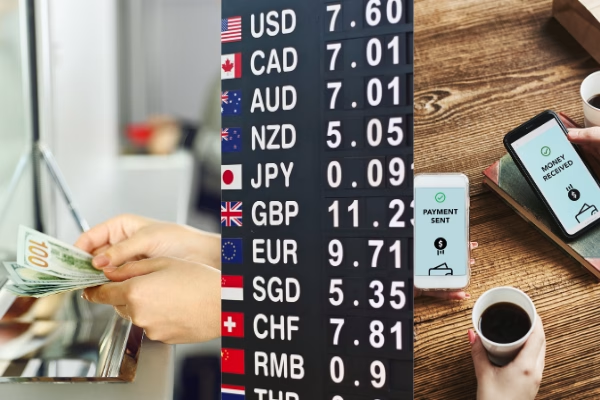
How to Choose the Best Cross-Border Payment Solution
Selecting the right payment solution depends on balancing cost, speed, reliability, and compliance. Here’s a detailed checklist to evaluate your options:
1. Range of Supported Payment Methods
- Does the provider support bank transfers, cards, wallets, and mobile payments?
- Can you accept payments in local payment methods favored by your customers?
2. Currency Coverage and Exchange Rates
- How many currencies does the provider support?
- Are the exchange rates competitive and transparent?
- Does the platform offer multi-currency wallets to hold funds in different currencies?
3. Cost Structure
- Understand the total cost, including transaction fees, exchange rate margins, setup costs, and cancellation penalties.
- Are there tiered pricing plans that reduce costs for high-volume users?
4. Settlement Times
- How quickly are funds credited to your account?
- Does the provider offer real-time or near-instant payments in some corridors?
5. Customer Service and Support
- Is support available 24/7 or during your business hours?
- Are multilingual support options available, especially for global customers?
6. Security and Compliance
- Does the provider comply with international standards such as PCI DSS?
- What fraud prevention and dispute resolution mechanisms are in place?
- Is the provider registered with FinCEN as a Money Services Business (MSB)?
- Do they have a written AML program in place, including employee training and internal controls?
- Do they file required reports, including CTRs and SARs, through the BSA E-Filing System?
7. Integration and Reporting
- Can the payment solution integrate with your existing accounting, ERP, or e-commerce platform?
- Does it provide detailed financial reporting for reconciliation, tax filings, and audits?
Why Choose Modern Solutions Like Order Express?
Modern fintech companies have transformed cross-border payments by addressing traditional pain points.
- Integrates payment and logistics solutions to help e-commerce merchants streamline both payment and delivery.
- Supports multiple payment options and currencies.
- Offers tools to optimize shipping and customs clearance, reducing delays and unexpected costs.
- Provides a unified platform to manage international orders and payments seamlessly.

Additional Factors to Consider for Cross-Border Payments
Integration with Business Workflows
Efficient payments are not just about the transaction—they must fit into your broader business systems. Look for solutions that offer:
- API access for custom integration.
- Automated reconciliation with accounting software.
- Subscription management for recurring payments.
Transparency and Real-Time Tracking
Customers and businesses alike benefit from visibility:
- Real-time payment status updates.
- Notifications for payment confirmations or failures.
- Transparent fee breakdowns upfront.
Multi-Language and Regional Support
Providing a localized experience can improve customer trust and payment success rates. Choose providers offering support in multiple languages and tailored interfaces for different regions.
The Impact of Emerging Technologies on Cross-Border Payments
Real-Time Payment Networks
Payment infrastructures like SWIFT gpi are reducing settlement times drastically. Some countries have launched instant payment schemes allowing cross-border transfers within seconds, enhancing liquidity and customer experience.
Blockchain and Digital Currencies
While still maturing, blockchain technology offers:
- Faster settlements by removing intermediaries.
- Lower costs due to reduced reliance on correspondent banks.
- Increased transparency with immutable ledgers.
Several startups and banks are piloting blockchain-based systems for cross-border payments, and cryptocurrencies are being explored as alternative payment rails.
Artificial Intelligence and Automation
AI-driven fraud detection and automated KYC processes are improving security and compliance, without slowing down payments. These technologies help reduce operational costs and improve scalability.
Tips for Customers to Optimize Cross-Border Payments
- Plan transfers around exchange rate fluctuations: Use tools that let you lock in favorable rates.
- Verify recipient details carefully: Mistakes can cause delays or lost funds.
- Use local currency billing where possible: This avoids multiple currency conversions.
- Choose providers with transparent pricing: Avoid surprises from hidden fees.
- Leverage payment tracking features: This helps manage cash flow and resolve issues promptly.
- Understand your provider’s dispute resolution process: In case of fraudulent or failed transactions.
Conclusion
Choosing the right cross-border payment solution requires more than comparing fees—it demands a strategic evaluation of speed, security, compliance, and scalability. In an era of digital-first commerce, your provider should offer more than just transactions; they must integrate seamlessly with your systems, support local preferences, and provide real-time insights. Whether you’re running a global SaaS platform or sourcing goods internationally, the right solution empowers you to save costs, reduce delays, and deliver better experiences. Fintech innovators like GoCardless and OrderExpress lead this transformation, offering efficient, transparent, and tech-driven alternatives to outdated systems. Don’t settle for one-size-fits-all. Assess your needs, map them to modern capabilities, and take control of your international payments with confidence and clarity.
FAQs
1. What are cross-border payment solutions and why do they matter?
Cross-border payment solutions enable individuals and businesses to send money internationally. They manage currency conversion, compliance, and fund transfers. These services are essential for global trade, online businesses, and remote work. Without them, international payments would be slower, more expensive, and less secure.
2. What hidden costs should I watch for in cross-border payments?
Beware of currency conversion markups above mid-market rates. Intermediary banks may charge routing fees, and receiving banks might deduct handling charges. Some providers add setup, maintenance, or cancellation fees. Always review the full cost per transaction, not just the headline rate.
3. How can I reduce delays in international payment processing?
Choose providers with real-time tracking and modern infrastructure. Avoid sending around global holidays or weekends. Select services with strong regional payout networks. Automate compliance checks when possible to improve speed and customer satisfaction.
4. What features should I prioritize when choosing a provider?
Look for wide currency coverage, low exchange margins, and local payment method support. Ensure integration with your systems, clear pricing, strong security, and 24/7 multilingual customer service.
5. How do I know if a provider complies with AML regulations?
Ensure the provider is registered as an MSB with FinCEN, has a robust AML program, verifies identities, files SARs/CTRs, and follows KYC rules. If this isn’t clearly stated, request documentation before proceeding.

John is a Content & SEO Specialist who enjoys breaking down complex financial topics, like cross-border payments and money transfers, into content that’s easy to understand. He focuses on creating practical, search-driven content that helps people find answers and make informed decisions.


