 Skip to content



Banks may refuse to cash non-bank money orders due to verification limits, compliance rules, and fraud-prevention policies. These refusals protect financial institutions from counterfeit or altered instruments and ensure compliance with federal reporting standards under the Bank Secrecy Act (BSA) and FinCEN guidance. Customers who receive non-bank money orders should verify authenticity through a licensed money transfer provider. As a licensed Money Services Business (MSB) registered with FinCEN, Order Express operates a secure, compliant system for money order issuance and tracking.
This verification process helps prevent fraud, supports compliance with applicable laws, and ensures that funds are transferred safely and securely. Order Express maintains its own internal compliance program consistent with federal standards but separate from the regulations governing banks.

Understanding Why Banks May Refuse A Money Order
Banks and credit unions operate under strict regulatory and compliance frameworks. These policies affect how and when they cash certain financial instruments. Customers often find that while a money order is valid, their bank may not cash it immediately or at all.
Risk Management And Fraud Prevention
Banks must protect themselves from counterfeit or altered instruments. Non-bank money orders, issued by licensed financial service providers like Order Express can be targets for fraud attempts if presented at institutions unfamiliar with the issuer. To comply with federal anti-fraud and reporting standards, banks must verify authenticity before releasing funds.
Under the Bank Secrecy Act (BSA) and anti-money laundering (AML) rules, financial institutions must assess the source of funds and confirm the legitimacy of the transaction. This process helps prevent money laundering, structuring, and identity theft. Banks often choose to limit which issuers they accept to manage this risk more efficiently. These decisions stem from internal policy, not from federal laws about money orders. Order Express operates under its own regulated program for money order issuance and verification, which differs from the compliance standards that apply to banks.
As explained in the FinCEN Guidance for Money Services Businesses, institutions must maintain programs that identify and mitigate financial-crime risk.
Verification And Compliance Challenges
Each licensed money-order issuer maintains a unique verification network. If a bank lacks direct access to an issuer’s system, it cannot confirm whether the money order is genuine or already cashed. This creates uncertainty for both the bank and the customer.
Financial institutions must comply with 31 CFR § 1022.210 Customer Identification Program, which outlines requirements for verifying customer identity and transaction sources. When a verification connection does not exist, banks often decline to cash non-bank-issued money orders. This is a compliance safeguard designed to prevent financial crimes, not a reflection on the legitimacy of the money order itself. While banks must comply with federal identity-verification standards, Order Express follows comparable verification processes tailored to money service businesses.
Learn more about secure money transfer services available through Order Express for verified transactions.
Institutional Policy And Discretion
Federal law does not require any financial institution to cash a money order. Instead, each bank sets its own risk policies based on internal compliance programs and state-level regulations. Some banks choose to process only their own money orders or those issued by a partner institution. Others require the customer to hold an account before cashing. These choices reflect risk tolerance and operational security preferences, not rejection of the money order as a valid payment tool.
Banks follow oversight guidance such as the FFIEC BSA/AML Manual Appendix H to design institution-specific controls.
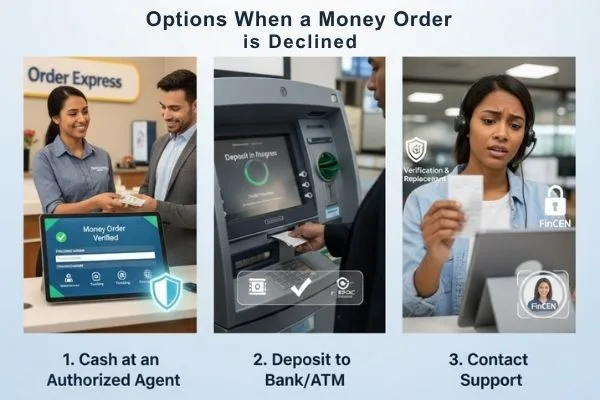
What Customers Can Do When A Money Order Is Declined
Customers have several compliant and secure options when a bank declines a money order. Understanding these options helps ensure smooth and successful transactions.
1. Cash The Money Order At An Authorized Location
If your bank refuses to cash a money order, visit an authorized Order Express location or participating retailer. These locations have access to the issuer’s verification system and can process your payment securely. Each money order carries a unique tracking number, allowing the issuer to confirm authenticity and payment status in real time.
You can find details on check cashing options and authorized partners directly through Order Express.
Authorized providers like Order Express follow strict Know Your Customer (KYC) and anti-money-laundering (AML) standards consistent with the USA PATRIOT Act and FinCEN AML Act of 2020. This ensures all transactions remain compliant with federal law while protecting both senders and recipients from fraud.
2. Deposit It Into Your Own Bank Account
If your financial institution will not cash a money order, you can usually deposit it into your personal account. Once deposited, the bank verifies the funds through standard clearing processes. This option may take longer but ensures full traceability and security. Always confirm your bank’s policy before deposit to avoid delays.
The FDIC Consumer Resource Center provides consumer guidance on funds availability and check-clearing rules.
Keep your money order receipt until the payment fully clears. This serves as proof of purchase and allows the issuer to investigate any issues. Order Express customers can explore additional other services such as bill payments and prepaid options for greater convenience.
3. Request Verification Or Replacement
If you suspect a money order may have been altered or lost, contact Order Express customer support immediately. Provide the serial number and purchase details for verification. The company can confirm whether it has been cashed or issue a replacement once investigation confirms validity. This process adheres to FinCEN and federal consumer protection requirements for secure and transparent transactions.
For reference, institutions must also comply with 31 CFR § 1022.320 Suspicious Activity Reporting when reporting suspected misuse.
Banks that reject non-bank-issued money orders often do so to avoid handling instruments they cannot verify directly. By working with the original issuer, you ensure that your funds are handled within regulated and compliant channels.
Why Financial Institutions And Order Express Follow Different Rules
It’s important for customers to understand that Order Express and traditional banks serve different functions in the financial system. Both are regulated, but they follow different sections of federal law. Federal banking laws apply to deposit institutions, while Order Express follows money services business regulations enforced by FinCEN and state financial authorities.
Order Express As A Licensed Money Services Business (MSB)
Order Express operates as a Money Services Business, registered with FinCEN and compliant with state and federal money transmission laws. The company issues and processes money orders under its own compliance program, which includes transaction monitoring, OFAC screening, and AML/KYC verification. These safeguards ensure every money order issued through Order Express is secure and traceable.
The company’s policies are designed to protect customers, prevent misuse, and maintain transparency. Order Express meets the obligations outlined in the BSA-AML Corporate Compliance Manual (v25.1) and regularly updates procedures to align with regulatory changes.
To learn more about the company’s mission and compliance approach, visit the About Us page.
OFAC expectations are described in the U.S. Treasury OFAC Compliance Framework, which all MSBs must consider when screening transactions. These are federal obligations, and Order Express integrates them into its internal screening process as part of its own compliance program.
When suspicious or potentially fraudulent activity continues over time, Order Express follows FinCEN’s continuing-activity reporting guidance by reviewing and, if necessary, refiling Suspicious Activity Reports every 90 to 120 days.
This ensures that ongoing risks are monitored and reported promptly, consistent with FinCEN SAR Activity Review Issue #21.
Banks’ Regulatory Obligations
Banks operate under broader federal oversight through agencies such as the Federal Deposit Insurance Corporation (FDIC) and the Office of the Comptroller of the Currency (OCC). They must comply with federal rules such as 31 CFR § 1010.311 Currency Transaction Reporting and 31 CFR § 1022.320 Suspicious Activity Reporting. These regulations govern how banks handle large or unusual transactions and report potential suspicious activity.
Under the Currency Transaction Reporting (CTR) rules in 31 CFR §1010.313(b), banks must combine all same-day cash transactions conducted by or on behalf of the same person to determine whether the $10,000 reporting threshold applies.
Banks also rely on the FinCEN Guidance Hub for updates to AML enforcement expectations.
When banks refuse to cash a non-bank money order, they are following their internal compliance risk assessments, not rejecting the product’s legitimacy. These policies protect both institutions and customers from fraudulent or unverified transactions.
Customer Protection And Transparency
Order Express and banks share the same goal: keeping customers safe. The difference lies in operational structure. Order Express provides services focused on money transmission, bill payments, and prepaid instruments through verified agents and partners. Banks focus on deposit management and credit risk. Both must meet federal and state compliance standards but are regulated under different frameworks.
By maintaining separate compliance programs, Order Express ensures customer data remains secure while staying fully aligned with federal expectations. This separation also prevents mixing corporate policy with national regulatory mandates, supporting accuracy and accountability in all customer communications.
Financial institutions are required to retain verification and transaction records for at least five (5) years in accordance with federal recordkeeping regulations under 31 CFR §1010.430.
Order Express applies the same retention period within its internal compliance program to ensure consistency with regulatory expectations.
Final Thoughts
Understanding why some banks refuse to cash non-bank money orders empowers you to take confident, informed action. These refusals stem from verification limits and internal risk controls, not product issues. With Order Express, every money order is traceable, federally compliant, and backed by strict security standards. If your bank declines, you can verify, deposit, or cash it at authorized Order Express locations with ease. Protect your money by using regulated financial providers who prioritize transparency and compliance.
Take charge of your financial transactions today. Visit Order Express or your nearest authorized agent to send or cash your next money order quickly and securely.
Disclaimer: This article is for educational purposes only and does not constitute financial or legal advice. Order Express, Inc. is a licensed Money Services Business (MSB) registered with FinCEN. The company operates under its own compliance program that aligns with, but remains separate from, federal and state money transmission laws. Customers should review current transaction limits, identification requirements, and fees before completing any transfer.
Frequently Asked Questions
Q: Why do banks refuse to cash non-bank Money Orders?
A: Banks may refuse non-bank Money Orders due to fraud risks, verification limitations, or internal compliance policies, not because the Money Order is invalid.
Q: How can I cash a non-bank Money Order if my bank refuses?
A: Visit an authorized Order Express location or participating retailer. They can verify authenticity and securely process your Money Order.
Q: Can I deposit a Money Order into my bank account?
A: Yes. Deposit the Money Order into your account. The bank verifies and clears funds using standard federal transaction procedures.
Q: What should I do if I lose my Money Order?
A: Contact Order Express customer support immediately. Provide the serial number and purchase details for verification or replacement.
Q: Are Order Express Money Orders federally regulated?
A: Yes. Order Express is a licensed Money Services Business registered with FinCEN, complying with BSA, OFAC, and state money transmission laws.

John is a Content & SEO Specialist who enjoys breaking down complex financial topics, like cross-border payments and money transfers, into content that’s easy to understand. He focuses on creating practical, search-driven content that helps people find answers and make informed decisions.


