Exchanging a larger amount at once is often more practical. The best choice depends on timing, fees, and verification requirements. Compare rate spreads before exchanging currency. Review transaction thresholds and applicable compliance requirements before deciding.
Direct Answer: Exchanging a larger amount at once may reduce repeated fees. It may also require additional identity verification. Smaller exchanges offer greater flexibility. They may also increase cumulative costs and rate variability over time.
Before deciding how much to exchange, compare available locations and rates in our Currency Exchange Near Me: Find Locations And Compare Rates guide.
Exchange Rate And Cost Efficiency Considerations
Exchange rate spreads affect your total cost. Transaction fees also influence whether large or small exchanges make more financial sense. Review rate variability before exchanging currency. Also compare fees before selecting a transaction size.
How Exchange Rate Spreads Affect Total Value
Currency exchange providers apply a spread between wholesale and customer exchange rates. Federal Reserve exchange rate data shows that currency values fluctuate regularly. These movements may affect exchange timing. The spread directly affects the final amount you receive. Its impact increases as transaction amounts grow.
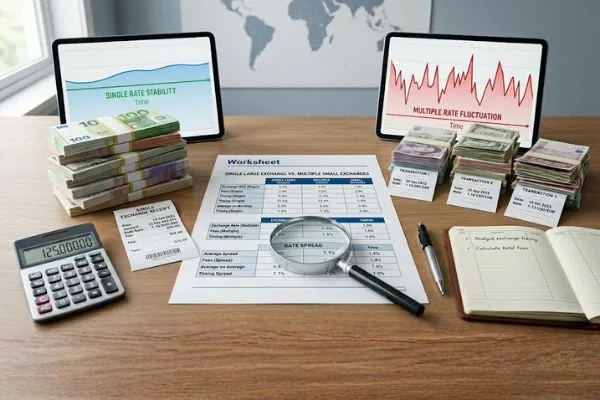
If you exchange once, you lock in one rate and one spread at that moment. If you exchange multiple times, you may encounter different rates across separate transactions.
Rate variability matters because foreign exchange markets move throughout the day. Customers making several smaller exchanges may encounter different pricing conditions. This can affect the overall amount received.
For example, consider how timing influences value:
- A single large exchange captures one rate and one applied spread.
- Three smaller exchanges may capture three different rates and spreads.
- Market movement between visits can increase or decrease final currency received.
No approach guarantees a better outcome. Exchange rates depend on market conditions. Consolidating transactions may reduce repeated exposure to exchange rate spreads. The U.S. Treasury explains how broader currency movements are monitored. Its exchange rate framework provides additional market context.
Transaction Fees And Repeated Costs
Some currency exchange services apply flat transaction fees in addition to rate spreads. If you divide one exchange into multiple visits, you may incur separate fees each time.
Repeated service fees can increase overall cost, particularly for customers planning travel. Exchanging a larger amount once may reduce duplicate processing charges.
Customers using money transfers or money orders should also plan related transactions together. Coordinating services in one visit may simplify documentation. It may also reduce repeated service interactions. The Consumer Financial Protection Bureau explains disclosure requirements for remittance transfers. These resources describe transparency standards for cross-border payments.
Before deciding, review:
- Posted exchange rates and disclosed fees
- Whether pricing changes based on transaction size
- How many times you expect to transact before travel
Order Express provides pricing disclosures before customers confirm their transaction. As described on the Order Express company page, Order Express is registered with FinCEN as a Money Services Business where applicable. It also maintains applicable state licenses where required. Order Express follows compliance policies designed to support its regulatory obligations.

Compliance Thresholds And Practical Transaction Planning
Identity verification requirements may affect larger currency exchanges. Applicable regulations and provider policies both influence documentation requirements. Understanding documentation requirements helps customers prepare before visiting a financial services location.
Identity Verification And Recordkeeping Requirements
Under the Bank Secrecy Act, Money Services Businesses must maintain records and comply with applicable identification requirements. Specific requirements depend on the transaction type and applicable regulations. Financial Crimes Enforcement Network guidance outlines compliance expectations for transaction monitoring and recordkeeping. Financial institutions also monitor transaction patterns to identify unusual activity under anti-money laundering requirements.
Identification requirements may apply when currency exchange transactions reach applicable regulatory or provider thresholds.
According to current Order Express policy and applicable regulatory requirements, currency exchange transactions totaling $1,000 or more within 48 hours require valid identification. This policy applies to a single transaction or qualifying transactions aggregated within that period.
Customers exchanging larger amounts should bring valid government-issued identification. Smaller exchanges may require less documentation in some situations. Additional verification may still apply based on applicable regulations, provider policies, transaction characteristics, or state requirements.
Identity verification supports anti-money laundering controls and helps protect customers from fraud. The FDIC Money Smart program explains how identification safeguards support financial awareness and fraud prevention. Legitimate transactions can still be completed. Processing time may vary depending on transaction complexity.
Aggregation Rules And Transaction Structuring Risks
Providers may evaluate related transactions together under applicable reporting requirements. Aggregation rules apply in specific circumstances. Aggregation rules require providers to review related transactions completed within designated timeframes.
Under current Order Express policy, qualifying exchanges totaling $1,000 or more within 48 hours require the same identification process. Applicable regulations may also require recordkeeping or additional review. Attempting to divide transactions to avoid identification requirements may be considered structuring. This may result in regulatory reporting or other consequences under applicable law.
Customers should plan transactions based on legitimate financial needs. They should not attempt to avoid applicable documentation requirements. Open communication with service representatives helps ensure accurate processing and avoids unnecessary delays. For location-specific assistance or transaction preparation questions, customers may use the Order Express contact information page before visiting.
When preparing for currency exchange, consider:
- Whether your total exchange amount may require identification.
- Whether you prefer completing documentation once rather than across multiple visits.
- Whether timing flexibility outweighs potential repeated processing steps.
Order Express operates as a registered Money Services Business where applicable. The company also follows applicable federal and state regulatory requirements. These controls aim to balance accessibility with responsible financial oversight.
Key Takeaways
- Exchanging a larger amount at once may reduce repeated fees. It may also reduce repeated exposure to changing exchange rates.
- Smaller exchanges provide greater flexibility. They may increase cumulative spreads and processing costs over time.
- Identity verification requirements may apply when exchange totals reach applicable provider or regulatory thresholds.
- Multiple related exchanges may be reviewed together. The same documentation requirements may apply.
- Practical preparation involves reviewing rates, fees and identification needs before visiting a location.
Frequently Asked Questions
Q: Does Exchanging A Larger Amount Usually Give A Better Exchange Rate?
A: Not necessarily. Exchange rates depend on market conditions and provider spreads. Larger exchanges reduce repeated exposure to changing rates. They do not guarantee a better exchange rate.
Q: Can I Avoid Identification By Splitting My Exchange Into Smaller Transactions?
A: No. Providers aggregate related transactions within certain timeframes, and identification requirements may still apply.
Q: Do Currency Exchange Fees Increase With Multiple Visits?
A: They can. Separate transactions may involve separate service fees and rate spreads, increasing total cost.
Q: Is There A Minimum Amount Required For Currency Exchange?
A: Minimum amounts vary by provider and location. Confirm applicable requirements before visiting.
Q: Should I Exchange Everything At Once Before Traveling?
A: That depends on your budget, exchange rate timing, and documentation requirements. Many customers prefer completing one planned transaction to simplify preparation.
Conclusion
Exchanging a larger amount at once may reduce repeated fees. It may also reduce repeated exposure to exchange rate spreads. Compare exchange rates before deciding. Review fees and identification requirements before selecting a transaction size. Understanding aggregation rules can help reduce processing delays. It also supports smoother transaction preparation. Order Express operates as a registered Money Services Business where applicable. The company follows applicable federal and state regulatory requirements. Planning ahead helps customers choose an appropriate transaction size. It also supports smoother transaction preparation.
Review current exchange rates before visiting an Order Express location. Bring any required identification to help prepare your transaction.
Disclaimer: This content is for informational purposes only and does not constitute financial advice. Exchange rates, fees, availability, and verification requirements may vary by provider, service, transaction type, and location.

John is a Content & SEO Specialist who enjoys breaking down complex financial topics, like cross-border payments and money transfers, into content that’s easy to understand. He focuses on creating practical, search-driven content that helps people find answers and make informed decisions.