 Skip to content


At Order Express, Daily money transfer limits for most corridors fall between $500 and $2,500; exact caps vary by state rule, partner payout ceiling, and the sender’s verification tier. These caps reset every 24 hours, measured midnight-to-midnight Central Time, which is an internal Order Express system convention rather than a regulatory rule. While limits vary, most users stay well within their assigned daily caps unless approved for higher thresholds. For a full overview of available services and support, visit the Order Express.
Note: That higher or lower daily caps may apply when state-specific triggers, partner payout limits, or customer risk assessments require stricter controls.

Foundations of Money Transfer Limits
Transfer limits are essential controls in money transfer services. They define how much a customer can send and help maintain financial safety, regulatory compliance, and operational consistency. Understanding these limits, why they exist, how they are enforced, and the rules behind them, gives customers confidence while reducing risk for the business.
What Are Transfer Limits?
A transfer limit is the maximum sum you may send through one service within a defined window. These windows can be daily, weekly, monthly, or per transaction. Limits apply to cash, card, account, or wallet-funded transfers. Money transfer services, its agents, and its payout partners enforce limits through real-time system controls.
Why Do Limits Exist?
Transfer limits protect customers and the company from fraud and theft. They stop criminals from draining funds in one move. Limits also ensure compliance with the Bank Secrecy Act and state money transmitter rules. Strong limits reinforce customer trust and streamline operational risk reviews. They also align with requirements around Suspicious Activity Reporting for financial institutions.
Regulatory Triggers Specific to Order Express
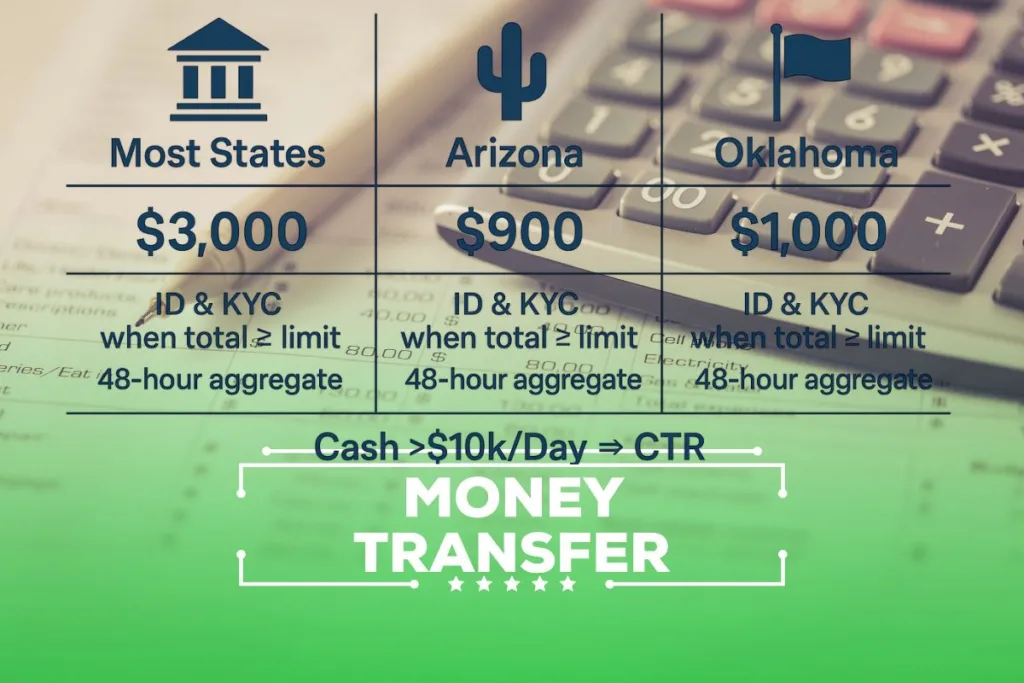
Federal rules demand ID when transfers total three thousand dollars within forty-eight hours. Order Express follows this baseline across most states. Certain jurisdictions impose stricter caps. Arizona demands full documentation for nine hundred dollars in any forty-eight-hour period. Oklahoma sets a one-thousand dollar trigger within twenty-four hours. Partner Spectrum requires identification at one thousand dollars and keeps enhanced due diligence tiers at higher amounts. Cash deals over ten thousand dollars mandate a Currency Transaction Report.
Operational Limits
Transfer limits work alongside record-keeping triggers but are not identical. Operational caps can be lower and vary by customer. These ceilings are reviewed weekly by the risk committee. Adjustments consider fraud trends, partner feedback, and new legal interpretations. Historical data shows most customers never exceed five-thousand monthly.

Setting and Adjusting Limits for Your Money Transfers
When sending money transfers, your ability to move funds depends on pre-set limits that adjust based on various risk and user factors. These caps ensure secure transactions while helping Order Express meet compliance and fraud-prevention standards. By understanding how your daily, weekly, and per-transaction thresholds are set, and how they can be raised, you can manage your transfers more confidently and efficiently.
Daily, Weekly, and Per-Transaction Caps
Daily caps restrict the sum you can send between midnight and midnight Central Time. Weekly caps measure Sunday through Saturday totals. Per-transaction boundaries apply to each individual transfer request at the moment of submission. Monthly ceilings aggregate a rolling thirty days of activity. Internal audit teams monitor breaches and freeze accounts that exceed any cap.
Factors That Set Your Limit
Several factors drive the limit you see at checkout. Account tenure shows how long you have transacted without issues. Verification tier reflects the depth of documents on file. Service channel matters because agent locations, the mobile app, and web portal each hold tailored caps. The destination corridor plays a role; high-risk countries receive lower limits. Funding method impacts limits because cash presents greater risk than debit or ACH. Seasonality can affect caps when fraud spikes during holidays.
How to Increase Your Limit Safely
Request a higher limit through the app or any staffed agent. Provide a valid government photo ID, proof of address, and recent proof of income. State the exact amount needed and the purpose of the transfer. Compliance will review within two business days. If approved, the new limit appears automatically. Always wait for written confirmation before sending larger amounts. Learn more about your rights and protections in money transfers.
Digital Tools and Dynamic Limits
Order Express uses machine-learning models that analyze device reputation, location mismatch, and past chargebacks. Low-risk users may see their limits double after six months of clean history. These tools work similarly to those in broader fintech fraud prevention systems, which emphasize identity verification and behavioral monitoring.

Compliance and Risk Management in High-Value Money Transfers
Managing compliance and risk is critical when handling high-value money transfers. While higher limits offer flexibility, they also expose customers and agents to greater financial, legal, and operational vulnerabilities. From illegal structuring to multi-jurisdictional rules, understanding the safeguards, from Currency Transaction Reports (CTRs) to state-specific limits, ensures that transfers remain both lawful and secure. Order Express uses real-time controls, identity checks, and intelligent aggregation to prevent abuse and maintain trust in its money transfer services.
Risks of Higher Limits
Higher limits increase convenience but raise exposure. A compromised password could let thieves move larger sums. Businesses might overspend if internal approval chains lag behind bigger caps. Unauthorized agents could attempt to override limits under duress. Order Express therefore requires multi-factor authentication for high-limit logins and dual approval for limit increases above twenty-five-thousand dollars.
Avoiding Illegal Structuring
Structuring means splitting a large payment into smaller ones to dodge reporting. It is illegal under federal rules and Order Express policy. Examples include using several branches on the same day or instructing family members to send parts of one payment. Employees must refuse the transaction and alert compliance. Customers should instead provide the required documents for a lawful single transfer. Review how FinCEN and federal prosecutors enforce anti-structuring provisions under 31 U.S.C. § 5324.
Reporting: CTRs, SARs, and Record-Keeping
Cash or cash-equivalent transfers over ten-thousand dollars in one day need a Currency Transaction Report. Compliance files the report within fifteen days through the FinCEN e-filing system. Suspicious activities at or above two-thousand dollars require a Suspicious Activity Report within thirty days. Employees must never alert customers that a SAR will be filed. Records are kept for five years, meeting federal retention rules.
State and Partner Exceptions
Arizona enforces tighter cash caps across services. Combined transfers over nine-hundred dollars in forty-eight hours trigger identity checks and forms. Oklahoma sets the trigger at one-thousand dollars in twenty-four hours. Spectrum needs ID at one-thousand and source documentation at five-thousand. Elektra Guatemala pays cash only up to two-thousand five-hundred. Some Eastern European payout countries stop cash at one-thousand five-hundred. Always review the payout matrix before sending. Honduras and Nicaragua demand ID for any transfer at or above two-thousand dollars. Spain escalates diligence for transactions beyond five-thousand euros under national antimoney-laundering law. These foreign limits appear automatically in the Order Express system and override domestic ceilings when lower. Agents should confirm corridor limits using the compliance dashboard before serving customers.
You can find additional state trigger amounts for money orders, bill pay, check cashing and other service options in the compliance dashboard and the published payout matrix.
Managing Aggregated Transactions
The system aggregates multiple transfers to detect threshold breaches. Aggregation considers sender name, address, date of birth, and identification number. It also links related customers through phone numbers or shared IDs. When the total reaches a trigger, the cashier sees a hard stop requiring documentation. Attempts to bypass by swapping small variations in names will still match because of fuzzy-logic identity screening.
Conclusion
Understanding transfer limits with Order Express empowers you to send money securely, efficiently, and within legal boundaries. These limits protect against fraud, help maintain compliance, and ensure operational consistency across various channels. Whether you’re sending cash abroad or using digital tools, knowing your caps and how to adjust them helps avoid delays. You’ll also avoid legal missteps like structuring, which can trigger serious penalties. Each transfer type like cash, card, app, or agent follows distinct rules that align with both domestic and international regulations. By reviewing your limit regularly and submitting complete documentation, you’ll ensure smoother transactions. Use the mobile app or agent support to manage your transfer needs confidently. Staying informed is the smartest way to protect your funds and personal data.
Frequently Asked Questions
1. How do I check my money transfer limit with Order Express?
Check your transfer limits via the Order Express app or at any staffed agent location. Your daily, weekly, and per-transaction caps appear at checkout. These limits automatically adjust based on your account history and verification level. If you’re unsure, request your current limit from an agent or contact customer support.
2. What documents are needed to raise my money transfer limit?
You’ll need a government-issued photo ID, proof of address, and recent income documentation. You must also state the transfer amount and purpose. Submit these through the app or at a staffed location. Compliance will review your request within two business days. Only send larger transfers after receiving written approval.
3. Why does my money transfer limit vary between the app and agent locations?
Different channels have different risk controls. Mobile platforms follow digital security protocols, while in-person agents may enforce stricter ID policies. Your destination region and funding method like cash or debit, also impact your transfer limit due to fraud risk variations.
4. What happens if I exceed my money transfer limit?
The system will block the transaction automatically. You might receive a request for documents. Repeated over-limit attempts can trigger temporary account freezes. These are reviewed weekly by the risk team. Always check your limit before sending large amounts to avoid delays.
5. Is splitting money transfers to stay under the limit allowed?
No. That’s considered structuring and violates both federal law and company policy. Attempting to avoid reporting by splitting transfers raises alerts. Staff are required to stop such actions and report them. Structured transfers may lead to investigation or suspension. Always send single, verified transfers with documentation when required.

John is a Content & SEO Specialist who enjoys breaking down complex financial topics, like cross-border payments and money transfers, into content that’s easy to understand. He focuses on creating practical, search-driven content that helps people find answers and make informed decisions.


