 Skip to content



The primary U.S. privacy law for money transfer services is the Gramm-Leach-Bliley Act (GLBA). This law governs how financial institutions—including banks, credit unions, and money transmitters—protect customer financial data. It requires firms to secure records, limit data sharing, and notify customers of privacy rights. Compliance with GLBA, alongside global regulations like GDPR and India’s DPDPA, is critical for cross-border money transfers. Financial data protection also includes state laws and security standards like PCI DSS. Financial service providers must implement encryption, breach response, and vendor oversight to remain compliant. As data residency laws tighten, U.S. money transmitters must adapt storage strategies to meet global privacy expectations and avoid costly penalties.
For broader context on how money transfer regulations, compliance, taxes, and reporting operate, review our pillar guide explaining the regulatory frameworks that govern money transfer services. That foundation helps you better understand how U.S. privacy laws apply to money transfer providers and how your personal and financial data is handled within regulated financial systems.
Data Protection Context for Financial Services
Financial services power modern economies through payments, credit, savings, and investment products. Each activity relies on sensitive customer identifiers, account numbers, and behavioral insights. Threat actors target this information because of its high value. Industry research from Statista ranks finance as the second most attacked sector in the United States. Regulators therefore place strict accountability on every institution that stores or moves personal data. Compliance staff must follow federal, state, and foreign rules that frequently change without long grace periods. Technology teams must translate legal text into technical controls, logging, and encryption frameworks. Business leaders must balance fast customer experiences with the heavy obligation to keep data safe. Companies that ignore privacy expectations risk penalties, lawsuits, and irreplaceable damage to brand trust.
Data governance programs in finance pursue two intertwined targets. The first target is absolute adherence to every applicable privacy rule. The second target is effective security that prevents unauthorized disclosure or alteration. Successful programs adopt data minimization, collecting only what operations require. They deliver recurring training so employees understand real-world threats. They maintain a structured incident response plan that drills tabletop scenarios each quarter. Audit teams then test controls and suggest improvements before regulators arrive. Our organization’s background and approach align with current regulatory expectations and operational best practices.
Why Data Residency Matters
Data residency answers a simple question: where exactly does customer information live? The answer carries legal and operational weight. Many jurisdictions, including the European Union, Russia, and India, insist that personal data stay within national borders. Even within the United States, some state regulators encourage in-country storage to support subpoena enforcement. Keeping data local accelerates breach investigations and reduces latency for nearby customers. Conversely, scattered hosting complicates risk assessments and multiplies contractual obligations.
Reasons to respect residency requirements
- Legal compliance. Many jurisdictions impose border rules for personal data. Breaking these rules can cost millions and suspend operations.
- Protection and security. Local hosting enables stronger controls and faster response. Teams can visit data centers, inspect walls, and verify certificates.
- Trust and confidence. Customers feel safer when data never leaves approved regions. Institutions advertise local storage to win corporate partnerships.
- Control and governance. Knowing the location aids retention, discovery, and audits. Litigation holds fewer surprises when data mapping is clear.
- Operational continuity. Localization limits disputes that might halt service. Courts cannot block transfers that never leave their jurisdiction.
- Cross-border transfers. Proper rules keep information safe while in transit. Structured contracts and encryption maintain privacy across networks.
Growing Threat Landscape
Ransomware gangs increasingly target mid-size credit unions with limited security budgets. Phishing campaigns trick call-center staff into disclosing multi-factor tokens. Dark-web marketplaces sell credential dumps that include full account numbers. The average breach cost for financial firms reached $5.9 million in 2024, according to IBM research. Regulators respond by tightening breach notification deadlines and increasing audit frequency. Insurance carriers raise cyber premiums, pushing firms toward stronger controls.
Residency Use Case Example
A remittance company serves migrant workers sending money to the Philippines. Philippine regulators require personal data to remain onshore or within approved clouds. The company uses bifurcated databases storing identity documents in Manila. Transaction metadata sits in the United States for analytics purposes. Tokenization links both databases without exposing sensitive fields across borders. This design satisfies the Philippine Data Privacy Act and U.S. FinCEN recordkeeping requirements.

Key Financial Data Protection Laws
Money transfer services must follow strict data protection laws to stay compliant and build customer trust. These laws define how financial data is collected, stored, shared, and secured. U.S. and international regulations like GLBA, GDPR, PCI DSS, and India’s DPDPA impose unique requirements. Each law enforces specific rules on encryption, breach response, data sharing, and cross-border transfers. Understanding these frameworks helps companies reduce legal risk and avoid costly penalties across jurisdictions. Our internal policies map these regulatory requirements to day-to-day controls for money-transfer operations.
The Gramm-Leach-Bliley Act (GLBA)
The GLBA reshaped American privacy when enacted in 1999. It covers banks, credit unions, securities firms, insurers, and money transmitters. Section 501 requires institutions to protect customer records against anticipated threats. The Financial Privacy Rule mandates an initial and annual notice that explains data sharing. Customers may opt out of most non-affiliated sharing, excluding certain service providers. Boards of directors must approve the written security program and oversee its execution. The Safeguards Rule expects risk assessments, employee training, physical access controls, and regular penetration testing. Enforcement jurisdiction is split among the Federal Trade Commission, prudential banking regulators, and state insurance departments. Civil money penalties can reach $100,000 per violation and include personal officer liability. Recent GLBA amendments demand multi-factor authentication, encryption, and disposal procedures.
GLBA Practical Controls
Encrypt laptops and mobile devices that store customer files. Rotate encryption keys annually and after staff turnover. Deploy endpoint detection systems and monitor unusual data exfiltration. Segment internal networks so teller stations cannot reach accounting servers directly. Use data loss prevention tools that flag emails containing routing numbers. Review vendor SOC reports and document remediation plans. Consult qualified compliance professionals before implementing any control changes.
The General Data Protection Regulation (GDPR)
The GDPR became enforceable on 25 May 2018 and set a global privacy benchmark. It applies when an organization processes EU resident data, regardless of company location. Lawful bases for processing include consent, contract necessity, legal obligation, vital interests, public task, and legitimate interest. Processors must only act on documented instructions and maintain written contracts with controllers. Article 5 outlines principles such as accuracy, integrity, confidentiality, and accountability. Articles 12 through 22 enumerate individual rights, empowering subjects to control their data journey. Supervisory authorities issue warnings, reprimands, and fines reaching twenty million euros or four percent of turnover. Data transfer outside the EU requires adequacy decisions, standard clauses, or binding corporate rules. Breach notifications to authorities must occur within 72 hours unless the incident is unlikely to risk rights. Organizations also need to inform affected subjects without undue delay when high risk exists.
GDPR Real-World Scenario
A U.S. money transmitter offers online transfers to France. The website collects sender and recipient information, creating an establishment in the EU. The firm appoints an EU representative and updates privacy notices. It performs transfer impact assessments for U.S. data storage. Standard Contractual Clauses govern processors located in Virginia data centers. Regular audits validate encryption against NIST recommendations. Data transfer rights can also be safeguarded through the use of approved blockchain platforms and smart contract frameworks.
The Payment Card Industry Data Security Standard (PCI DSS)
PCI DSS originated in 2004 and reached version 4.0 in 2022. The standard covers any entity that stores, processes, or transmits cardholder data. It defines twelve high-level requirements grouped into six control objectives.
- The first requirement directs firms to install firewalls and establish documented network rules.
- Next, organizations must ban vendor default passwords on every asset.
- Another key rule requires encryption of stored cardholder data using strong algorithms.
- Additionally, firms should secure transmissions over open networks with TLS and VPNs.
- A fifth control deploys anti-malware solutions and daily signature updates.
- The sixth requirement addresses secure development, patch management, and change control.
- Requirements seven through nine enforce restricted access, unique IDs, and strict physical security.
- For logging, the tenth rule records every access to critical systems and card data.
- Testing is also crucial, so requirement eleven mandates internal scanning, external scanning, and penetration testing.
- Finally, requirement twelve formalizes policies, risk assessments, and an incident response plan.
Compliance validation varies by transaction volume and can involve Qualified Security Assessors. If your business offers check-cashing services or processes card payments, be sure that transaction workflows remain within PCI DSS scope and follow the controls outlined above.
PCI DSS Compliance Tips
Scope reduction lowers audit cost. Use a hosted checkout page so card data bypasses your servers. Ensure service providers sign Attestation of Compliance documents. Conduct quarterly vulnerability scans through an Approved Scanning Vendor. Rotate cryptographic keys and monitor HSM logs. Flag any file containing full PAN for automatic deletion after purpose completion. If your transfer volumes exceed regulatory thresholds, review the applicable reporting rules in advance.
The Digital Personal Data Protection Act (DPDPA) of India
India’s parliament passed the DPDPA on 11 August 2023. The law grants Indian residents rights similar to those under the GDPR. Data fiduciaries must process personal data only for lawful purposes and with consent. Children receive heightened safeguards, including parental approval and age verification. Sensitive personal data, such as biometrics and health information, deserves extra protection. The act establishes a Data Protection Board with investigative and enforcement powers. The Board may impose penalties up to 2.5 billion rupees for serious violations. Cross-border transfers require a whitelist approach approved by the central government. Organizations must appoint a data protection officer reachable by data principals. Breach reporting to the Board and affected individuals must occur promptly. The government will release detailed rules and phase implementation through future notifications.
DPDPA Compliance Roadmap
Start by mapping data flows involving Indian residents. Update consent language to meet upcoming detailed rules. Appoint a grievance officer reachable within thirty days. Implement local storage or approved transfer mechanisms. Monitor Gazette notifications announcing penalty schedules and code of practice guidelines. Educate marketing teams about restrictions on behavioral profiling. Learn your rights in remittance and money transfers as part of broader compliance.
Other Notable U.S. Rules
The Right to Financial Privacy Act protects bank records from government access without consent or subpoena. Section 5 of the Federal Trade Commission Act prohibits unfair or deceptive practices regarding data security claims. The New York Department of Financial Services Cybersecurity Regulation imposes annual certification and 72-hour breach reporting for licensed entities. California’s Consumer Privacy Act lets residents know, delete, and opt out of data sales except some financial records. Colorado, Virginia, and Connecticut introduced similar consumer privacy acts effective 2023. Money transmitters must also protect Suspicious Activity Reports under Bank Secrecy Act confidentiality rules. Tipping off a customer about a SAR can create criminal liability and regulatory sanctions. The Telephone Consumer Protection Act regulates marketing calls, texts, and faxes, requiring consent and honoring do-not-call lists.
OFAC Sanctions screening is also essential for compliance. State money transmitter laws often include privacy provisions that surpass federal baselines. Companies must track overlap to avoid contradictory disclosure statements.
Under U.S. law, money transmitters must also register as Money Services Businesses (MSBs) with FinCEN under 31 CFR §1022. Registration requires ongoing compliance with Anti-Money Laundering (AML) and Know Your Customer (KYC) obligations. These programs demand collection and secure storage of sensitive customer data, linking privacy law directly to AML requirements. Protecting this information is critical, as privacy breaches can also create AML violations and regulatory penalties.

Data Residency Challenges and Cross-Border Rules
Storing and transferring financial data across borders introduces legal, technical, and operational challenges. Each region imposes unique residency laws, security standards, and enforcement practices. Money transmitters must navigate conflicts between international laws like the EU GDPR and U.S. CLOUD Act. This section outlines the key risks, mitigation strategies, and compliance rules for cross-border operations. It also includes a real-world case study and vendor checklist to support secure and compliant expansion.
Common Industry Challenges
Varying requirements across jurisdictions create complex compliance roadmaps. Russia, for instance, mandates primary data storage on local servers. At the same time, U.S. authorities may issue CLOUD Act subpoenas, which complicates operations. Additionally, hosting in diverse jurisdictions can weaken consistent security enforcement. Vendors in lower-regulation regions may skip patch cycles or enforce fewer physical controls. Companies must weigh data sovereignty expectations alongside budget constraints.
Mitigation Strategies
Organizations can adopt policy engines to route data based on residency tags and negotiate cloud contracts with localization clauses. Using unified tools for multi-region log aggregation and patch synchronization strengthens global posture. Backup solutions and disaster recovery systems should align with local legal expectations and latency needs. Currency hedging and cyber insurance help mitigate financial risks from breach or interruption.
Cross-Border Operational Rules
Licensing remains fundamental. Countries like Mexico, Brazil, and Colombia each require approvals from central authorities before permitting operations. Financial services must also comply with AML screening, error resolution mandates, and privacy controls. Contracts should include standard data transfer clauses and security audits. Use of local payment rails and transparent fees reduces friction in remittances. Organizations engaged in cross-border activity may evaluate other financial service options, including regional payment rails and correspondent arrangements, to reduce friction.
Case Study: Latin America Expansion
A U.S.-based money transfer provider plans entry into Brazil, Mexico, and Colombia. Brazil’s Central Bank requires a local subsidiary and stringent controls. Mexico’s Fintech Law mandates sandbox testing. Colombian authorities enforce local record storage. To align, the provider opens a regional office in São Paulo and partners with domestic banks for disbursements. KYC files are integrated with sanction screening and customs systems. Expansion plans should also cover any vehicle service requirements, such as registration or permitting, when physical assets cross national borders.
Vendor Selection Checklist
Choose vendors with strong audit history (SOC 2 Type II, ISO 27001), verified uptime, and secure key handling. Demand encryption at rest and in transit, segregated data access, and a dual authorization protocol. Validate that vendors conduct quarterly penetration testing and uphold regional data standards like GDPR Article 28. Ensure portability and continuity during exit through tested backup procedures and transparent SLAs.
Regulator Enforcement Trends
Global regulators increasingly coordinate data privacy enforcement. The U.S. SEC requires disclosure of material cybersecurity events within four business days. The FTC may impose multi-year audit mandates. In India, the Data Protection Board can impose high fines modeled after GDPR penalties. Consumer class actions and cyber insurance deductibles also increase pressure. Public trust often suffers more than regulatory penalties. Transparent security disclosures reduce long-term damage.
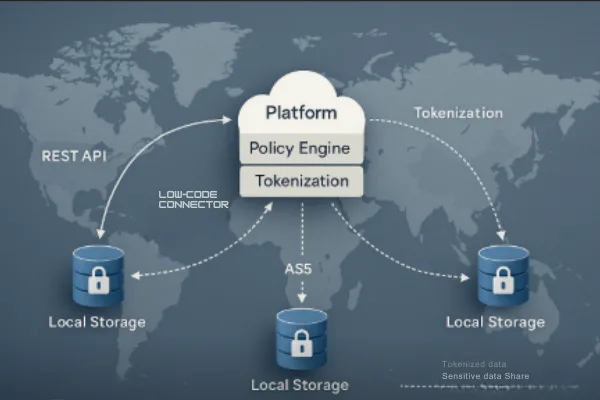
Third-Party Data Residency Solutions
A compliant third-party data residency platform can support local storage requirements in more than 100 countries. Clients use policy-driven architecture to control where data fields are stored. Tokenized metadata enables performance across borders while keeping sensitive information local. The platform supports RESTful APIs, low-code connectors, and region-specific cryptographic modules. Encryption keys stay local using FIPS-certified HSMs.
Security Architecture Details
The platform’s edge nodes encrypt data using AES-256 with FIPS-validated modules. Customer keys never leave the jurisdiction thanks to Hardware Security Modules. Access requests pass through policy enforcement that checks user claims and geolocation. Audit logs write simultaneously to local storage and immutable cloud buckets. Disaster recovery replicates encrypted data to a secondary zone within the same country. Zero-trust architecture blocks lateral movement between tenants.
Customer Success Story
A European neo-bank needed to serve Philippine freelancers paid in dollars. GDPR forced strict protection of EU customer data. Philippine regulators required onshore hosting of Filipino recipient IDs. Using the chosen residency platform, the bank stored Filipino data in Manila and European data in Frankfurt. Latency remained low because tokenized transaction metadata traveled globally. Regulators in both regions approved the architecture without additional conditions.
Implementation Timeline
Week one through four: gather stakeholders from legal, security, and product teams. Map data flows using automated discovery tools and manual interviews. Identify residency gaps against target jurisdictions and rank remediation priorities. Week five through eight: prototype tokenization and local storage for high-risk data sets. Conduct security architecture reviews and threat modeling workshops. Week nine through twelve: migrate pilot applications and measure performance impacts. Update privacy notices, contracts, and record retention schedules. Train employees on new processes and run phishing simulations. Week thirteen through sixteen: conduct independent audits and obtain necessary certifications. Launch production deployment in waves to monitor system stability and user feedback.
Cost Considerations
Initial integration fees vary based on data volume and number of jurisdictions. Tokenization increases database storage because of mapping tables. Local data centers might cost more for electricity, real estate, and skilled engineers. However, consolidation of compliance tooling can offset operating expenses. Penalties avoided and customer trust preserved often outweigh new infrastructure bills. Vendors offer subscription tiers combining storage, compute, and compliance support. Variable costs align with transaction levels, helping startups scale gradually. Enterprises negotiate multi-year contracts with committed volume discounts. Budget committees should allocate funds for annual audits and regulator filings. Monitoring software licenses and SIEM ingestion fees can rise with additional logs.
Metrics for Measuring Compliance Success
Mean time to detect security incidents measures monitoring effectiveness. Mean time to respond gauges containment speed and operational resilience. Percentage of data mapped with confirmed residency status tracks visibility progress. Breach count over rolling twelve months highlights trend direction. Audit findings closed within deadline indicates governance health. Employee phishing click rate measures awareness training impact. Encryption key rotation compliance rate shows cryptographic hygiene. Number of vendor controls validated each quarter reveals supply chain risk posture. Privacy request response time reflects customer experience and regulatory adherence. Fines or legal actions avoided provide ultimate evidence of program value.
Emerging Technologies Impacting Privacy
Open banking APIs increase data sharing among fintech platforms and traditional banks. Real-time payment systems create higher throughput, demanding automatic compliance checks at sub-second speeds. Blockchain remains immutable, so storing personal data on-chain can conflict with erasure rights. Edge computing pushes processing closer to users, complicating centralized audit logging. Quantum computing threatens current encryption schemes, driving research into post-quantum algorithms. Smart contracts can automate escrow but still require external oracles that must respect residency laws.
Artificial Intelligence in Privacy Compliance
Machine learning models analyze transaction patterns to detect fraud without manual rule updates. Natural language processing redacts personal data from free-form text fields in real time. Predictive analytics forecast breach likelihood, helping prioritize security investment. However, AI models need training data, raising questions about lawful processing and bias. Model interpretability becomes essential when regulators ask for decision explanations. Companies must document data sources, training methods, and mitigation steps for discriminatory outcomes.
Conclusion
Money transfer services must treat data privacy as a regulatory requirement and competitive advantage. U.S. financial privacy laws including GLBA, PCI DSS, and others demand strong controls across encryption, access, and disclosures. As operations expand across borders, data residency rules and regional nuances increase the stakes for noncompliance. Firms that proactively build privacy-by-design architectures reduce legal risk, lower breach impact, and gain customer trust. In-country storage, secure transfer mechanisms, and ongoing audits are no longer optional, they’re foundational to sustainable growth. Whether navigating EU GDPR, India’s DPDPA, or U.S. state statutes, alignment across legal, technical, and business teams is essential. Privacy laws will evolve. But institutions that invest in resilience and transparency today will lead tomorrow’s cross-border financial ecosystem.
Frequently Asked Questions
1. What U.S. privacy law mainly applies to money transfer services?
The Gramm-Leach-Bliley Act (GLBA) is the main U.S. law for financial data privacy. It applies to banks, credit unions, and money transmitters. GLBA requires customer notices, secure data handling, encryption, breach response, and employee training. Boards must oversee compliance, and violations can lead to fines or liability.
2. How does data residency affect money transfer companies?
Data residency defines where customer data is stored or processed. Many jurisdictions require local storage or restricted transfers. Residency impacts breach response and sets legal jurisdiction. Violations may trigger penalties or suspensions. Using compliant storage builds customer trust and reduces cross-border risks.
3. What are the most important data protection controls under GLBA?
Key controls include encryption, access restrictions, staff training, and risk assessments. Laptops must be encrypted, networks segmented, and programs overseen. Vendor risks need documented reviews, and audits help prove compliance and prevent enforcement actions.
4. Do global data laws like GDPR apply to U.S. money transmitters?
Yes, if serving EU residents or handling EU personal data. GDPR requires lawful processing, minimization, and breach notification. U.S. firms may need EU representatives, updated contracts, and Standard Contractual Clauses. Noncompliance can bring severe EU fines.
5. What steps help ensure cross-border compliance for financial data?
Start by mapping data flows and identifying residency obligations. Encrypt data at rest and in transit. Use tokenization for sensitive fields. Negotiate vendor contracts with localization clauses. Conduct audits and update policies to match evolving regulations.
Order Express marketing disclaimer: This content is published by Order Express. For approved marketing uses only; not for redistribution without written permission.Legal disclaimer: The information provided is for general educational purposes and does not constitute legal advice. Readers should consult qualified counsel for guidance specific to their situation.

John is a Content & SEO Specialist who enjoys breaking down complex financial topics, like cross-border payments and money transfers, into content that’s easy to understand. He focuses on creating practical, search-driven content that helps people find answers and make informed decisions.


